 Back
Evolution, Natural Selection, and Population Genetics: Study Notes
Study Guide - Smart Notes
 Tailored notes based on your materials, expanded with key definitions, examples, and context.
Evolution and Natural Selection
Historical Perspectives on Evolution
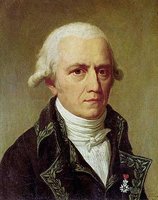
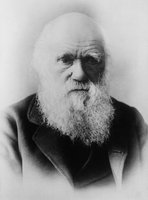
Early theories of evolution sought to explain how organisms change over time. Two major contributors were Jean-Baptiste Lamarck and Charles Darwin, whose ideas laid the foundation for modern evolutionary biology.
Lamarckism: Proposed that organisms adapt to their environments through acquired traits during their lifetime, which are then passed to offspring. Key concepts include use and disuse (organs used frequently become stronger, unused ones deteriorate) and inheritance of acquired characteristics.
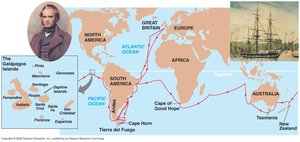
Darwinism: Charles Darwin, after his voyage on the HMS Beagle, proposed that species evolve through natural selection. He observed that species on the Galapagos Islands were unique yet resembled mainland species, suggesting adaptation to local environments.
Key Concepts in Natural Selection
Darwin's theory of natural selection is based on several observations and inferences:
Variation: Individuals in a population vary in their traits.
Overproduction: More offspring are produced than can survive.
Struggle for Existence: Competition for limited resources leads to differential survival.
Adaptation: Traits that enhance survival and reproduction become more common in the population over generations.
Speciation: Over long periods, these processes can lead to the formation of new species.
Fitness and Survival
Fitness refers to an organism's reproductive success. Individuals with higher fitness are more likely to survive and pass on their genes. This concept is often summarized as "survival of the fittest."
Lamarckian vs. Darwinian Evolution
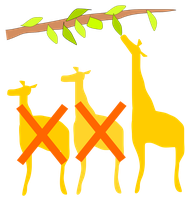
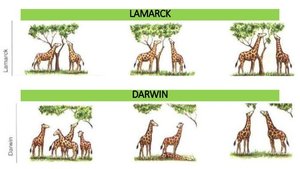
The difference between Lamarck's and Darwin's explanations is illustrated by the evolution of giraffe necks:
Lamarck: Giraffes stretch their necks to reach higher leaves, and this acquired trait is inherited by offspring.
Darwin: Giraffes with naturally longer necks survive and reproduce more, passing the trait to the next generation.
Mechanisms and Evidence of Evolution
Examples of Natural Selection
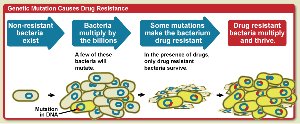
Antibiotic Resistance: Bacteria with mutations that confer resistance survive antibiotic treatment and reproduce, leading to resistant populations.
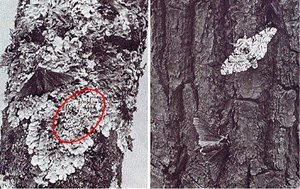
Peppered Moths: In England, the frequency of light and dark moths shifted due to industrial pollution, demonstrating natural selection in response to environmental change.
Types of Selection
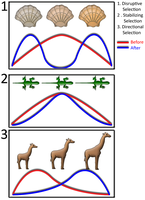
Natural selection can affect the distribution of phenotypes in a population in different ways:
Disruptive Selection: Favors extreme phenotypes over intermediates.
Stabilizing Selection: Favors intermediate phenotypes, reducing variation.
Directional Selection: Favors one extreme phenotype, shifting the population mean.
Artificial Selection
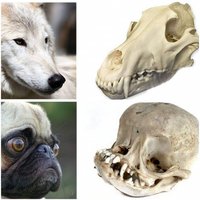
Artificial selection is the process by which humans select for desirable traits in other species, such as in the breeding of dogs, livestock, and crops. This contrasts with natural selection, where environmental pressures determine which traits are advantageous.
Evidence for Evolution
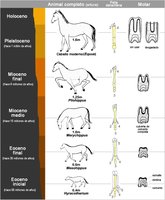
Fossil Record: Shows changes in organisms over time and descent from common ancestors.
Anatomical Record: Includes homologous structures (similar due to common ancestry), analogous structures (similar function, different ancestry), and vestigial structures (reduced or unused features).
Embryology: Similar embryonic development among related species suggests common ancestry.
Molecular Record: DNA and protein comparisons reveal evolutionary relationships; closely related species have more similar sequences.
HOX Genes
HOX (Homeobox) genes are a group of related genes that control the body plan of an embryo along the head-tail axis. They are highly conserved and provide molecular evidence for evolution.
Cladistics and Phylogenetics
Cladistics is a method of classification based on common ancestry. A phylogenetic tree (cladogram) shows evolutionary relationships. Key terms include:
Clade: A group of organisms with a common ancestor.
Node: The most recent common ancestor of a clade.
Derived Characters: Traits shared by members of a clade.
Outgroup: The least closely related group in the analysis.
Population Genetics
Factors Affecting Population Genetics
Population genetics studies the genetic composition of populations and how it changes over time. Key factors include:
Mutations: Create new genetic variation.
Gene Flow: Movement of alleles between populations (e.g., migration).
Sexual Reproduction: Increases genetic diversity through recombination and independent assortment.
Non-Random Mating: Certain traits increase reproductive success, altering allele frequencies.
Genetic Drift: Random changes in allele frequencies, especially in small populations (e.g., founder effect, bottleneck effect).
Natural Selection: Differential survival and reproduction based on phenotype.
Hardy-Weinberg Equilibrium
The Hardy-Weinberg equilibrium describes a non-evolving population. For a population to be in equilibrium, it must meet these criteria:
Very large population size (no genetic drift)
No migration (no gene flow)
No mutations
Random mating
No natural selection
The Hardy-Weinberg equations are:
Allele frequencies:
Genotype frequencies:
Where p is the frequency of the dominant allele and q is the frequency of the recessive allele.
Speciation and Evolutionary Patterns
Speciation
Speciation is the process by which new species arise. It occurs when populations become reproductively isolated and evolve independently. Types include:
Allopatric Speciation: Geographic separation leads to reproductive isolation.
Sympatric Speciation: Species diverge while living in the same area, often due to behavioral or genetic differences.
Reproductive Barriers
Pre-Zygotic Barriers: Prevent mating or fertilization (e.g., geographic, ecological, temporal, behavioral, mechanical, gametic isolation).
Post-Zygotic Barriers: Occur after fertilization, leading to reduced hybrid viability or fertility.
Adaptive Radiation
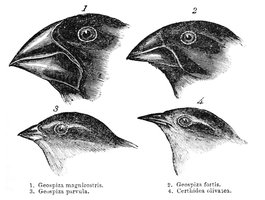
Adaptive radiation is the rapid evolution of many species from a common ancestor, often when new habitats or resources become available (e.g., Darwin's finches).
Rates and Patterns of Evolution
Gradualism: Slow, steady change over time.
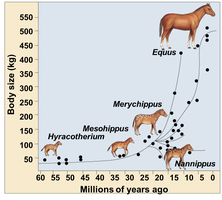
Punctuated Equilibrium: Rapid bursts of change followed by long periods of stability.
Divergent Evolution: Related species become more different.
Convergent Evolution: Unrelated species evolve similar traits due to similar environments.
Coevolution: Two or more species reciprocally affect each other's evolution.
Extinction
Extinction is the loss of species. It can be mass (many species in a short time) or background (ongoing, low-level). High diversity increases ecosystem stability.
Origin of Life and Early Evolution
Early Earth and the Origin of Life
Earth formed about 4.6 billion years ago. Life began after conditions became suitable, around 3.9 billion years ago. The origin of organic molecules is explained by:
Miller-Urey Experiment: Demonstrated that organic molecules could form from inorganic precursors under early Earth conditions.
Panspermia Hypothesis: Suggests organic molecules may have arrived via meteorites.
RNA World Hypothesis and Early Life
The RNA World Hypothesis proposes that RNA was the first genetic material. The earliest life forms were prokaryotes, which eventually gave rise to eukaryotes through endosymbiosis.
