 Back
BackEvolution of Life II: The Emergence of New Species
Study Guide - Smart Notes
 Tailored notes based on your materials, expanded with key definitions, examples, and context.
Chapter 20 – Evolution of Life II: The Emergence of New Species
20.1 Identification of Species
Understanding how species are identified is fundamental to evolutionary biology. Biologists use a variety of characteristics and concepts to distinguish species, each with its own strengths and limitations.
Species: A group of related organisms sharing a distinctive set of attributes in nature.
Microevolution: Evolutionary changes within a population, typically involving allele frequency shifts.
Macroevolution: Evolutionary changes that result in the formation of new species or groups of species.
Subspecies: Populations with distinct traits, but not enough to be classified as separate species.
Ecotypes: Genetically distinct populations adapted to local environments, common in bacteria.
Biologists use several characteristics to identify species:
Morphological traits: Physical characteristics (e.g., size, shape). Drawbacks: Variation within species, similarity between different species, and subjective trait selection.
Reproductive isolation: Ability to breed and produce fertile offspring. Drawbacks: Difficult to assess in nature, does not apply to asexual or extinct species.
Molecular features: DNA sequences, gene order, chromosome structure/number. Drawbacks: Unclear thresholds for species distinction.
Ecological factors: Habitat and resource use. Drawbacks: Overlap in habitat use, variation within species.
Evolutionary relationships: Fossil record and DNA analysis. Drawbacks: Incomplete fossil record, ambiguous genetic differences.
Several species concepts are used to define and distinguish species:
Biological species concept: Species are groups that can interbreed and produce fertile offspring.
Evolutionary lineage concept: Species are defined by their unique evolutionary history.
Ecological species concept: Species are defined by their ecological niche.
General lineage concept: Species are independently evolving lineages with unique characteristics.
20.2 Reproductive Isolating Mechanisms
Reproductive isolating mechanisms prevent interbreeding between different species, maintaining species boundaries. These mechanisms are categorized as prezygotic (before fertilization) or postzygotic (after fertilization).
Prezygotic isolating mechanisms (prevent zygote formation):
Habitat isolation: Species occupy different habitats.
Temporal isolation: Species reproduce at different times.
Behavioral isolation: Differences in mating behavior (e.g., song, courtship).
Mechanical isolation: Morphological differences prevent mating.
Gametic isolation: Gametes cannot unite to form a zygote.
Postzygotic isolating mechanisms (after zygote formation):
Hybrid inviability: Hybrid offspring do not develop properly.
Hybrid sterility: Hybrids are viable but sterile (e.g., mule).
Hybrid breakdown: Hybrids are viable and fertile, but subsequent generations have reduced fitness.
20.3 Mechanisms of Speciation
Speciation is the process by which new species arise, primarily through the accumulation of genetic changes that lead to reproductive isolation. There are two main modes: allopatric and sympatric speciation.
Allopatric Speciation
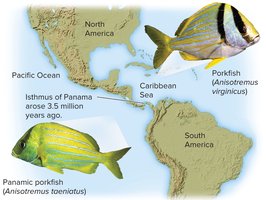
Allopatric speciation occurs when populations are geographically separated, leading to divergence and the formation of new species. This is the most common mode of speciation in sexually reproducing organisms.
Cladogenesis: Splitting of a population into two or more species.
Geographic barriers: Physical separation (e.g., mountain ranges, bodies of water) interrupts gene flow.
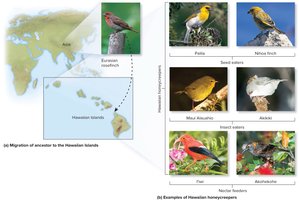
Adaptive radiation: Rapid evolution of multiple species from a common ancestor, often following colonization of new habitats.
Hybrid Zones
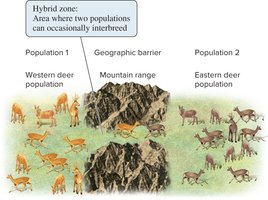
Hybrid zones are regions where two diverging populations meet and interbreed, producing hybrids. The outcomes of hybrid zones include reinforcement, fusion, and stability.
Reinforcement: Increased reproductive barriers; hybrids are less fit.
Fusion: Barriers decrease; populations merge.
Stability: Hybrid zone persists; hybrids are viable but less fit than parent species.
Sympatric Speciation
Sympatric speciation occurs without geographic separation, often through mechanisms such as polyploidy, hybrid speciation, and adaptation to local environments.
Polyploidy: Organisms have more than two sets of chromosomes, leading to reproductive isolation (common in plants).
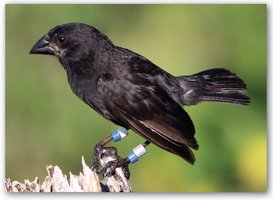
Hybrid speciation: New species arise from hybridization without polyploidy (e.g., Galapagos finches).
Ecological adaptation: Divergence due to adaptation to different ecological niches within the same area.
20.4 Evo-Devo: Evolutionary Developmental Biology
Evolutionary developmental biology (evo-devo) explores how changes in development contribute to evolutionary changes in morphology and body plans.
Development: Series of changes in cells, tissues, organs, and organisms that produce structure and function.
Pattern formation: The spatial and temporal expression of developmental genes shapes organismal morphology.
BMP4 and Gremlin: Proteins that regulate cell death and survival, influencing structures such as webbed vs. non-webbed feet in birds.
Hox genes: Master regulatory genes that determine the identity and arrangement of body regions; increases in Hox gene number are associated with greater morphological complexity.
Heterochrony: Evolutionary changes in the timing or rate of developmental events, leading to morphological differences (e.g., skull shape in humans vs. chimpanzees).
Summary Table: Species Identification Characteristics
Characteristic | Definition | Drawbacks |
|---|---|---|
Morphological traits | Physical features | Variation within species; similarity between species |
Reproductive isolation | Ability to interbreed and produce fertile offspring | Not applicable to asexual/extinct species; difficult to assess |
Molecular features | DNA, gene order, chromosome structure/number | Unclear thresholds for species distinction |
Ecological factors | Habitat and resource use | Overlap in habitat use; variation within species |
Evolutionary relationships | Fossil record, DNA analysis | Incomplete fossil record; ambiguous genetic differences |
Summary Table: Reproductive Isolating Mechanisms
Type | Mechanism | Description |
|---|---|---|
Prezygotic | Habitat isolation | Species occupy different habitats |
Prezygotic | Temporal isolation | Species reproduce at different times |
Prezygotic | Behavioral isolation | Differences in mating behavior |
Prezygotic | Mechanical isolation | Morphological differences prevent mating |
Prezygotic | Gametic isolation | Gametes cannot unite |
Postzygotic | Hybrid inviability | Hybrid offspring do not develop properly |
Postzygotic | Hybrid sterility | Hybrids are viable but sterile |
Postzygotic | Hybrid breakdown | Hybrids are viable and fertile, but later generations have reduced fitness |
Key Equations and Concepts
Polyploidy (chromosome number): where is the total chromosome number, is the basic chromosome set, and is the number of sets.
Additional info: The notes above expand on the provided outline with definitions, examples, and tables for clarity and completeness, following a mini-textbook style suitable for college-level biology students.
