 Back
Ch. 23 Evolution of Populations: Mechanisms and Genetic Variation (lecture slides)
Study Guide - Smart Notes
 Tailored notes based on your materials, expanded with key definitions, examples, and context.
Evolution of Populations
Misconceptions and Population-Level Evolution
Evolution is often misunderstood as a process affecting individual organisms, but in reality, it occurs at the population level. Natural selection acts on individuals, but only populations evolve over time as allele frequencies change.
Key Point: Individual organisms do not evolve; populations do.
Key Point: Natural selection acts on phenotypes, but evolutionary change is measured by shifts in allele frequencies within populations.
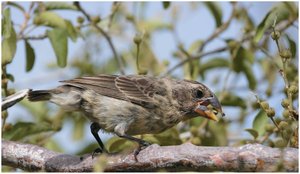
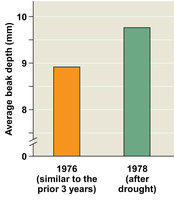
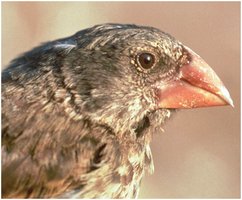
Example: Medium ground finches on Daphne Major Island evolved larger beaks after a drought, as those with larger beaks survived better and reproduced more.
Genetic Variation and Its Role in Evolution
Heritable Variation and Alleles
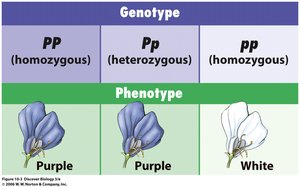
Genetic variation is essential for evolution. Variation in heritable traits provides the raw material for natural selection. Mendel's work demonstrated that genes are discrete units of inheritance, and different forms of a gene are called alleles.
Key Point: Genetic variation is a prerequisite for evolution by natural selection.
Key Point: Alleles are different variants of a gene.
Example: Flower color in pea plants is determined by different alleles.
Phenotype: Genotype and Environment
The phenotype of an organism is influenced by both its inherited genotype and environmental factors. Some traits are determined by a single gene, while others are polygenic and vary along a continuum.
Key Point: Environmental variation can affect phenotypes, as seen in hydrangea flowers.
Key Point: Polygenic traits show a range of phenotypes within a population.
Example: Hydrangea flower color varies with soil acidity.
Sources of Genetic Variation
Genetic variation arises from mutations and sexual reproduction. Mutations are random changes in DNA that can create new alleles, while sexual reproduction shuffles existing alleles into new combinations.
Key Point: Only mutations in gamete-producing cells are heritable.
Key Point: Sexual reproduction increases genetic variation but does not create new alleles.
Key Point: Mutation rates are generally low in animals and plants, but higher in viruses.
Population Genetics: Gene Pools and Allele Frequencies
Gene Pool and Population Structure
A population is a group of individuals of the same species that interbreed. The gene pool consists of all alleles present in the population. Allele and genotype frequencies can be calculated to understand genetic structure.
Key Point: A gene is fixed if all individuals are homozygous for the same allele.
Key Point: Individuals may be homozygous or heterozygous for a gene.
Example: Caribou populations may be geographically separated but belong to the same species.
Quantitative Analysis of Gene Pools
Allele and genotype frequencies are calculated as proportions within the population. For a gene with two alleles, their frequencies are represented as p and q, and their sum equals 1.
Key Point: Frequency = number of individuals with a genotype / total population.
Key Point: Allele frequency = number of copies of an allele / total number of alleles.
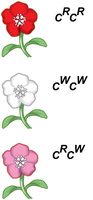
Example: In a wildflower population, flower color is determined by two alleles showing incomplete dominance.
Calculating Allele Frequencies
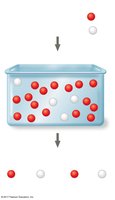
To calculate allele frequencies, count the number of each allele and divide by the total number of alleles. For two alleles, p + q = 1.
Key Point: p = frequency of one allele; q = frequency of the other allele.
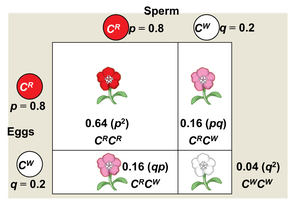
Example: In a population of 500 wildflowers, p = 0.8 and q = 0.2.
Punnett Square and Hardy-Weinberg Equilibrium
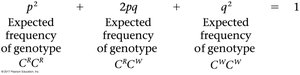
The Hardy-Weinberg equation predicts genotype frequencies in a population that is not evolving. If mating is random and all individuals have equal survival, allele and genotype frequencies remain constant.
Key Point: Hardy-Weinberg equation:
Key Point: Used to estimate carrier frequencies for recessive diseases.
Example: PKU disease frequency and carrier calculation.
Mechanisms of Evolutionary Change
Natural Selection
Natural selection changes allele frequencies by favoring traits that enhance survival and reproduction. It is the only mechanism that consistently leads to adaptive evolution.
Key Point: Alleles conferring advantages increase in frequency.
Example: DDT resistance in fruit flies increased after DDT use.
Genetic Drift
Genetic drift is the random fluctuation of allele frequencies, especially significant in small populations. It can lead to loss of genetic variation and fixation of harmful alleles.
Key Point: Founder effect and bottleneck effect are two forms of genetic drift.
Example: Hereditary blindness in Tristan da Cunha due to founder effect.
Gene Flow
Gene flow is the transfer of alleles between populations through migration. It tends to reduce genetic differences between populations and can affect adaptation.
Key Point: Gene flow can increase fitness by spreading beneficial alleles.
Example: Insecticide resistance in mosquitoes spread worldwide through gene flow.
Types of Natural Selection
Directional, Disruptive, and Stabilizing Selection
Natural selection can take different forms depending on environmental conditions:
Directional selection: Favors individuals at one extreme.
Disruptive selection: Favors individuals at both extremes.
Stabilizing selection: Favors intermediate phenotypes. Being average is good for relative fitness
Example: Bill size in seedcrackers and human birth weight.
Sexual Selection and Balancing Selection
Sexual Selection
Sexual selection favors traits that increase mating success, leading to sexual dimorphism. It includes intrasexual (competition) and intersexual (mate choice) selection. The ability to
Key Point: Sexual selection can drive the evolution of elaborate traits.
Balancing Selection
Balancing selection maintains stable frequencies of multiple phenotypes. It includes frequency-dependent selection and heterozygote advantage.
Key Point: Heterozygote advantage maintains deleterious alleles, such as sickle-cell, at high frequencies in some populations. No specific trait can be better. Freq of specific traits with always fluctuate in population once they are still common and relevant. Fitness of a trait (phenotype) depends on how common it it
Example: Scale-eating fish with right- and left-mouthed morphs.
Limits of Natural Selection
Constraints and Compromises
Natural selection cannot produce perfect organisms. It acts only on existing variation, is limited by historical constraints, and adaptations are often compromises. Chance and environmental changes also play a role.
Key Point: Evolution is a complex interplay of chance, selection, and environmental factors.
