 Back
Evolution of Populations: Mechanisms and Genetic Variation
Study Guide - Smart Notes
 Tailored notes based on your materials, expanded with key definitions, examples, and context.
The Evolution of Populations
Introduction to Population Evolution
Evolution at its most fundamental level involves changes in the genetic makeup of populations over time. While natural selection acts on individuals, it is populations—not individuals—that evolve. Variation in heritable traits is essential for evolution to occur, as demonstrated by Mendel’s work on pea plants, which provided evidence for discrete heritable units known as genes.
Genetic Variation: The Foundation of Evolution
Sources and Types of Genetic Variation
Genetic Variation refers to differences in genes or other DNA sequences among individuals in a population.
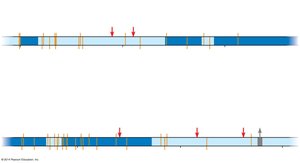
Variation can be measured at the molecular level (nucleotide variability) or at the whole gene level (gene variability).
Phenotypic variation may be due to single-gene differences (binary traits) or the influence of many genes (continuous traits).
Most nucleotide variation occurs in noncoding regions and rarely affects phenotype.
Heritability and Environmental Influence
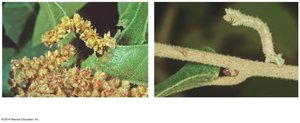
Phenotype is the product of genotype and environmental influences.
Natural selection can only act on heritable phenotypic variation.
Alleles and Mutation
Each gene is located at a specific locus on a chromosome and exists in different forms called alleles.
New alleles arise through mutation (changes in DNA sequence) or gene duplication.
Mutations in gamete-producing cells can be inherited; most are neutral or harmful, but some may be beneficial.
Rapid Reproduction and Genetic Variation
Mutation rates are generally low in animals and plants but higher in viruses.
Short generation times in prokaryotes and viruses allow mutations to accumulate rapidly.
Hardy-Weinberg Principle: Testing Evolution in Populations
Gene Pools and Allele Frequencies
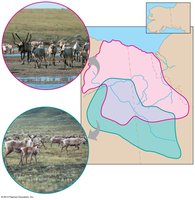
A population is a group of interbreeding individuals of the same species.
The gene pool includes all alleles at all loci in a population.
An allele is fixed if all individuals are homozygous for it.
Calculating Allele and Genotype Frequencies
For diploid organisms, total alleles at a locus = number of individuals × 2.
Allele frequencies are represented as p (dominant) and q (recessive), with p + q = 1.
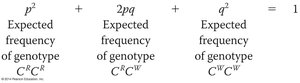
Genotype frequencies can be calculated using the Hardy-Weinberg equation:
Where = frequency of homozygous dominant, = frequency of heterozygotes, = frequency of homozygous recessive.
Conditions for Hardy-Weinberg Equilibrium
No mutations
Random mating
No natural selection
Extremely large population size
No gene flow
These conditions are rarely met in nature, so Hardy-Weinberg equilibrium serves as a null hypothesis for detecting evolution.
Mechanisms of Evolutionary Change
Natural Selection
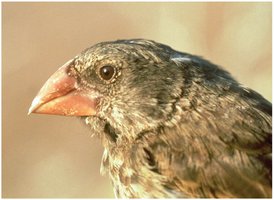
Natural selection increases the frequency of alleles that enhance survival and reproduction.
Example: Resistance to DDT in insects increased after widespread use of the pesticide.
Genetic Drift
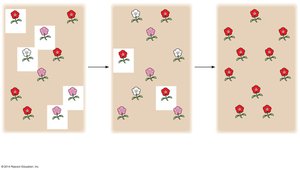
Genetic drift is random fluctuation in allele frequencies, especially significant in small populations.
It can lead to loss of genetic variation and fixation of harmful alleles.
The Founder Effect and Bottleneck Effect
Founder Effect: A few individuals become isolated, leading to different allele frequencies in the new population.
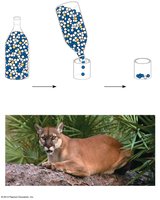
Bottleneck Effect: Sudden reduction in population size alters allele frequencies by chance.
Gene Flow
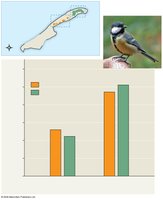
Gene flow is the movement of alleles among populations via migration of individuals or gametes.
It tends to reduce genetic differences between populations and can either increase or decrease fitness.
Natural Selection and Adaptive Evolution
Modes of Selection
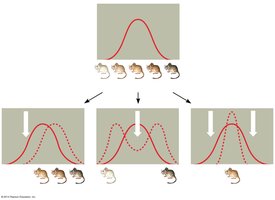
Directional Selection: Favors individuals at one extreme of the phenotypic range.
Disruptive Selection: Favors individuals at both extremes.
Stabilizing Selection: Favors intermediate variants, reducing extremes.
Sexual Selection
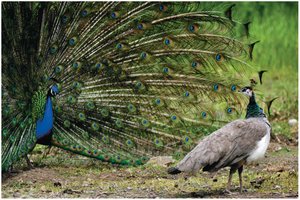
Sexual selection is natural selection for mating success, leading to sexual dimorphism (differences between sexes).
Intrasexual selection involves competition among one sex; intersexual selection involves mate choice, often by females.
Balancing Selection
Maintains stable frequencies of two or more phenotypes.
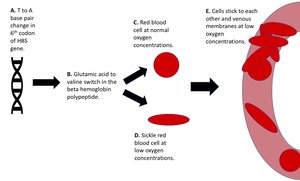
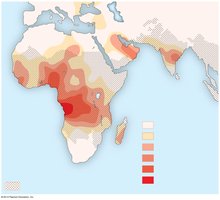
Includes heterozygote advantage (e.g., sickle-cell allele confers malaria resistance) and frequency-dependent selection (fitness depends on phenotype frequency).
Limits of Natural Selection
Selection can only act on existing variation.
Evolution is constrained by historical factors and trade-offs.
Chance, selection, and environment interact to shape adaptation.
