 Back
Evolution of Populations: Mechanisms and Genetic Variation
Study Guide - Smart Notes
 Tailored notes based on your materials, expanded with key definitions, examples, and context.
Evolution of Populations
Introduction to Population Evolution
Evolution in populations refers to changes in allele frequencies over generations, driven by various mechanisms. Understanding these processes is fundamental to modern biology and explains how species adapt and diversify. - Population evolution is not random; it is shaped by selective advantages. - Medium ground finch (Geospiza fortis) on the Galápagos Islands exemplifies natural selection during environmental stress. 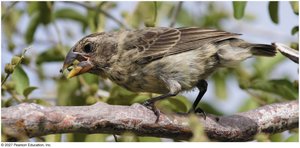
Mechanisms of Evolution
Evolution occurs when the allele frequencies in a population change over time. Three primary mechanisms drive these changes: - Natural selection: Adaptation to the environment, favoring traits that enhance survival and reproduction. - Genetic drift: Random events alter allele frequencies, especially in small populations. - Gene flow: Transfer of alleles between populations, often through migration or gamete movement. 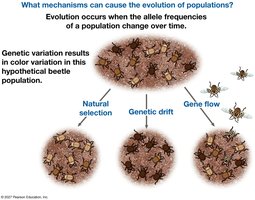
Natural Selection and Population Change
Natural selection acts on individuals, but only populations evolve. - Example: Larger-beaked finches survived droughts by eating large seeds, leading to an increase in average beak size in the next generation. - Evolution is observed as a change in the population, not in individual members.
Microevolution
Microevolution is the change in allele frequencies within a population across generations. - It is the smallest scale of evolution. - Driven by natural selection, genetic drift, and gene flow.
Genetic Variation
Sources and Importance of Genetic Variation
Genetic variation is essential for evolution by natural selection. - Genetic variation: Differences in genes or DNA sequences among individuals. - Phenotype: The observable traits, resulting from genotype and environmental influences. - Only genetic variation can be inherited and acted upon by natural selection.
Types of Phenotypic Variation
Phenotypic differences can be classified as: - Single gene: "Either–or" traits (e.g., pea flowers are purple or white). - Multiple genes: Traits vary along a continuum (e.g., coat color in horses, human height). 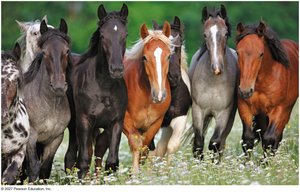
Quantifying Genetic Variation
- At the gene level: Percentage of heterozygous loci in a population. - At the molecular level: Comparison of nucleotide sequences among individuals. - Most nucleotide differences occur in noncoding DNA (introns); coding region (exons) variations rarely change protein function. 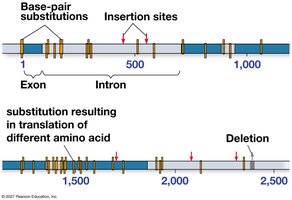
Environmental Influence and Phenotypic Plasticity
Phenotypic variation can result from environmental influences as well as genetic differences. - Phenotypic plasticity: Ability of a genotype to produce different phenotypes under varying environmental conditions. - Only genetically determined variation is heritable. 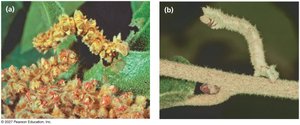
Origin of Genetic Variation
Genetic variation arises through: - Mutation: Changes in DNA sequence, including point mutations, insertions, deletions, and duplications. - Gene duplication: Can lead to new functions if duplicated genes persist and mutate. - Sexual reproduction: Recombines existing alleles via crossing over, independent assortment, and fertilization.
Mutation and Its Effects
Types and Consequences of Mutations
- Most mutations affecting phenotype are harmful, but some are neutral or beneficial. - Heterozygote protection: Harmful recessive alleles can be hidden in heterozygotes, maintaining genetic diversity. - Only mutations in gamete-producing cell lines are inherited.
Chromosomal Mutations and Gene Duplication
- Large chromosomal mutations are usually harmful. - Gene duplication is a key source of genetic variation and can lead to new functions.
Mutation Rates and Generation Time
- Mutation rates are low in animals and plants, but short generation times in prokaryotes and viruses allow rapid accumulation of mutations. - Example: HIV evolves drug resistance quickly due to high mutation rates and short generation times.
Genetic Variation in Sexual Reproduction
- Most genetic variation in sexually reproducing organisms results from recombination of alleles. - Mechanisms: crossing over, independent assortment, fertilization.
Population Genetics
Gene Pool and Allele Frequencies
- Gene pool: All copies of every allele at every locus in all members of a population. - Locus: Fixed if all individuals are homozygous for the same allele; otherwise, individuals may be homozygous or heterozygous.
Calculating Genotype and Allele Frequencies
- Genotype frequency: Number of individuals with a genotype divided by total population. - Allele frequency: Number of copies of an allele divided by total alleles in the population. - For diploid organisms: Total alleles = number of individuals × 2. 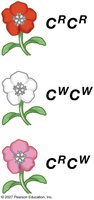
Hardy–Weinberg Equilibrium
The Hardy–Weinberg model describes the expected genetic makeup for a population not evolving at a particular locus. - If observed frequencies differ from Hardy–Weinberg predictions, evolution may be occurring. - Equilibrium conditions: No mutation, random mating, no natural selection, extremely large population size, no gene flow. - Equation: (allele frequencies), (genotype frequencies) 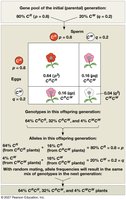
Mechanisms Altering Allele Frequencies
Natural Selection
- Based on differential success in survival and reproduction. - Adaptive evolution: Traits enhancing survival or reproduction increase in frequency.
Genetic Drift
- Random events cause allele frequencies to fluctuate unpredictably. - More significant in small populations; can lead to loss of genetic variation and fixation of harmful alleles. 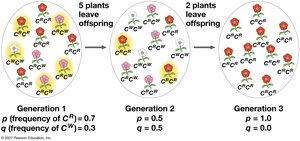
Founder Effect and Bottleneck Effect
- Founder effect: Small group forms a new population with different allele frequencies. - Bottleneck effect: Drastic reduction in population size alters gene pool; further genetic drift may occur if population remains small. 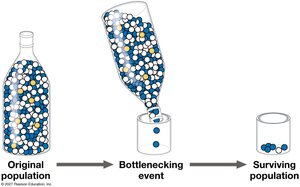
Gene Flow
- Movement of alleles among populations via migration or gametes. - Reduces variation among populations and can increase fitness (e.g., spread of insecticide resistance in mosquitoes).
Natural Selection and Adaptation
Modes of Selection
Natural selection can alter the frequency distribution of heritable traits in three ways: - Directional selection: Favors individuals at one extreme. - Disruptive selection: Favors individuals at both extremes. - Stabilizing selection: Favors intermediate variants. 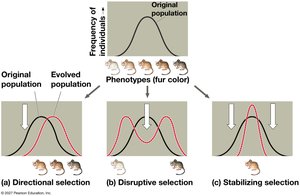
Striking Adaptations
- Example: Octopuses can change color rapidly for camouflage. - Example: Snake jaws allow swallowing prey larger than their heads. 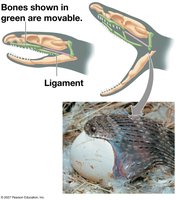
Sexual Selection and Dimorphism
- Sexual selection: Individuals with certain traits are more likely to obtain mates. - Results in sexual dimorphism: Differences in secondary sexual characteristics between sexes (e.g., peacock feathers). 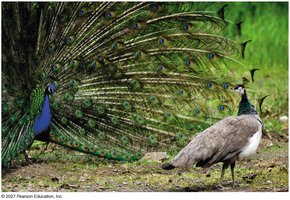
Intrasexual and Intersexual Selection
- Intrasexual selection: Competition among individuals of one sex for mates. - Intersexual selection: Mate choice, often by females, based on showiness or behavior.
Balancing Selection
Balancing selection maintains genetic diversity by preserving multiple phenotypes. - Includes frequency-dependent selection and heterozygote advantage.
Frequency-Dependent Selection
- Fitness of a phenotype depends on its frequency in the population. - Example: "Right-mouthed" and "left-mouthed" scale-eating fish are maintained by prey behavior. 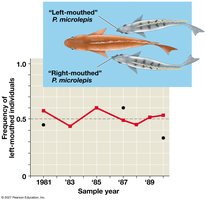
Heterozygote Advantage
- Heterozygotes have higher fitness than homozygotes. - Example: Sickle-cell allele is maintained in populations where malaria is common due to heterozygote advantage.
Limits to Adaptation
Constraints on Evolution
- Selection can only act on existing variation. - Evolution is limited by historical constraints and adaptations are often compromises. - Lack of variation can limit adaptation. 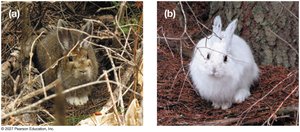
Summary Table: Mechanisms of Evolution
Mechanism | Description | Effect on Population |
|---|---|---|
Natural Selection | Favors traits that enhance survival/reproduction | Adaptive evolution; increases beneficial alleles |
Genetic Drift | Random changes in allele frequencies | Loss of genetic variation; fixation of alleles |
Gene Flow | Movement of alleles between populations | Reduces variation among populations; can increase fitness |
Key Equations
Allele frequency:
Genotype frequency (Hardy–Weinberg):
Conclusion
Understanding the mechanisms of population evolution and genetic variation is essential for explaining how species adapt, survive, and diversify. These principles form the foundation of evolutionary biology and are critical for General Biology students.
