 Back
BackEvolution of Populations: Mechanisms, Genetic Variation, and Hardy-Weinberg Equilibrium
Study Guide - Smart Notes
 Tailored notes based on your materials, expanded with key definitions, examples, and context.
The Evolution of Populations
Introduction to Population Evolution
Evolution in biological populations is driven by changes in allele frequencies over generations. While natural selection acts on individuals, it is populations that evolve.
Microevolution: Refers to small-scale changes in allele frequencies within a population across generations.
Genetic variation is essential for evolution, as it provides the raw material for natural selection and other evolutionary mechanisms.
Genetic Variation and Its Sources
Genetic variation among individuals arises from differences in genes or other DNA segments. The phenotype is determined by both inherited genotype and environmental influences.
Mutation: The primary source of new alleles, caused by changes in the nucleotide sequence of DNA.
Sexual reproduction: Generates genetic variation by recombining existing alleles.
Only mutations in cells that produce gametes can be passed to offspring.
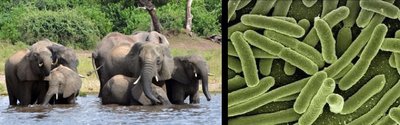
Mutation rates are generally low in animals and plants, but prokaryotes accumulate mutations rapidly due to short generation times.
Gene Pools and Allele Frequencies
The gene pool of a population consists of all alleles for all loci. Diploid individuals may be homozygous or heterozygous for a given locus.
The frequency of an allele in a population can be calculated by counting alleles in homozygous and heterozygous individuals.
For diploid organisms, the total number of alleles at a locus equals the number of individuals times two.
Calculating Allele Frequencies
If there are two alleles at a locus, their frequencies are represented by p and q. The sum of all allele frequencies in a population is always 1.
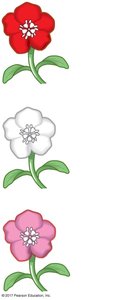
Example: In a population of flowers, calculate the number of copies of each allele and their frequencies.
The Hardy-Weinberg Principle
The Hardy-Weinberg equation is used to test whether a population is evolving. It states that allele frequencies in a population remain constant if certain conditions are met.
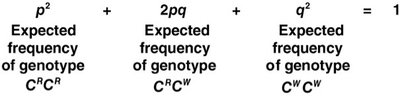
For a locus with two alleles, the expected genotype frequencies are:
CRCR =
CRCW =
CWCW =
The sum of genotype frequencies is always 1:
Conditions for Hardy-Weinberg Equilibrium
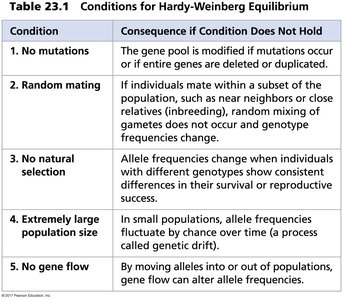
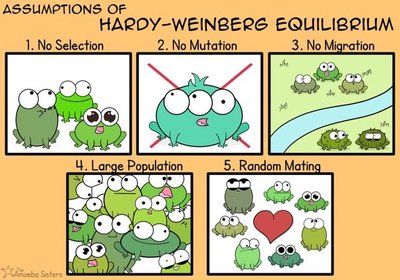
Hardy-Weinberg equilibrium requires five conditions:
No mutations
Random mating
No natural selection
Extremely large population size
No gene flow
If any of these conditions are not met, allele frequencies may change, indicating evolution.
Condition | Consequence if Condition Does Not Hold |
|---|---|
No mutations | The gene pool is modified if mutations occur or if entire genes are deleted or duplicated. |
Random mating | If individuals mate within a subset of the population, random mixing of gametes does not occur and genotype frequencies change. |
No natural selection | Allele frequencies change when individuals with different genotypes show consistent differences in survival or reproductive success. |
Extremely large population size | In small populations, allele frequencies fluctuate by chance over time (genetic drift). |
No gene flow | By moving alleles into or out of populations, gene flow can alter allele frequencies. |
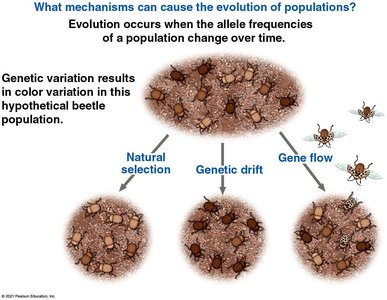
Mechanisms of Evolutionary Change
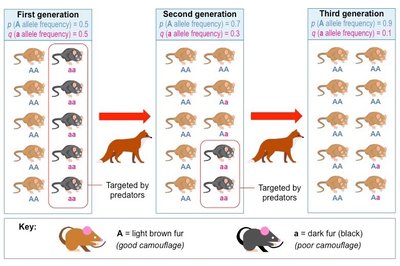
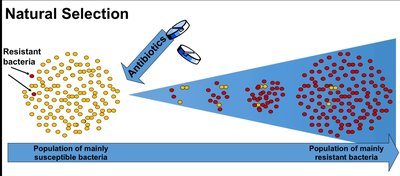
Three major factors alter allele frequencies and drive evolutionary change:
Natural selection: Alleles that enhance survival or reproduction increase in frequency over time, leading to adaptive evolution.
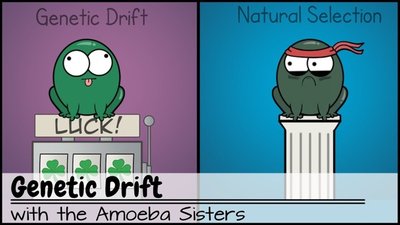
Genetic drift: Random fluctuations in allele frequencies, especially significant in small populations, can lead to loss of genetic variation and fixation of harmful alleles.
Gene flow: Movement of alleles between populations, which can affect adaptation to local environments.
Sexual Selection and Sexual Dimorphism
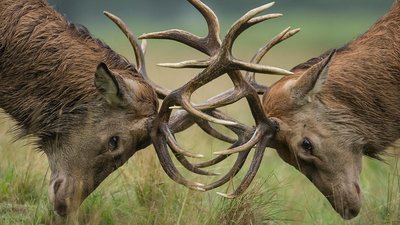
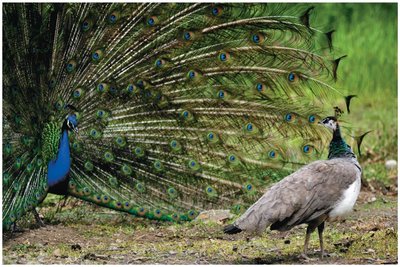
Sexual selection is a process in which individuals with certain inherited characteristics are more likely to acquire mates. This can result in sexual dimorphism, marked differences between the sexes in secondary sexual characteristics.
Examples include elaborate displays in peacocks and antler size in deer.
Summary Table: Mechanisms of Evolution
Mechanism | Description | Effect on Population |
|---|---|---|
Natural Selection | Alleles that increase fitness become more common | Adaptive evolution |
Genetic Drift | Random changes in allele frequencies | Loss of genetic variation, fixation of alleles |
Gene Flow | Movement of alleles between populations | Can increase or decrease adaptation |
Example: Hardy-Weinberg Calculation
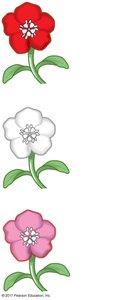
Given: 320 red flowers (CRCR), 160 pink flowers (CRCW), 20 white flowers (CWCW)
Total individuals = 500
Total alleles = 1000
Calculate allele frequencies:
CR alleles = (2 x 320) + 160 = 800
CW alleles = (2 x 20) + 160 = 200
p = 800/1000 = 0.8
q = 200/1000 = 0.2
Expected genotype frequencies:
CRCR:
CRCW:
CWCW:
Conclusion
Understanding the mechanisms that drive the evolution of populations is fundamental to biology. Genetic variation, Hardy-Weinberg equilibrium, and the forces of natural selection, genetic drift, and gene flow all contribute to the dynamic nature of populations. Additional info: Expanded explanations and calculations were added for clarity and completeness.
