 Back
Evolution of Populations: Mechanisms, Hardy-Weinberg, and Microevolution
Study Guide - Smart Notes
 Tailored notes based on your materials, expanded with key definitions, examples, and context.
Evolution of Populations
Species and Populations
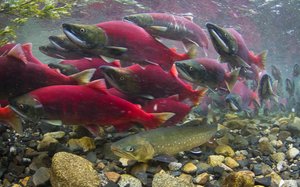
Populations are groups of individuals of the same species that occupy the same environment and can interbreed. Species often contain multiple populations, which may be separated geographically but are still capable of interbreeding if brought together.
Species: Groups of similar, sexually-reproducing individuals.
Population: Subset of a species in a specific area, capable of interbreeding.
Many species are divided into discrete populations across a wide geographic range.
Genetic Variation Within Populations
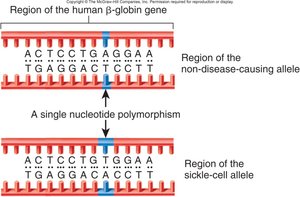
Genetic variation is the foundation for evolution. For a given gene, there is usually variation in nucleotide sequences between individuals in a population. Most genes are polymorphic, meaning they exist in multiple forms (alleles).
Single Nucleotide Polymorphisms (SNPs): The smallest type of genetic change in a gene; account for about 90% of variation in human gene sequences.
Large, healthy populations exhibit high genetic diversity, which is the raw material for natural selection.
Gene Pool and Population Genetics
The gene pool is the total collection of all alleles for every gene in a given population. Population genetics studies the frequencies of alleles and genotypes and how they change over time.
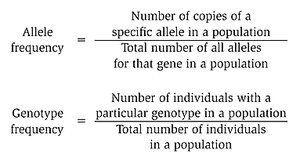
Allele frequency: Proportion of a specific allele among all alleles for a gene in a population.
Genotype frequency: Proportion of a specific genotype among all individuals in a population.
Calculating Allele and Genotype Frequencies
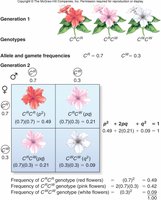
For a gene with two alleles (e.g., CR and CW), there are three possible genotypes. Calculating genotype and allele frequencies is essential for understanding population structure.
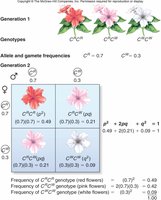
Example: In a population of 100 plants—9 red-flowered (CRCR), 42 pink-flowered (CRCW), 49 white-flowered (CWCW).
Genotype frequency of CWCW = 49/100 = 0.49 (49%)
Allele frequency of CW = (2*49 + 42)/(2*100) = 0.7 (70%)
The Hardy-Weinberg Principle
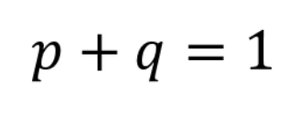
The Hardy-Weinberg equation describes the expected frequencies of alleles and genotypes in a non-evolving population. It provides a null model for detecting evolutionary change.
For two alleles, p (frequency of CR) and q (frequency of CW):
Genotype frequencies: (CRCR), (CRCW), (CWCW)
Applying Hardy-Weinberg Equilibrium
To determine if a population is evolving, compare observed genotype frequencies to those expected under Hardy-Weinberg equilibrium. Departure from expected values indicates evolution is occurring.
Example: If p = 0.4 and q = 0.6, frequency of heterozygotes (CRCW) = (48%)
Conditions for Hardy-Weinberg Equilibrium
The Hardy-Weinberg equilibrium is maintained only if the following conditions are met:
Large population size (no genetic drift)
No mutation
No migration (gene flow)
Random mating
No natural selection
If any of these are violated, evolution may occur.
Microevolution and Its Mechanisms
Microevolution refers to changes in a population’s gene pool from generation to generation. It is driven by several mechanisms:
Natural selection: Differential survival and reproduction of individuals with beneficial traits.
Genetic drift: Random changes in allele frequencies, especially in small populations.
Gene flow (migration): Movement of alleles between populations.
Nonrandom mating: Mating that is not random can change genotype frequencies.
Mutation: Source of new genetic variation.

Natural Selection and Fitness
Natural selection increases the frequency of beneficial, heritable traits, leading to adaptation. Fitness is measured by an individual’s reproductive success and contribution to the next generation’s gene pool.
Relative fitness (w): The reproductive success of a genotype compared to others.
Natural selection can take several forms: directional, stabilizing, disruptive, and balancing selection.
Patterns of Natural Selection
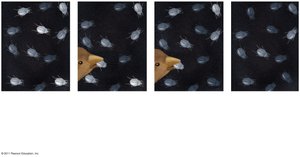
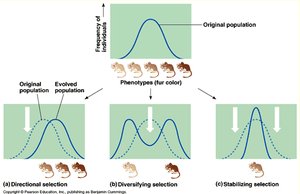
Directional selection: Favors individuals at one extreme of a trait distribution.
Stabilizing selection: Favors intermediate phenotypes, reducing variation.
Disruptive selection: Favors two or more extreme phenotypes over intermediates.
Balancing selection: Maintains genetic diversity (e.g., heterozygote advantage, frequency-dependent selection).
Genetic Drift
Genetic drift is the change in allele frequencies due to random chance, not fitness. It is more pronounced in small populations and can lead to the loss or fixation of alleles.
Bottleneck effect: Population size is drastically reduced, leading to loss of genetic diversity.
Founder effect: A small group establishes a new population with different allele frequencies than the original.
Gene Flow (Migration)
Gene flow is the movement of alleles between populations due to migration. It increases genetic diversity within populations and reduces differences between populations.
Gene flow can counteract the effects of genetic drift and selection, maintaining genetic similarity among populations.
Nonrandom Mating
Nonrandom mating occurs when individuals select mates based on phenotype or genetic relatedness. This can alter genotype frequencies but does not directly change allele frequencies.
Examples include inbreeding (mating between relatives) and assortative mating (preference for similar or dissimilar mates).
Summary Table: Mechanisms of Microevolution
Mechanism | Effect on Population | Example |
|---|---|---|
Natural Selection | Increases frequency of beneficial alleles | Antibiotic resistance in bacteria |
Genetic Drift | Random changes, loss/fixation of alleles | Bottleneck in cheetahs |
Gene Flow | Increases diversity, reduces differences | Migration between bird populations |
Nonrandom Mating | Changes genotype frequencies | Inbreeding in plants |
Mutation | Introduces new alleles | Sickle cell allele in humans |
Key Points
Microevolution is the change in allele and genotype frequencies in a population over generations.
Four main mechanisms shift allele frequencies: natural selection, genetic drift, gene flow, and nonrandom mating.
Hardy-Weinberg equilibrium is the null model; deviation from it signals evolution is occurring.
