 Back
BackLec 38
Study Guide - Smart Notes
 Tailored notes based on your materials, expanded with key definitions, examples, and context.
Evolution of Reproductive Isolation
Introduction to Reproductive Isolation
Reproductive isolation is a key mechanism in the process of speciation, preventing gene flow between populations and leading to the formation of new species. In Drosophila (fruit flies), reproductive isolation can evolve rapidly and is often studied to understand the genetic and evolutionary basis of speciation.
Rapid Evolution of Assortative Mating
Experimental Evidence in Drosophila
Assortative mating refers to the tendency of individuals to mate with others that are similar to themselves, often based on ecological or behavioral traits.
In a classic experiment, Drosophila pseudoobscura populations were reared on different substrates (starch or maltose) for ~25 generations. Afterward, strong evidence for assortative mating based strictly on feeding substrate was observed, indicating rapid evolution of prezygotic isolation.
Prezygotic isolation prevents mating or fertilization between species, while postzygotic isolation affects hybrid viability or fertility.
Prezygotic Reproductive Isolation
Measuring Prezygotic Isolation
Prezygotic isolation can be quantified using indices that compare the probability of conspecific (same species) versus interspecific (different species) matings.
Studies by Coyne & Orr (1997) collected data from sister pairs of Drosophila species to analyze the evolution of prezygotic isolation.
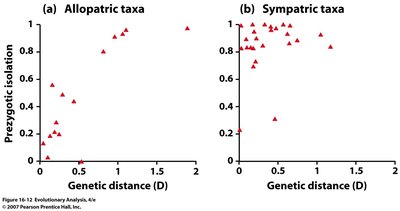
Reinforcement and Sympatry
Reinforcement is the process by which natural selection increases reproductive isolation between populations in sympatry (overlapping ranges) to avoid the production of unfit hybrids.
Females from sympatric populations often show stronger discrimination against heterospecific males compared to allopatric populations.
Example: Drosophila pseudoobscura females from sympatric populations avoid mating with D. persimilis males, while allopatric females do not.
Types of Premating Barriers
Ecological isolation: Species breed at different times (temporal) or in different habitats.
Mating isolation: Potential mates come into contact but do not mate due to behavioral differences or specialized pollinators.
Postzygotic Reproductive Isolation
Haldane’s Rule and Genetic Basis
Haldane’s Rule: When hybrid sterility or inviability is limited to one sex, it is usually the heterogametic sex (e.g., XY males in Drosophila).
This suggests that sex chromosomes play a major role in the evolution of postzygotic isolation.
Pleiotropic effects of recessive alleles may contribute to hybrid sterility or inviability, especially in geographically isolated populations.
Intrinsic Reproductive Isolation in Drosophila
Intrinsic barriers are genetic incompatibilities that reduce hybrid fitness, such as hybrid sterility or inviability.
Example: D. yakuba and D. santomea are sister species with distinct elevational ranges. Hybrids between these species show reduced viability and fertility.
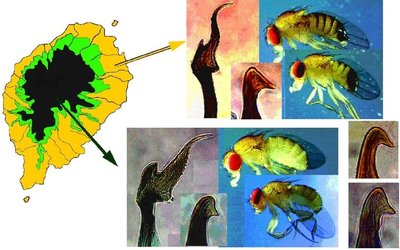
Hybrid Incompatibility and Genomic Conflict
Hybrid zygotes may form but often have reduced fitness due to genomic incompatibilities.
Genes involved in essential cell functions, such as nucleoporins (e.g., Nup96), can cause hybrid inviability when divergent alleles are combined in hybrids.
Presgraves et al. (2003) mapped hybrid inviability between D. melanogaster and D. simulans to the Nup96 gene.
Genetic Mapping of Hybrid Incompatibility
Experimental Approaches
Systematic genetic screens can identify chromosomal regions responsible for hybrid inviability.
In D. melanogaster × D. simulans crosses, hybrid males typically die at the pupal/larval transition, but can be rescued by specific chromosomal deletions or rescue alleles.
Genetic mapping techniques can localize the responsible gene to a specific chromosomal region (e.g., 95AB on chromosome 3R for Nup96).
Accumulation of Reproductive Isolation
Snowball Effect Hypothesis
Genetic incompatibilities are hypothesized to accumulate at an exponential rate over time, a concept known as the Snowball Effect.
As more incompatibilities accumulate, reproductive isolation becomes more complete, reinforcing species boundaries.
Summary Table: Mean Development Time in Drosophila Crosses
The following table summarizes mean development time (in hours) from egg to first-instar larva in pure-species and F1 hybrids of D. yakuba and D. santomea:
Cross/Line | Mean development time (ISO) | Mean development time (SYN) |
|---|---|---|
yak × yak | 16.84 (0.62) A | 18.34 (0.77) A |
san × san | 17.19 (0.55) A | 19.15 (0.75) A |
yak × san | 22.63 (0.54) B | 22.07 (0.95) B |
san × yak | 30.05 (1.06) C | 28.64 (1.35) C |
ISO refers to standard lines; SYN refers to synthetic strains. Letters indicate statistical groupings (Tukey-Kramer HSD).
Key Terms and Concepts
Prezygotic isolation: Barriers that prevent mating or fertilization between species.
Postzygotic isolation: Barriers that reduce the fitness of hybrids after fertilization.
Reinforcement: Natural selection increases reproductive isolation in sympatry to avoid unfit hybrids.
Haldane’s Rule: Hybrid sterility/inviability is more likely in the heterogametic sex.
Snowball Effect: The exponential accumulation of genetic incompatibilities over time.
Relevant Equations
Prezygotic Isolation Index:
Genetic Distance (D): A measure of genetic divergence between populations or species, often used to correlate with reproductive isolation.
Conclusion
Studies in Drosophila provide critical insights into the mechanisms and genetic basis of reproductive isolation and speciation. Both prezygotic and postzygotic barriers contribute to the formation of new species, and their evolution can be rapid and driven by ecological, behavioral, and genetic factors.
