 Back
Evolution, Population Genetics, and Plant Biology: Core Concepts and Mechanisms
Study Guide - Smart Notes
 Tailored notes based on your materials, expanded with key definitions, examples, and context.
Evolution by Natural Selection
Historical Perspectives and Key Concepts
Evolutionary biology explores how populations adapt to their environments through changes in genetic composition over time. Early theories, such as typological and essentialist thinking, emphasized fixed traits, while modern evolutionary theory recognizes the importance of variation among individuals.
Typological Thinking: Focuses on the 'essence' of a species, dismissing individual differences.
Essentialist Thinking: Assumes traits are innate, inherited, and permanent.
Population Thinking: Emphasizes variation among individuals as the key to understanding evolution.
Lamarck's Theory: Proposed inheritance of acquired characteristics, but lacked evidence for genetic mechanisms.
Darwin & Wallace: Proposed natural selection, where the fittest individuals survive and reproduce, leading to adaptation.
Modern Definition of Evolution: A change in allele frequencies in a population over time.
Law of Succession: Fossil species are succeeded by similar species in the same region.
Vestigial Traits: Reduced or nonfunctional structures inherited from ancestors (e.g., human appendix, wisdom teeth).
Mechanisms of Natural Selection
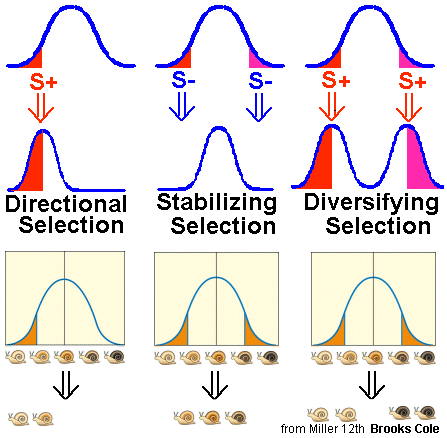
Natural selection can act on populations in several distinct ways, shaping genetic and phenotypic diversity.
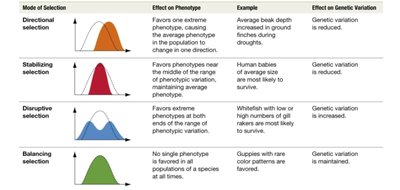
Directional Selection: Favors one extreme phenotype, shifting the population mean in one direction. Example: Industrial melanism in moths.
Stabilizing Selection: Favors intermediate phenotypes, reducing variation. Example: Mouse fur color matching the forest floor.
Diversifying (Disruptive) Selection: Favors multiple extreme phenotypes, increasing variation. Example: Alpha and sneaking male strategies in animals.
Population Genetics and Hardy-Weinberg Equilibrium
Hardy-Weinberg Principle
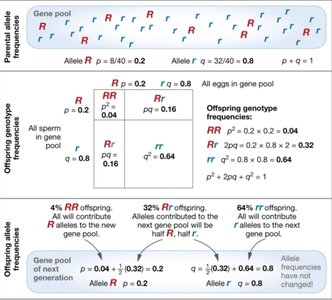
The Hardy-Weinberg equilibrium provides a mathematical model to study genetic variation in populations. It predicts genotype frequencies under the absence of evolutionary forces.
Equation:
p: Frequency of one allele (e.g., A1)
q: Frequency of the other allele (e.g., A2)
Assumptions: No mutation, migration, selection, or genetic drift; random mating.
Application: Used to calculate expected genotype frequencies and detect evolutionary change.
Genetic Drift and Founder Effects
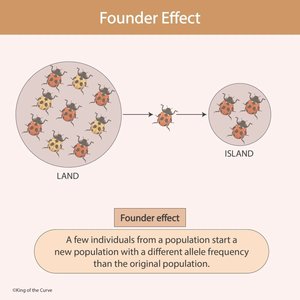
Genetic drift refers to random changes in allele frequencies, especially pronounced in small populations. The founder effect and bottleneck effect are two important forms of genetic drift.
Founder Effect: A new population is established by a small number of individuals, leading to reduced genetic variation.
Bottleneck Effect: A drastic reduction in population size due to environmental events, reducing genetic diversity.
Gene Flow
Gene flow is the movement of alleles between populations, which tends to homogenize genetic differences and can affect fitness.
Effect: Makes allele frequencies more similar between populations; can increase or decrease fitness depending on context.
Speciation and Reproductive Isolation
Genetic Isolation and Divergence
Speciation is the process by which one species splits into two or more distinct species, often initiated by genetic isolation and divergence.
Genetic Isolation: Barriers to gene flow separate populations.
Genetic Divergence: Mutation, selection, and drift cause populations to diverge genetically.
Species Concepts
Three main species concepts are used to define and distinguish species:
Biological Species Concept: Groups that can interbreed and produce fertile offspring; not applicable to asexual or fossil species.
Morphospecies Concept: Based on morphological differences; widely applicable but may miss cryptic species.
Phylogenetic Species Concept: Smallest monophyletic group on a phylogenetic tree; based on genetic data but may over-split species.
Mechanisms of Reproductive Isolation
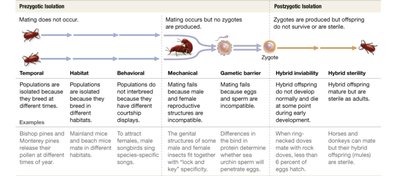
Reproductive isolation prevents gene flow between populations and can be prezygotic or postzygotic.
Prezygotic Isolation: Temporal, habitat, behavioral, mechanical, and gametic barriers prevent mating or fertilization.
Postzygotic Isolation: Hybrid inviability or sterility prevents hybrids from surviving or reproducing.
Plant Diversity and Adaptations
Monocots vs. Eudicots
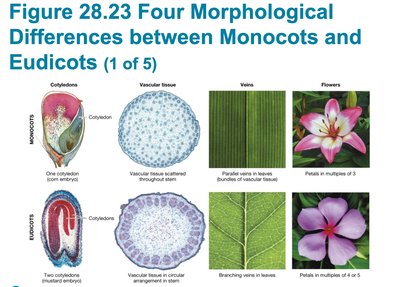
Monocots and eudicots are two major groups of angiosperms, differing in several key morphological traits.
Monocots: One cotyledon, parallel leaf veins, vascular tissue scattered, flower parts in multiples of three.
Eudicots: Two cotyledons, branching leaf veins, vascular tissue in a ring, flower parts in multiples of four or five.
Tracheids and Vessel Elements
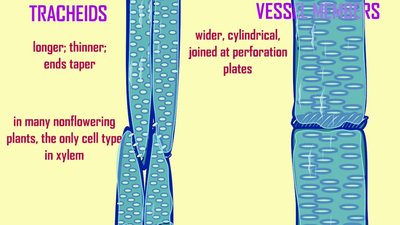
Tracheids and vessel elements are specialized water-conducting cells in the xylem of vascular plants.
Tracheids: Long, narrow, tapered cells found in all vascular plants; water moves through pits.
Vessel Elements: Shorter, wider cells with perforation plates; found mainly in angiosperms.
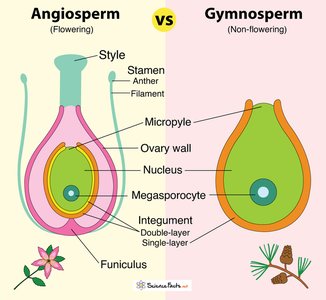
Angiosperms vs. Gymnosperms
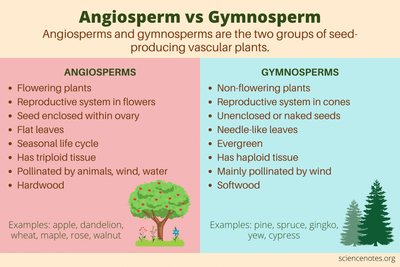
Angiosperms and gymnosperms are the two main groups of seed-producing vascular plants, differing in reproductive structures and strategies.
Angiosperms: Produce seeds enclosed in fruits, have flowers, broad leaves, and rely on animals or wind for pollination.
Gymnosperms: Produce naked seeds (not enclosed in fruits), have cones, needle-like leaves, and rely mainly on wind for pollination.
Plant Structure and Transport
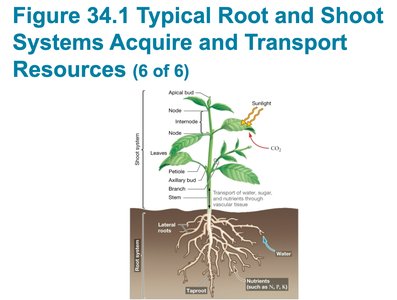
Root and Shoot Systems
Plants have specialized root and shoot systems for acquiring and transporting resources such as water, minerals, and sugars.
Root System: Anchors the plant, absorbs water and minerals, stores carbohydrates.
Shoot System: Includes stems, leaves, and reproductive structures; responsible for photosynthesis and transport of sugars.
Osmosis and Water Movement
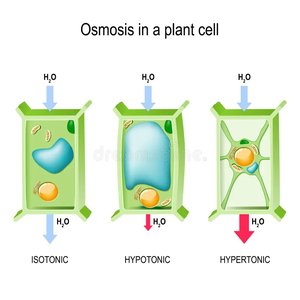
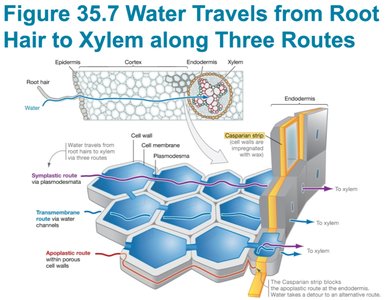
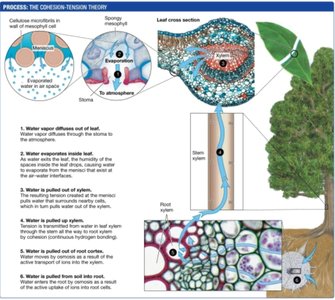
Osmosis is the movement of water from areas of high to low concentration across a semipermeable membrane. In plants, water moves from the soil into root hairs and then through the plant via the xylem.
Turgor Pressure: Pressure of water inside the cell against the cell wall, keeping plants upright.
Pathways: Water can move via the symplastic, apoplastic, or transmembrane routes to reach the xylem.
Translocation of Sugars
Sugars produced in mature leaves (sources) are transported to growing tissues and storage organs (sinks) via the phloem in a process called translocation.
Sources: Mature leaves
Sinks: Roots, fruits, seeds, young leaves
Plant Reproduction and Development
Angiosperm Life Cycle
Angiosperms undergo a complex life cycle involving alternation of generations, double fertilization, and seed development.
Megaspores: Produce female gametophytes inside the ovule.
Microspores: Produce male gametophytes (pollen grains) inside the anther.
Double Fertilization: One sperm fertilizes the egg (zygote), another fuses with polar nuclei (endosperm).
Seed Development: Involves formation of embryo, nutritive tissue, and protective seed coat.
Summary Table: Modes of Selection
Mode of Selection | Effect on Phenotype | Example | Effect on Genetic Variation |
|---|---|---|---|
Directional selection | Favors one extreme phenotype, shifting the population mean | Average beak depth in ground finches increased in drought | Genetic variation is reduced |
Stabilizing selection | Favors intermediate phenotypes, maintaining average phenotype | Human babies with average size more likely to survive | Genetic variation is reduced |
Disruptive selection | Favors extreme phenotypes at both ends of the range | Whitefish with low or high numbers of gill rakers more likely to survive | Genetic variation is increased |
Balancing selection | No single phenotype is favored at all times | Guppies with rare color patterns are favored | Genetic variation is maintained |
