 Back
Evolution, Population Genetics, and the Origin of Eukaryotes: Study Notes for General Biology
Study Guide - Smart Notes
 Tailored notes based on your materials, expanded with key definitions, examples, and context.
Hardy-Weinberg Equilibrium and Population Genetics
Hardy-Weinberg Principle
The Hardy-Weinberg Equilibrium (HWE) provides a mathematical model to study genetic variation in populations and to determine if evolution is occurring. It describes a population in which allele and genotype frequencies remain constant from generation to generation, provided that certain conditions are met.
Null Model: HWE serves as a baseline to detect evolutionary change.
Assumptions: No mutations, random mating, no natural selection, infinite population size, and no gene flow.
Detecting Evolution: Deviations from HWE indicate that one or more assumptions are violated, suggesting evolution is occurring.
Hardy-Weinberg Equations
Allele Frequencies:
Genotype Frequencies:
Definitions:
p: Frequency of the dominant allele
q: Frequency of the recessive allele
p^2: Frequency of homozygous dominant genotype
2pq: Frequency of heterozygous genotype
q^2: Frequency of homozygous recessive genotype
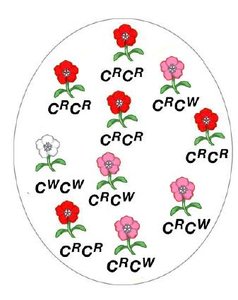
Example: In a population of flowers, red (CRCR), white (CWCW), and pink (CRCW) phenotypes can be used to calculate allele and genotype frequencies using the above equations.
Mechanisms of Evolution
Genetic Variation and Evolutionary Mechanisms
Genetic variation is the raw material for evolution. Several mechanisms can alter allele frequencies in a population:
Mutation: Random changes in DNA that introduce new alleles.
Natural Selection: Differential survival and reproduction of individuals with advantageous traits.
Genetic Drift: Random changes in allele frequencies, especially in small populations.
Gene Flow: Movement of alleles between populations through migration.
Phylogenetics
Character Matrices and Evolutionary Trees
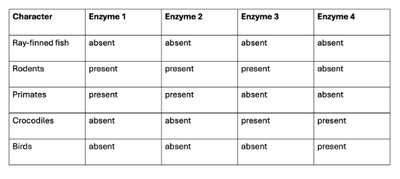
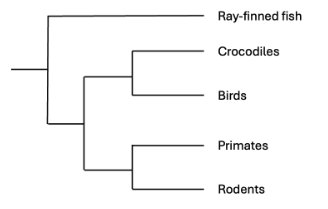
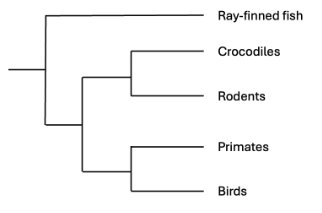
Phylogenetics is the study of evolutionary relationships among species. Scientists use character matrices (tables of traits) to hypothesize evolutionary trees (phylogenies).
Character | Enzyme 1 | Enzyme 2 | Enzyme 3 | Enzyme 4 |
|---|---|---|---|---|
Ray-finned fish | absent | absent | absent | absent |
Rodents | present | present | present | absent |
Primates | present | present | absent | absent |
Crocodiles | absent | absent | present | present |
Birds | absent | absent | absent | present |
Application: The most likely evolutionary tree is chosen based on shared derived characters (synapomorphies) in the matrix.
The Origin of Eukaryotes and Multicellularity
Endosymbiotic Theory
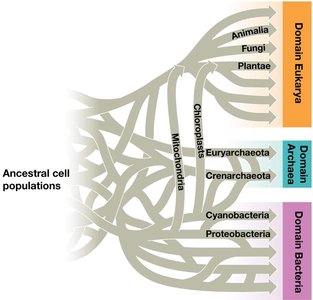
The endosymbiotic theory explains the origin of mitochondria and plastids (e.g., chloroplasts) in eukaryotic cells. According to this theory, these organelles originated as free-living bacteria that were engulfed by ancestral eukaryotic cells.
Evidence:
Similarities in DNA structure (circular chromosomes)
Similar ribosomes and sensitivity to antibiotics
Ability to replicate independently of the host cell
Homologous inner membrane structures
Origin of Multicellularity
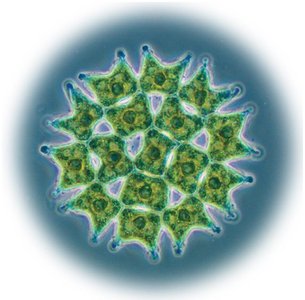
Multicellularity evolved independently in several eukaryotic lineages, including plants, fungi, and animals. The earliest multicellular organisms were simple colonies of connected cells.
Colony Formation: Early multicellular forms were colonies with little cell differentiation.
Extracellular Matrix: Development of extracellular matrix allowed for cell adhesion and communication.
Diversification: Multicellularity enabled the evolution of complex body plans and rapid diversification.
The Origin of Life
Stages in the Origin of Life
Chemical and physical processes on early Earth could have produced simple cells through four main stages:
Abiotic synthesis of small organic molecules
Joining of these molecules into macromolecules
Packaging of molecules into protocells
Origin of self-replicating molecules
Speciation and Reproductive Isolation
Reproductive Barriers
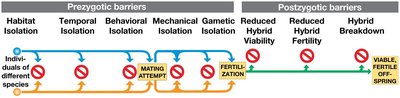
Speciation is the process by which new species arise. Reproductive isolation prevents gene flow between populations, leading to the formation of new species.
Prezygotic Barriers: Prevent mating or fertilization between species (e.g., habitat, temporal, behavioral, mechanical, and gametic isolation).
Postzygotic Barriers: Occur after fertilization, reducing hybrid viability or fertility.
Modes of Speciation
Allopatric Speciation: Occurs when populations are geographically separated, leading to divergence.
Sympatric Speciation: Occurs without geographic separation, often through polyploidy, habitat differentiation, or sexual selection.
Hybrid Zones and Speciation Outcomes
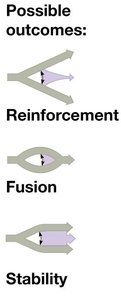
When diverging populations come into contact, several outcomes are possible:
Reinforcement: Strengthening of reproductive barriers
Fusion: Weakening of barriers, populations merge
Stability: Continued production of hybrids
Broad Patterns of Evolution
Macroevolutionary Patterns
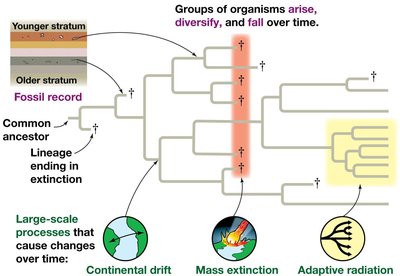
Macroevolution refers to large-scale evolutionary changes above the species level, including the origin of new taxonomic groups, adaptive radiations, and mass extinctions.
Fossil Record: Provides evidence for the rise, diversification, and extinction of groups over time.
Major Processes: Continental drift, mass extinction, and adaptive radiation shape the history of life.
Practice Questions
Bird guides once listed the myrtle warbler and Audubon's warbler as distinct species that lived side by side in parts of their ranges. However, recent books show them as eastern and western forms of a single species, the yellow-rumped warbler. Apparently, the myrtle warbler and Audubon's warbler successfully interbreed and produce fertile offspring.
Three species of frogs mate in the same ponds but pair off correctly because they have different calls. This is a specific example of a prezygotic barrier, called behavioral isolation.
Comparison of human fossils with living humans shows no significant physical changes in 30,000 to 50,000 years. An advocate of punctuated equilibrium would say that lack of change is consistent with the punctuated equilibrium model.
Abiotically-produced vesicles display the ability to perform simple reproduction and metabolism.
Bacteria that use light for energy and CO2 for carbon are called photoautotrophs.
Evidence that mitochondria and plastids evolved from prokaryotic endosymbionts includes having a single circular chromosome and prokaryote-like ribosomes.
If humans selectively hunt individuals with the dominant trait, the frequency of the homozygous dominants will go down, and the frequency of the homozygous recessives will go up.
A change in phenotypic frequency in a small population due to random deaths is an example of genetic drift.
The least useful in determining relationships among species is analogous structures.
Fewer insects dying from insecticide over time is due to descendants of insects with insecticide-resistant characteristics.
