 Back
BackEvolutionary Adaptations of Vertebrate Digestive Systems and Their Correlation with Diet
Study Guide - Smart Notes
 Tailored notes based on your materials, expanded with key definitions, examples, and context.
Evolutionary Adaptations of Vertebrate Digestive Systems
Dentition and Dietary Adaptations
The structure and arrangement of teeth (dentition) in vertebrates are closely linked to dietary habits. Mammals, in particular, exhibit a wide variety of tooth shapes and sizes, reflecting their diverse diets. This adaptation is a key factor in the evolutionary success of mammals.
Carnivores possess large, pointed incisors and canines for killing prey and tearing flesh, while jagged premolars and molars crush and shred food.
Herbivores have broad, ridged surfaces on premolars and molars for grinding tough plant material. Incisors and canines are often modified for biting off pieces of vegetation.
Omnivores (e.g., humans) have a combination of tooth types, allowing them to process both animal and plant matter efficiently.
Some nonmammalian vertebrates, such as venomous snakes, have specialized teeth (fangs) for injecting venom into prey.
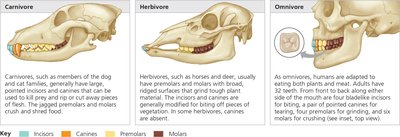
Example: Sea otters use sharp canines to tear apart prey and rounded molars to crush shells.
Stomach and Intestinal Adaptations
Digestive tract morphology varies among vertebrates, reflecting dietary needs. Carnivores, herbivores, and omnivores show distinct differences in the size and complexity of their digestive organs.
Carnivores often have large, expandable stomachs to accommodate infrequent, large meals. Their digestive tracts are relatively short, as meat is easier to digest.
Herbivores and omnivores typically have longer alimentary canals, providing more time and surface area for the breakdown and absorption of plant material, which is more difficult to digest due to cellulose-rich cell walls.
Specialized structures, such as an enlarged cecum or colon, house symbiotic bacteria that aid in the digestion of fibrous plant material.
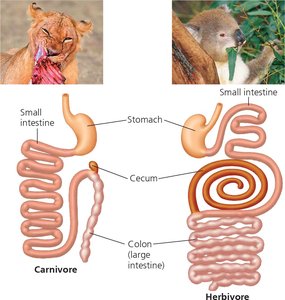
Example: Koalas have long intestines and a large cecum to process eucalyptus leaves, while lions have shorter digestive tracts suited for meat digestion.
Advantages of a longer alimentary canal for herbivores:
Increased time for digestion of tough plant material.
Greater surface area for nutrient absorption.
Mutualistic Adaptations: The Microbiome
Many vertebrates rely on mutualistic relationships with microorganisms to aid in digestion. The microbiome refers to the collection of microorganisms and their genetic material living in and on the body.
In humans, 10–100 trillion bacteria inhabit the digestive tract, producing essential vitamins (e.g., vitamin K, biotin, folic acid) and regulating immune and epithelial function.
Microbiome composition varies with diet, age, and health status.
DNA sequencing (e.g., PCR) has revealed over 400 bacterial species in the human gut.
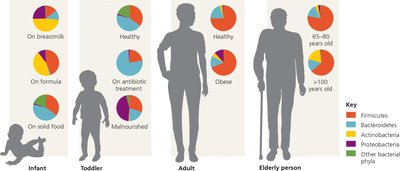
Example: The abundance of different bacterial phyla changes from infancy to old age, influenced by diet and health.
Microbiome and Disease
Infection with Helicobacter pylori can drastically reduce stomach microbiome diversity, leading to gastric ulcers.
Fecal microbial transplantation is an emerging therapy for restoring healthy microbiomes in patients with antibiotic-resistant infections, such as those caused by Clostridium difficile.
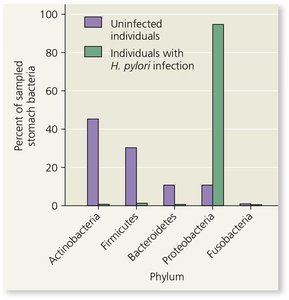
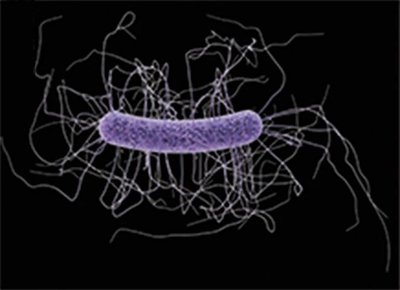
Example: In individuals infected with H. pylori, over 95% of stomach bacteria are from this species, reducing overall diversity.
Mutualistic Adaptations in Herbivores
Herbivores depend heavily on symbiotic microorganisms to digest cellulose, a major component of plant cell walls. These microorganisms reside in specialized fermentation chambers within the digestive tract.
In animals like horses, koalas, and elephants, the cecum houses cellulose-digesting bacteria and protists.
Birds such as the hoatzin use a muscular crop for fermentation.
Rabbits and rodents practice coprophagy (re-ingesting feces) to recover nutrients produced by fermentation in the large intestine.
Ruminants (e.g., cows, sheep, deer) have a four-chambered stomach (rumen, reticulum, omasum, abomasum) for efficient cellulose digestion and nutrient absorption.
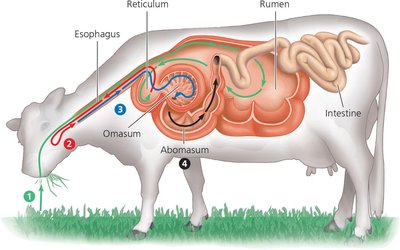
Example: In ruminants, food is regurgitated and rechewed as "cud" to enhance microbial digestion before passing through the rest of the stomach chambers.
Adaptations Beyond Vertebrates
Some invertebrates, such as giant tubeworms living near hydrothermal vents, lack a digestive system entirely. Instead, they rely on mutualistic bacteria within their bodies to obtain energy and nutrients through chemoautotrophy.
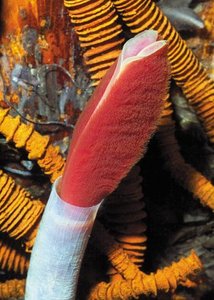
Example: Tubeworms obtain all nutrients from symbiotic bacteria that use chemicals from vent water for energy.
Concept Check
What are two advantages of a longer alimentary canal for processing plant material that is difficult to digest? - Provides more time for digestion and more surface area for nutrient absorption.
What features of a mammal’s digestive system make it an attractive habitat for mutualistic microorganisms? - Warm, moist, nutrient-rich environment with a steady supply of food and stable conditions.
What if? People with lactose intolerance sometimes eat yogurt containing bacteria that produce lactase. Why would this likely provide only temporary relief? - The bacteria in yogurt may temporarily help digest lactose, but they do not permanently colonize the gut, so symptoms may return once the yogurt is no longer consumed.
