 Back
Evolutionary Processes and Mechanisms: Study Notes for General Biology
Study Guide - Smart Notes
 Tailored notes based on your materials, expanded with key definitions, examples, and context.
Evolutionary Processes
Introduction to Evolution
Evolution is the process by which populations of organisms change over generations through the inheritance of genetic traits. It is a central concept in biology, explaining the diversity of life and adaptation to different environments.
Evolution: Descent with inherited modification; more specifically, changes in allelic frequencies of populations over time.
Population: A group of organisms of the same inter-breeding species living in the same geographic area at the same time.
Populations, not individuals, evolve. Natural selection acts on individuals, but evolutionary change is observed at the population level.
Darwin’s Postulates for Natural Selection
Natural selection is a primary mechanism of evolution. Charles Darwin outlined four key criteria for natural selection to occur:
Variation in traits exists among individuals within a population.
Some traits are heritable (passed from parents to offspring).
Not all individuals survive or reproduce (differential reproductive success).
Individuals with traits better suited to their environment are more likely to survive and reproduce (non-random survival and reproduction).
Example: Natural Selection in Beetles
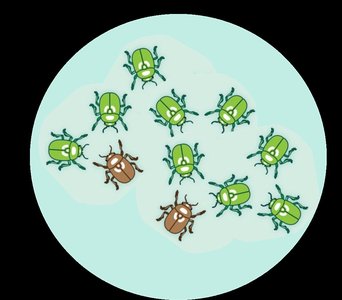
Consider a population of beetles with two color morphs: green and brown. Environmental pressures, such as predation and background color, influence which traits are advantageous.
First generation: 82% green, 18% brown.
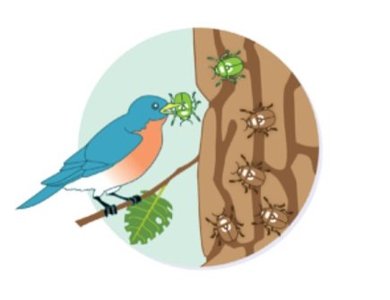
Selective pressure: Birds preferentially eat green beetles on brown trees.
Second generation: Higher proportion of brown beetles survive and reproduce.
Result: Brown phenotype increases in frequency in the next generation.
Selective Pressures
Selective pressures are environmental factors that influence which individuals survive and reproduce. Examples include predation, climate, and competition for resources.
Traits can be advantageous, disadvantageous, or neutral depending on the environment.
Selective pressures drive adaptation and changes in trait frequencies.
Genetic Variation and the Gene Pool
Sources of Variation
Genetic variation is essential for evolution. It arises from differences in DNA sequences among individuals in a population.
Gene pool: The total collection of alleles in a population.
Variation is caused by mutations, genetic recombination during sexual reproduction, and gene flow between populations.
Population Genetics and Hardy-Weinberg Equilibrium
Population genetics is the study of how genetic composition changes in populations over time. The Hardy-Weinberg equilibrium provides a mathematical model for a non-evolving population.
Hardy-Weinberg Equilibrium: If a population is not evolving, allele frequencies remain constant from generation to generation.
Conditions for equilibrium: random mating, no natural selection, no genetic drift, no gene flow, no mutations.
Deviation from equilibrium indicates evolution is occurring.
Hardy-Weinberg Equation:
where p and q are the frequencies of two alleles at a locus.
Mechanisms of Evolution
Overview of Evolutionary Mechanisms
Several mechanisms can cause changes in allele frequencies in populations:
Natural Selection: Differential survival and reproduction based on heritable traits.
Non-Random Mating (Sexual Selection): Individuals select mates based on specific traits.
Genetic Drift: Random changes in allele frequencies due to chance events.
Gene Flow: Movement of alleles between populations (migration).
Mutation: Random changes in DNA sequence, introducing new genetic variation.
Mutation
Mutations are changes in the DNA sequence of an organism’s genome. They are the ultimate source of genetic variation.
Can occur in somatic (body) cells or gametic (reproductive) cells.
Only mutations in gametes are heritable and contribute to evolution.
Types of mutations: point mutations, frameshift mutations, nonsense mutations, missense mutations.
Mutations can be beneficial, harmful, or neutral depending on the environment.
Environmental Context of Traits
The advantage or disadvantage of a trait depends on the environment and selective pressures present. For example, a trait that is beneficial in one environment may be neutral or harmful in another.
Example: Beetle color is advantageous or disadvantageous depending on tree color and predation.
Example: Burrowing behavior in rodents is advantageous in the presence of predators but neutral in their absence.
Key Terms in Evolutionary Biology
Adaptation: A trait that increases an organism’s fitness in a particular environment.
Allele: A variant form of a gene.
Allelic Frequency: The proportion of a specific allele among all alleles in a population.
Ancestor: An organism from which others have descended.
Fitness: The ability of an organism to survive and reproduce in its environment.
Heritability: The proportion of trait variation that is due to genetic factors.
Mutation: A change in the DNA sequence.
Trait: A characteristic of an organism, often heritable.
Summary Table: Mechanisms of Evolution
Mechanism | Description | Effect on Population |
|---|---|---|
Natural Selection | Non-random survival and reproduction based on trait advantage | Increases frequency of advantageous traits (adaptation) |
Mutation | Random change in DNA sequence | Introduces new genetic variation |
Genetic Drift | Random changes in allele frequencies | Can decrease genetic variation, especially in small populations |
Gene Flow | Movement of alleles between populations | Increases genetic variation within populations |
Non-Random Mating | Mate selection based on specific traits | Can change genotype frequencies |
Practice and Application
Understanding and applying these concepts is essential for success in biology. Practice using key terms, solving problems related to allele frequencies, and analyzing examples of evolutionary change in populations.
