 Back
Evolutionary Processes: Mechanisms of Evolution and Their Effects on Populations
Study Guide - Smart Notes
 Tailored notes based on your materials, expanded with key definitions, examples, and context.
Ch. 23 – Evolutionary Processes
Introduction to Evolutionary Processes
Evolution is defined as the change in allele frequencies in a population over time. While natural selection is a key mechanism, three other processes—genetic drift, gene flow, and mutation—also contribute to evolutionary change. Understanding these processes is fundamental to modern evolutionary biology and population genetics.
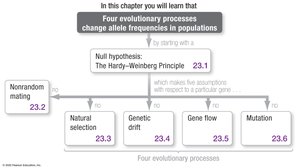
Natural Selection: Differential survival and reproduction based on heritable traits.
Genetic Drift: Random changes in allele frequencies, especially significant in small populations.
Gene Flow: Movement of alleles between populations through migration and breeding.
Mutation: Introduction of new alleles through changes in DNA sequence.
Modern Synthesis integrated Darwinian evolution with Mendelian genetics, leading to the field of population genetics, which quantifies how these processes affect allele and genotype frequencies.
The Hardy–Weinberg Principle
Hardy–Weinberg Equilibrium as a Null Model
The Hardy–Weinberg Principle provides a mathematical model to predict genotype frequencies in a non-evolving population. It serves as a null hypothesis for detecting evolutionary change.
Equation:
p: Frequency of the dominant allele
q: Frequency of the recessive allele
Assumptions: No selection, no mutation, no migration, large population size, and random mating
Deviations from Hardy–Weinberg equilibrium indicate that one or more evolutionary processes are at work.
Nonrandom Mating
Inbreeding and Its Effects
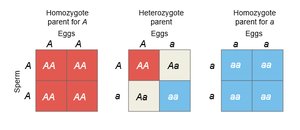
Nonrandom mating occurs when individuals do not mate randomly within a population. Inbreeding, or mating between close relatives, is a common form of nonrandom mating and has significant genetic consequences.
Increases homozygosity: More individuals become homozygous for alleles, reducing heterozygosity.
Does not change allele frequencies directly, but alters genotype frequencies.
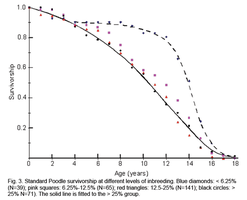
Inbreeding depression: Reduced fitness due to increased expression of deleterious recessive alleles.
Example: Inbreeding depression is observed in small populations such as Florida panthers and purebred dogs, where increased homozygosity leads to health problems and reduced survival.
Sexual Selection
Sexual selection is a form of nonrandom mating where individuals with certain traits are more likely to obtain mates. It can lead to changes in allele frequencies and often results in sexual dimorphism.
Intersexual selection: Mate choice, often by females selecting for 'honest signals' of genetic quality.
Intrasexual selection: Competition among individuals of the same sex for mates.
Example: Peacock tails and elephant seal size are classic examples of traits shaped by sexual selection.
Natural Selection
Modes of Selection
Natural selection can act in several patterns, each with distinct effects on genetic variation and population adaptation.
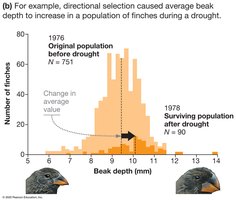
Directional Selection: Favors one extreme phenotype, shifting the population mean and reducing genetic variation.
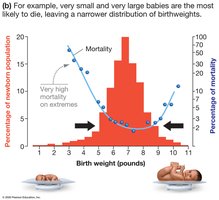
Stabilizing Selection: Favors intermediate phenotypes, reducing variation but maintaining the mean.
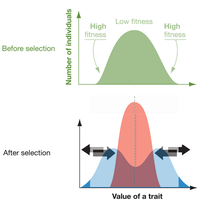
Disruptive Selection: Favors extreme phenotypes at both ends, increasing variation and potentially leading to speciation.
Balancing Selection: Maintains genetic diversity through mechanisms such as heterozygote advantage and frequency-dependent selection.
Mode of Selection | Effect on Phenotype | Example | Effect on Genetic Variation |
|---|---|---|---|
Directional | Shifts mean phenotype | Finch beak size during drought | Decreases |
Stabilizing | Favors intermediates | Human birth weight | Decreases |
Disruptive | Favors extremes | Gill raker number in fish | Increases |
Balancing | Maintains diversity | Color patterns in guppies | Maintained |
Genetic Drift
Random Changes in Allele Frequencies
Genetic drift refers to random fluctuations in allele frequencies due to chance events. It is especially significant in small populations and can lead to the fixation or loss of alleles.
Founder Effect: When a new population is established by a small group, allele frequencies may differ from the source population.
Bottleneck Effect: Sudden reduction in population size due to catastrophe, reducing genetic diversity.
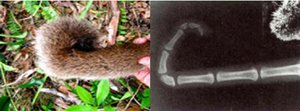
Example: Cheetahs and Florida panthers have experienced bottlenecks, resulting in low genetic diversity.
Gene Flow
Movement of Alleles Between Populations
Gene flow occurs when individuals migrate between populations and breed, introducing new alleles and homogenizing genetic differences between populations.
Increases genetic diversity within populations but reduces differences between populations.
Can counteract effects of selection, drift, and inbreeding.
Example: Introduction of captive-bred fish into wild populations can reduce the fitness of wild populations due to maladapted alleles.
Mutation
Source of New Genetic Variation
Mutation is the ultimate source of genetic variation, creating new alleles. While most mutations are neutral or deleterious, some can be beneficial and increase in frequency through selection.
Rare and slow in most eukaryotes, but significant in organisms with short generation times (e.g., bacteria).
Types: Point mutations, insertions, deletions, gene duplications, and lateral gene transfer.
Example: Aphids acquired genes for carotenoid synthesis from fungi via lateral gene transfer, a rare but impactful evolutionary event.
Summary Table: Effects of Evolutionary Processes
Process | Effect on Allele Frequencies | Effect on Genetic Variation | Effect on Fitness |
|---|---|---|---|
Natural Selection | Non-random change | Can increase or decrease | Usually increases |
Genetic Drift | Random change | Decreases | Random |
Gene Flow | Homogenizes populations | Can increase or decrease | Random |
Mutation | Introduces new alleles | Increases | Usually neutral or deleterious |
