 Back
Exam 5 Practice Questions – General Biology Study Guidance
Study Guide - Smart Notes
 Tailored notes based on your materials, expanded with key definitions, examples, and context.
Q10. What two colors of light drive most of photosynthesis?
Background
Topic: Photosynthesis – Light Absorption
This question tests your understanding of which wavelengths (colors) of light are most effective for photosynthesis in plants. It relates to the absorption spectra of plant pigments such as chlorophyll.
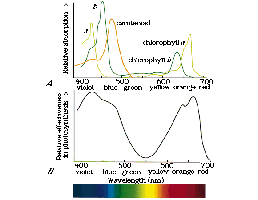
Key Terms and Concepts:
Photosynthesis: The process by which plants convert light energy into chemical energy.
Chlorophyll: The main pigment in plants that absorbs light for photosynthesis.
Absorption Spectrum: A graph showing how much light is absorbed by pigments at different wavelengths.
Action Spectrum: A graph showing the rate of photosynthesis at different wavelengths of light.
Step-by-Step Guidance
Examine the absorption spectrum for chlorophyll and other pigments. Notice which colors (wavelengths) are absorbed most strongly.
Look at the action spectrum for photosynthesis, which shows the effectiveness of different wavelengths in driving photosynthesis.
Identify the peaks in both spectra. These peaks indicate which colors are most important for photosynthesis.
Recall that chlorophyll absorbs light most efficiently in certain regions of the visible spectrum.
Use the information from the spectra to determine which two colors are most effective for photosynthesis. The answer choices provide several color pairs to consider.
Try solving on your own before revealing the answer!
Final Answer: c. red and blue
The absorption and action spectra show that photosynthesis is most efficient in the red and blue regions of the visible spectrum. Chlorophyll absorbs these wavelengths strongly, leading to higher rates of photosynthesis.
