 Back
LECTURE 20: Excretory System and Osmoregulation in Animals
Study Guide - Smart Notes
 Tailored notes based on your materials, expanded with key definitions, examples, and context.
LECTURE 20
Excretory System and Osmoregulation
Introduction
The excretory system is essential for maintaining homeostasis in animals by regulating water and solute concentrations and removing metabolic wastes. This system is especially important for animals living in diverse environments, such as marine, freshwater, and terrestrial habitats, each presenting unique osmotic challenges.
Osmoregulation
Osmosis and Osmolarity
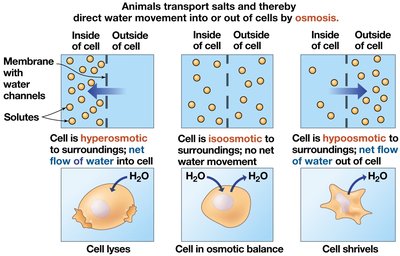
Osmoregulation is the process by which animals control the balance of water and solutes in their bodies. Water moves across cell membranes by osmosis, driven by differences in osmolarity (solute concentration). Cells can be:
Hyperosmotic to surroundings: Net flow of water into the cell, causing it to swell or lyse.
Isoosmotic to surroundings: No net water movement; cell remains stable.
Hypoosmotic to surroundings: Net flow of water out of the cell, causing it to shrivel.
Osmoregulatory Strategies
Osmoconformers: Animals that are isoosmotic with their environment and do not actively regulate osmolarity (e.g., most marine invertebrates).
Osmoregulators: Animals that expend energy to maintain internal osmolarity different from their environment. This adaptation allows survival in a wide range of habitats.
Stenohaline: Tolerate only a narrow range of external osmolarity.
Euryhaline: Tolerate a wide range of external osmolarity (e.g., salmon).
Osmoregulatory Challenges in Different Habitats
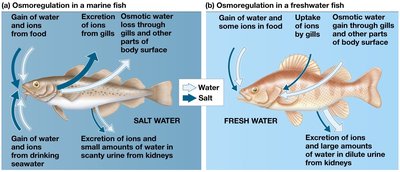
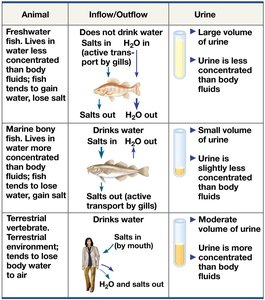
Marine Animals: Marine bony fishes are hypoosmotic to seawater and lose water by osmosis. They drink seawater and excrete excess salts through gills and kidneys. Sharks retain urea but are protected from its toxicity by TMAO.
Freshwater Animals: Constantly gain water by osmosis and lose salts. They excrete large amounts of dilute urine and actively uptake salts through gills and food. Euryhaline fishes adjust their osmoregulatory mechanisms when moving between fresh and saltwater.
Terrestrial Animals: Face dehydration risk. Adaptations include waterproof body coverings, nocturnal behavior, and metabolic water production.
Energetics of Osmoregulation
Osmoregulation requires energy, with the cost depending on the difference between internal and external osmolarity, permeability of body surfaces, and the work required to transport solutes.
Transport Epithelia
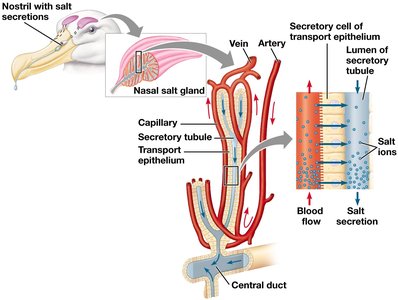
Specialized epithelial cells move solutes in specific directions, forming complex tubular networks. An example is the nasal salt glands in marine birds, which excrete excess salt.
Nitrogenous Wastes
Types of Nitrogenous Waste
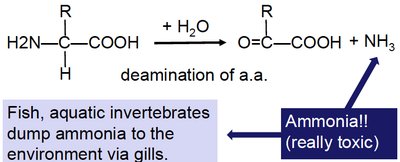
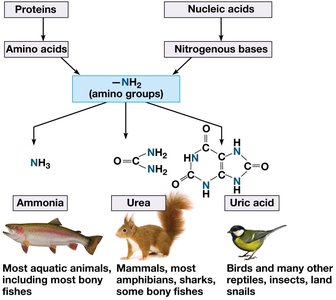
Animals excrete nitrogenous wastes resulting from protein and nucleic acid metabolism. The main forms are:
Ammonia (NH3): Highly toxic, requires large amounts of water for excretion. Common in aquatic animals.
Urea: Less toxic, requires less water, but energetically expensive to produce. Common in mammals, amphibians, and some marine species.
Uric Acid: Least toxic, excreted as a paste with minimal water loss. Common in birds, reptiles, insects, and land snails.
Excretory System Function
Key Steps in Excretory Systems
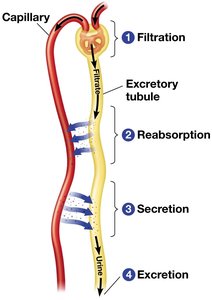
Most excretory systems produce urine by refining a filtrate derived from body fluids. The main steps are:
Filtration: Filtering of body fluids through a selectively permeable membrane.
Reabsorption: Reclaiming valuable solutes and water from the filtrate.
Secretion: Adding nonessential solutes and wastes to the filtrate.
Excretion: Expelling the processed filtrate (urine) from the body.
Survey of Excretory Systems
Protonephridia
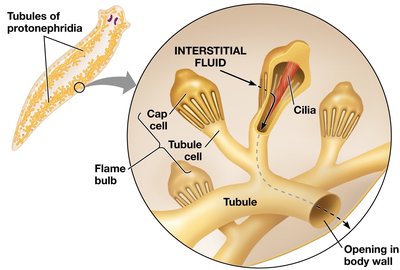
Found in flatworms (planarians), protonephridia are networks of dead-end tubules capped by flame bulbs. They function in osmoregulation and excrete dilute fluid.
Metanephridia
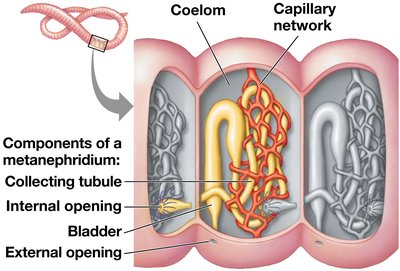
Found in annelids (earthworms), each segment contains a pair of open-ended metanephridia that collect coelomic fluid and produce dilute urine for excretion and osmoregulation.
Malpighian Tubules
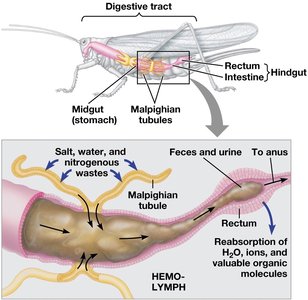
In insects and terrestrial arthropods, Malpighian tubules remove nitrogenous wastes from hemolymph and function in osmoregulation. They are highly effective at conserving water.
Kidneys
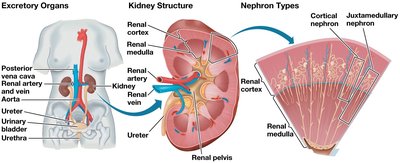
Vertebrate kidneys are highly organized excretory organs that function in both excretion and osmoregulation. They contain numerous tubules (nephrons) and associated ducts for urine transport.
Nephron Structure and Function
Types of Nephrons
Cortical nephrons: Short Loop of Henle, limited concentrating ability.
Juxtamedullary nephrons: Long Loop of Henle, significant concentrating ability, crucial for water conservation in terrestrial animals.
Desert animals have more juxtamedullary nephrons, while aquatic animals have more cortical nephrons.
Nephron Organization
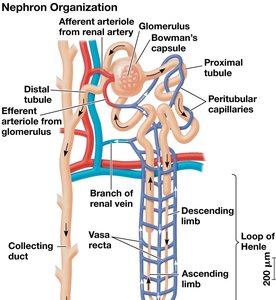
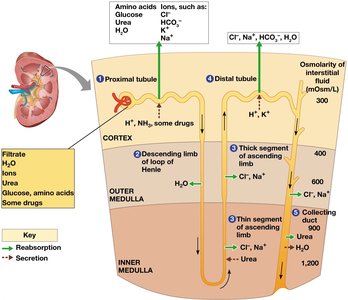
Each nephron is organized for stepwise processing of blood filtrate:
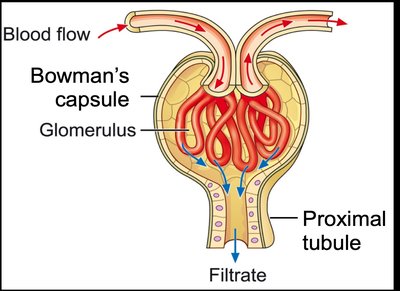
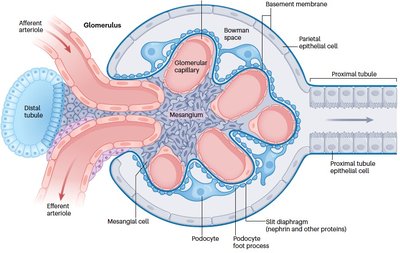
Bowman's capsule: Produces filtrate containing salts, glucose, amino acids, vitamins, nitrogenous wastes, and other small molecules.
Proximal tubule: Reabsorbs ions, water, and nutrients.
Loop of Henle: Descending limb reabsorbs water; ascending limb reabsorbs salts, making filtrate more dilute.
Distal tubule: Regulates K+ and NaCl concentrations; contributes to pH regulation.
Collecting duct: Reabsorbs solutes and water; produces hyperosmotic urine.
Solute Gradients and Water Conservation
The kidney's ability to produce hyperosmotic urine is essential for water conservation in terrestrial animals. This process requires energy to transport solutes against concentration gradients, primarily involving NaCl and urea.
Hormonal Regulation of Kidney Function
Antidiuretic Hormone (ADH)
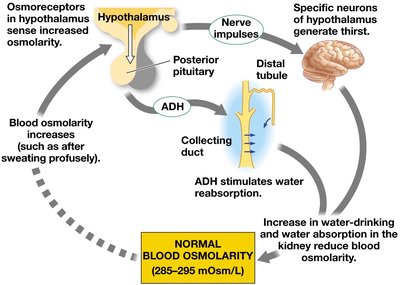
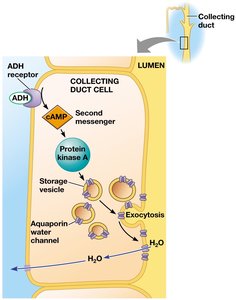
ADH (vasopressin) is released from the posterior pituitary in response to increased blood osmolarity. It increases the permeability of the collecting duct to water by promoting the insertion of aquaporin channels, reducing urine volume and lowering blood osmolarity.
Renin-Angiotensin-Aldosterone System (RAAS)
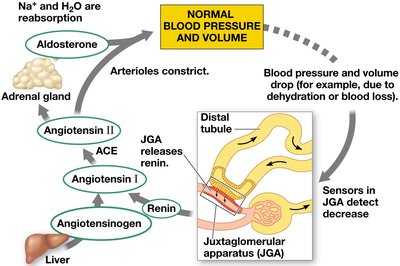
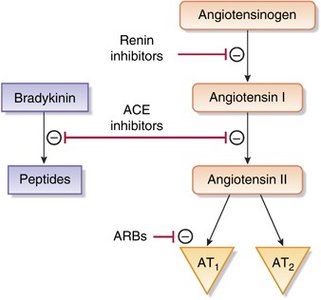
The RAAS is a hormonal circuit that responds to decreased blood pressure or volume. The juxtaglomerular apparatus (JGA) releases renin, which leads to the formation of angiotensin II, causing vasoconstriction and stimulating aldosterone release. Aldosterone increases Na+ and water reabsorption, raising blood pressure and volume.
Disorders of the Excretory System
Hypertension
Elevated blood pressure can damage small blood vessels and organs. It may be primary (essential) or secondary to other conditions. Treatments include diuretics, beta-blockers, calcium channel blockers, and RAAS inhibitors.
Diabetic Nephropathy
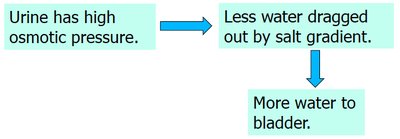
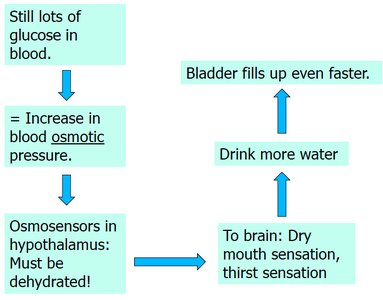
High blood glucose damages nephrons, leading to increased urination and dehydration. Excess glucose in the filtrate saturates transporters, preventing reabsorption and causing osmotic diuresis.
Summary Table: Osmoregulation and Excretion in Different Animals
Animal | Inflow/Outflow | Urine |
|---|---|---|
Freshwater fish | Does not drink water; salts in, H2O in (active transport by gills); salts out | Large volume of urine, less concentrated than body fluids |
Marine bony fish | Drinks water; salts in, H2O out; salts out (active transport by gills) | Small volume of urine, slightly less concentrated than body fluids |
Terrestrial vertebrate | Drinks water; salts in (by mouth); H2O and salts out | Moderate volume of urine, more concentrated than body fluids |
Conclusion
The excretory system is vital for maintaining internal balance in animals, allowing them to survive in diverse environments. Understanding the mechanisms of osmoregulation, nitrogenous waste management, and hormonal control is essential for comprehending animal physiology and addressing related health disorders.
