 Back
Feedback Control and Homeostasis in Animals
Study Guide - Smart Notes
 Tailored notes based on your materials, expanded with key definitions, examples, and context.
Feedback Control and Homeostasis in Animals
Regulating and Conforming
Animals use different strategies to manage their internal environment in response to external fluctuations. These strategies are classified as regulation and conformity, particularly with respect to variables such as temperature and solute concentration.
Regulator: An animal that uses internal mechanisms to control internal change despite external environmental variation. For example, the river otter maintains a stable body temperature regardless of water temperature.
Conformer: An animal whose internal condition changes in accordance with external changes in a particular variable. The largemouth bass, for instance, allows its body temperature to fluctuate with the surrounding water temperature.
Partial Regulation: Some animals regulate certain variables while conforming in others. For example, a bass regulates blood solute concentration but conforms to water temperature.
Marine Invertebrates: Many, such as spider crabs (Libinia), conform to the stable salinity of their ocean environment.
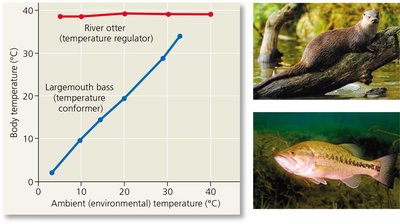
Example: The river otter (regulator) maintains a constant body temperature, while the largemouth bass (conformer) shows a direct relationship between body and environmental temperature.
Homeostasis
Homeostasis is the maintenance of a stable internal environment despite external changes. This steady state is crucial for proper physiological function.
Examples in humans include maintaining body temperature (36–38°C), blood pH (around 7.4), and blood glucose concentration (70–110 mg/100 mL).
Homeostasis involves dynamic equilibrium, where internal mechanisms counteract external changes.
Mechanisms of Homeostasis
Homeostasis is achieved through control systems that operate via feedback mechanisms. A common nonliving example is the regulation of room temperature using a thermostat.
Set Point: The desired value for a variable (e.g., 20°C for room temperature).
Sensor: Detects changes in the variable (e.g., thermometer in thermostat).
Control Center: Receives information from the sensor and initiates a response.
Response: A physiological activity that returns the variable to the set point (e.g., heater or air conditioner turns on).
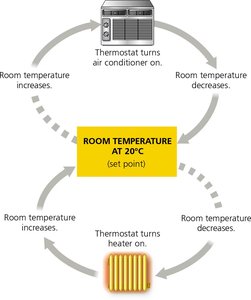
Example: If room temperature drops below the set point, the thermostat (sensor/control center) activates the heater (response) to restore the temperature.
Feedback Control in Homeostasis
Feedback mechanisms are central to homeostatic regulation:
Negative Feedback: Reduces or "damps" the stimulus that triggers it, maintaining variables within a set range. For example, sweating in response to increased body temperature cools the body and returns temperature to the set point.
Dynamic Equilibrium: Homeostasis moderates, but does not eliminate, internal changes. Adaptations such as insulation or physiological buffers enhance stability.
Positive Feedback: Amplifies the stimulus and drives processes to completion, such as uterine contractions during childbirth. Positive feedback is less common in homeostasis.
Alterations in Homeostasis
Set points for homeostasis can change due to life stage, cyclic processes, or environmental changes.
Regulated Changes: Occur during life stages (e.g., puberty) or cycles (e.g., menstrual cycle).
Circadian Rhythm: Physiological changes that follow a roughly 24-hour cycle, maintained by an intrinsic biological clock. For example, body temperature and melatonin secretion vary predictably over the day.
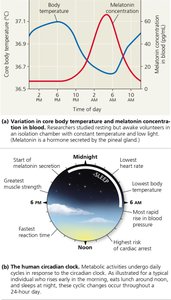
Example: Melatonin secretion peaks at night, and body temperature is lowest during sleep, reflecting circadian regulation.
Acclimatization: Physiological adjustment to a new environment, such as increased breathing and altered kidney function at high altitude to maintain blood pH.

Example: Mountain climbers acclimatize by camping at intermediate altitudes, allowing their bodies to adjust to lower oxygen levels.
Summary Table: Regulators vs. Conformers
Strategy | Definition | Example |
|---|---|---|
Regulator | Uses internal mechanisms to maintain a stable internal environment | River otter (body temperature) |
Conformer | Internal condition changes with external environment | Largemouth bass (body temperature) |
Key Terms
Homeostasis: Maintenance of a stable internal environment.
Negative Feedback: Mechanism that reduces the stimulus.
Positive Feedback: Mechanism that amplifies the stimulus.
Circadian Rhythm: Daily physiological cycle.
Acclimatization: Physiological adjustment to environmental change.
Additional info:
Negative feedback in homeostasis is analogous to feedback inhibition in enzyme-catalyzed pathways, where the end product inhibits the pathway to maintain balance.
Biological clocks are intrinsic but can be reset by environmental cues such as light.
