 Back
BackFeedback Loops and Albedo in Climate Regulation
Study Guide - Smart Notes
 Tailored notes based on your materials, expanded with key definitions, examples, and context.
Feedback Loops in Biological and Climate Systems
Positive Feedback
Positive feedback occurs when the effects of a process reinforce the original stimulus, amplifying the response. In biological and climate systems, positive feedback can lead to rapid changes and instability.
Definition: A process where the outcome enhances or increases the initial stimulus.
Example: Ice-albedo feedback in climate change.
Mechanism:
Climate warming increases energy absorption.
Ice melts, exposing surfaces with lower albedo.
Lower albedo surfaces absorb more energy, further warming the climate.
This cycle continues, reinforcing the warming effect.
Key Point: Positive feedback loops can accelerate environmental changes, such as polar ice melt.
Negative Feedback
Negative feedback occurs when the effects of a process counteract the original stimulus, stabilizing the system. This is essential for maintaining homeostasis in biological systems and climate regulation.
Definition: A process where the outcome reduces or opposes the initial stimulus.
Example: Cloud-albedo feedback in climate change.
Mechanism:
Climate warming increases evaporation.
More evaporation leads to denser low cloud coverage.
Low clouds have high albedo, reflecting more energy.
Reflected energy cools the surface, counteracting warming.
Key Point: Negative feedback loops help stabilize climate and biological systems.
Albedo and Climate Regulation
Albedo: Definition and Importance
Albedo is the fraction of solar energy reflected by a surface. It is a critical factor in climate regulation, as surfaces with high albedo reflect more energy and remain cooler, while surfaces with low albedo absorb more energy and warm up.
Definition: Albedo (α) ranges from 0 (no reflection) to 1 (total reflection).
Examples:
Snow: α = 0.4–0.9
Desert Sand: α = 0.4
Grasslands: α = 0.25
Forest: α = 0.1–0.2
Ocean: α = 0.1
Application: Surfaces with higher albedo (e.g., snow) reflect more sunlight, keeping the environment cooler.
Albedo and Surface Types
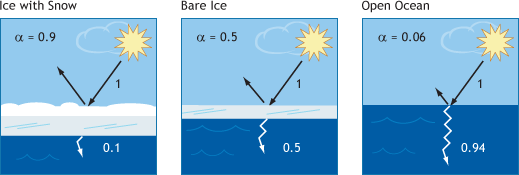
The albedo of different surfaces affects how much solar energy is absorbed or reflected, influencing local and global climate.
Surface | Albedo (α) | Energy Absorbed |
|---|---|---|
Snow | 0.9 | 0.1 |
Bare Ice | 0.5 | 0.5 |
Open Ocean | 0.06 | 0.94 |
Feedback Loops in Climate Change
Positive Feedback Loop: Ice-Albedo Feedback
This loop explains how melting ice leads to further warming due to changes in surface albedo.
Step 1: Climate warming increases energy absorption.
Step 2: Ice melts, exposing surfaces with lower albedo.
Step 3: Lower albedo surfaces absorb more energy.
Step 4: Increased absorption leads to further warming.
Negative Feedback Loop: Cloud-Albedo Feedback
This loop describes how increased evaporation and cloud formation can counteract climate warming.
Step 1: Climate warming increases evaporation.
Step 2: More evaporation leads to denser low cloud coverage.
Step 3: Low clouds have high albedo, reflecting more energy.
Step 4: Reflected energy cools the surface, counteracting warming.
Global and Regional Climate Coupling
Interactions Between Terrestrial and Marine Systems
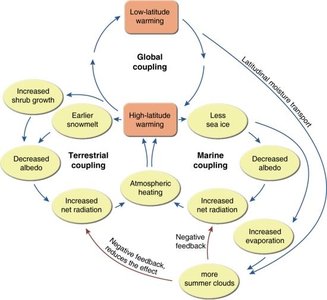
Climate feedback loops involve both terrestrial and marine systems, with high-latitude warming affecting global climate through changes in albedo, net radiation, and cloud formation.
Terrestrial Coupling: Increased shrub growth and earlier snowmelt decrease albedo, increasing net radiation and atmospheric heating.
Marine Coupling: Less sea ice decreases albedo, increasing net radiation and evaporation, leading to more summer clouds (negative feedback).
Global Coupling: Low-latitude warming influences high-latitude warming through moisture transport and atmospheric heating.
Equations and Scientific Principles
Albedo Calculation
The albedo of a surface is calculated as:
Feedback Loop Representation
Feedback loops can be represented mathematically as:
Where the feedback factor is greater than 1 for positive feedback and less than 1 for negative feedback.
Summary Table: Feedback Loops
Type | Mechanism | Effect |
|---|---|---|
Positive Feedback | Reinforces stimulus | Accelerates change |
Negative Feedback | Counteracts stimulus | Stabilizes system |
Conclusion
Understanding feedback loops and albedo is essential for predicting and managing climate change. Positive feedback can accelerate warming, while negative feedback can help stabilize the climate. The interplay between surface types, energy absorption, and reflection is a key factor in global climate regulation.
