 Back
Female Reproductive System, Obstetrics, and Neonatology: Structured Study Notes
Study Guide - Smart Notes
 Tailored notes based on your materials, expanded with key definitions, examples, and context.
Female Reproductive System
Overview and Main Functions
The female reproductive system is responsible for producing female sex cells (oocytes), supporting fertilization and development of the embryo and fetus, and providing nourishment to the infant. It also produces hormones essential for reproductive health and secondary sexual characteristics.
Oogenesis: Production of oocytes (egg cells).
Fertilization Site: Provides a pathway for sperm to reach the oocyte and supports fertilization.
Gestation: Nurtures the developing embryo and fetus within the uterus.
Lactation: Nourishes the infant post-birth via breast milk.
Anatomy of the Female Reproductive System
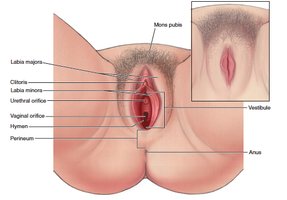
External Genitalia (Vulva): Includes the mons pubis, labia majora, labia minora, clitoris, vestibule, and openings of the urethra and vagina. These structures protect internal organs and facilitate sexual intercourse.
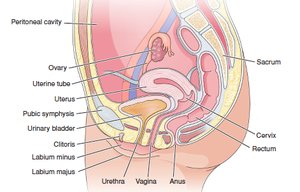
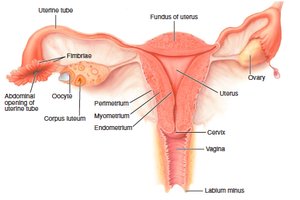
Internal Genitalia: Consists of the vagina, cervix, uterus, uterine tubes (fallopian tubes), and ovaries. These organs are involved in the transport of gametes, fertilization, and gestation.
Breasts: Functionally part of the reproductive system due to their role in lactation.
Key Structures and Their Functions
Ovary: Produces oocytes and female sex hormones (estrogen and progesterone).
Uterine Tube (Fallopian Tube): Site of fertilization; transports oocyte from ovary to uterus.
Uterus: Muscular organ where implantation and fetal development occur.
Cervix: Lower part of the uterus opening into the vagina; produces mucus and dilates during childbirth.
Vagina: Muscular canal for intercourse, childbirth, and menstrual flow.
Labia Majora/Minora: Protect the vaginal and urethral openings.
Clitoris: Erectile tissue involved in sexual arousal.
Breast Anatomy and Terminology
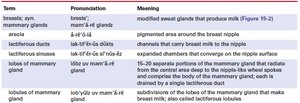
The breasts contain mammary glands responsible for milk production. Key terms include:
Term | Meaning |
|---|---|
Breasts, mammary glands | Modified sweat glands that produce milk |
Areola | Pigmented area around the nipple |
Lactiferous ducts | Channels that carry breast milk to the nipple |
Lobes/lobules of mammary gland | Subdivisions of the mammary gland that make breast milk |
Key Terms and Definitions
General Reproductive Terms
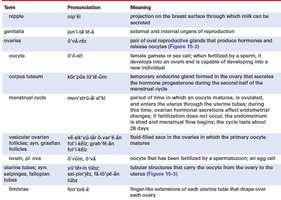
Term | Meaning |
|---|---|
Genitalia | External and internal organs of reproduction |
Ovary | Gonad producing oocytes and hormones |
Oocyte | Female gamete (egg cell) |
Corpus luteum | Temporary endocrine gland formed after ovulation |
Menstrual cycle | Monthly cycle preparing the uterus for pregnancy |
Uterine and Associated Structures
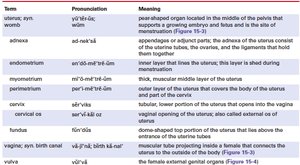
Term | Meaning |
|---|---|
Uterus | Pear-shaped organ supporting embryo/fetus |
Endometrium | Inner lining of the uterus |
Myometrium | Muscular middle layer of the uterus |
Perimetrium | Outer serous layer of the uterus |
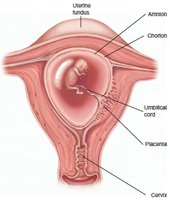
Cervix | Lower portion of the uterus opening into the vagina |
Fundus | Dome-shaped top portion of the uterus |
External Genitalia (Vulva) Terms
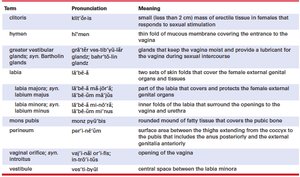
Term | Meaning |
|---|---|
Clitoris | Erectile tissue involved in sexual arousal |
Hymen | Thin fold of mucous membrane covering vaginal entrance |
Labia majora | Outer folds of skin covering the genitalia |
Labia minora | Inner folds surrounding the vaginal opening |
Perineum | Area between the thighs, from pubic bone to coccyx |
Vestibule | Central space between the labia minora |
Obstetrics and Neonatology
Key Terms in Obstetrics and Neonatology
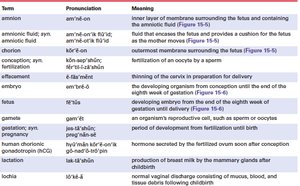
Term | Meaning |
|---|---|
Amnion | Inner membrane surrounding the fetus |
Chorion | Outermost fetal membrane |
Embryo | Developing organism from fertilization to the end of the eighth week |
Fetus | Developing organism from the end of the eighth week to birth |
Gamete | Reproductive cell (sperm or oocyte) |
Placenta | Organ for nutrient and waste exchange between mother and fetus |
Umbilical cord | Connects fetus to placenta |
Stages of Embryonic and Fetal Development
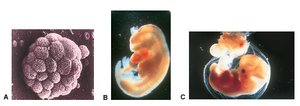
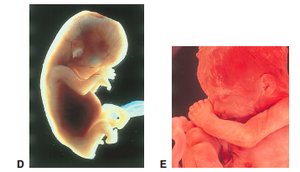
Human development progresses from fertilization (zygote) through embryonic and fetal stages. Key events include implantation, organogenesis, and growth.
Implantation: Occurs about 7-8 days after conception.
Embryonic Stage: Weeks 2-8; major organs begin to form.
Fetal Stage: Begins at week 9 and continues until birth; growth and maturation of tissues and organs.
Medical Terminology: Word Parts
Combining Forms
Combining Form | Meaning |
|---|---|
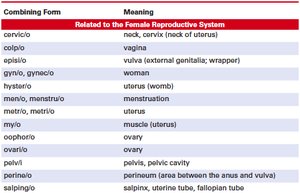
cervic/o | Neck, cervix |
colp/o | Vagina |
hyster/o | Uterus |
oophor/o | Ovary |
salping/o | Uterine tube, fallopian tube |
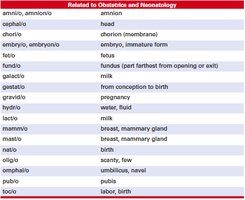
Combining Form | Meaning |
|---|---|
amnio/o | Amnion |
fet/o | Fetus |
gravid/o | Pregnancy |
lact/o | Milk |
nat/o | Birth |
Prefixes and Suffixes
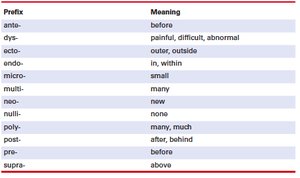
Prefix | Meaning |
|---|---|
ante- | Before |
dys- | Painful, difficult, abnormal |
endo- | In, within |
poly- | Many, much |
post- | After, behind |
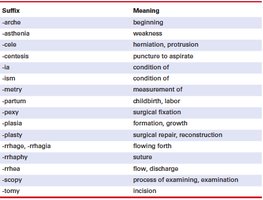
Suffix | Meaning |
|---|---|
-arche | Beginning |
-centesis | Puncture to aspirate |
-ectomy | Excision, removal |
-plasty | Surgical repair, reconstruction |
-scopy | Process of examining, examination |
Medical Conditions and Procedures
Common Conditions
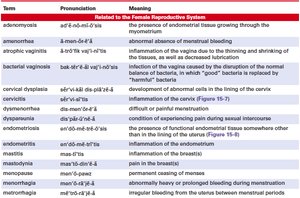
Term | Meaning |
|---|---|
Endometriosis | Presence of endometrial tissue outside the uterus |
Amenorrhea | Absence of menstrual bleeding |
Bacterial vaginosis | Infection of the vagina due to imbalance of bacteria |
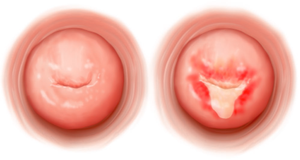
Cervicitis | Inflammation of the cervix |
Dysmenorrhea | Painful menstruation |
Summary
The female reproductive system is essential for producing oocytes, supporting pregnancy, and nourishing infants.
Obstetrics focuses on pregnancy and childbirth, while neonatology deals with newborn care.
Understanding medical terminology, including word parts, conditions, and procedures, is crucial for studying reproductive health.
