 Back
Fish Diversity and Early Vertebrate Evolution
Study Guide - Smart Notes
 Tailored notes based on your materials, expanded with key definitions, examples, and context.
Fish Diversity and Early Vertebrate Evolution
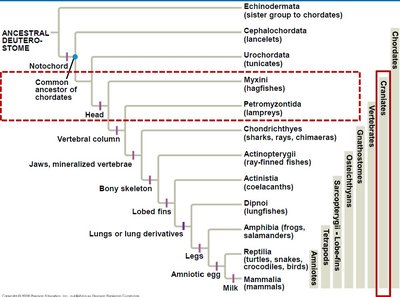
Introduction to Chordates and Early Vertebrates
The phylum Chordata includes animals with a notochord, dorsal nerve cord, pharyngeal slits, and post-anal tail at some stage in their development. The evolution of vertebrates from early chordates marks a significant transition in animal diversity, leading to the emergence of fish and eventually all other vertebrate groups.
Chordates are defined by four key characteristics: notochord, dorsal hollow nerve cord, pharyngeal slits, and post-anal tail.
Craniates are chordates with a head, including a braincase (cranium) made of cartilage or bone.
The earliest vertebrates were aquatic and lacked jaws, but had a notochord and rudimentary vertebral elements.
Early Chordates: Lancelets and Tunicates
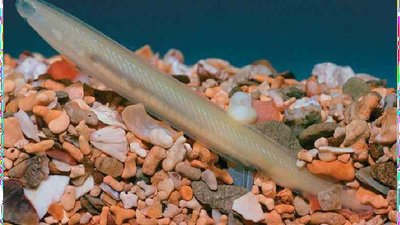
Lancelets (Cephalochordata) and tunicates (Urochordata) are the most basal chordates, retaining the notochord throughout life or during the larval stage, respectively. They provide insight into the ancestral features of vertebrates.
Lancelets are small, fish-like marine animals that filter feed using pharyngeal slits.
Tunicates are sessile as adults but have a free-swimming larval stage with chordate features.
Fossil Evidence of Early Chordates
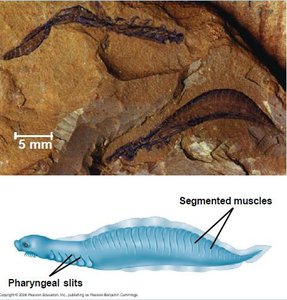
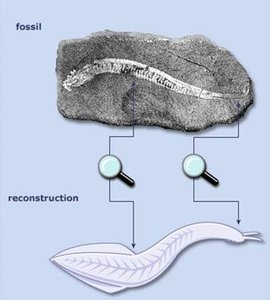
Fossils such as Pikaia and Haikouella provide evidence for the early evolution of chordate features, including the notochord and segmented muscles.
Pikaia (Burgess Shale, ~508 mya): Flattened body, notochord, dorsal nerve cord, segmented muscles.
Haikouella (~521 mya): Suspension feeder with a well-formed brain and muscle segments, but lacking a skull.
Origin of Craniates and Vertebrates
Craniates are chordates with a distinct head, including a brain encased in a cranium. The evolution of the vertebral column was a key innovation, providing support and protection for the nerve cord.
Craniates include hagfish and lampreys, which possess a cranium but lack jaws.
The vertebral column evolved from the notochord, eventually forming the backbone in more derived vertebrates.
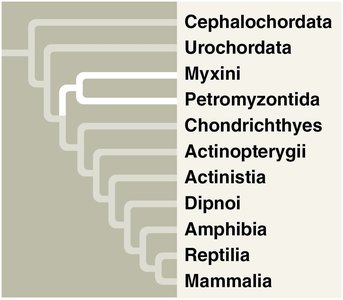
Jawless Fishes: Hagfish (Myxini) and Lampreys (Petromyzontida)
Hagfish and lampreys are the only extant groups of jawless vertebrates (agnathans). They provide important insights into the early evolution of vertebrate features.
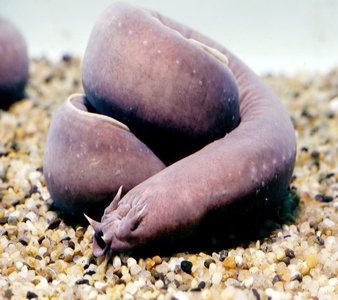
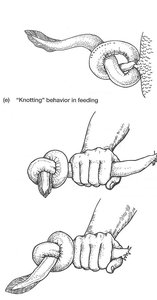
Hagfish (Class Myxini)
Marine, deep-sea scavengers.
Lack jaws but have tooth-like keratin structures.
Produce copious slime as a defense mechanism.
Retain a notochord as the main axial support; lack true vertebrae but have rudimentary cartilage elements.
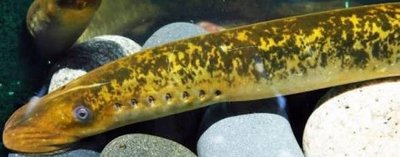
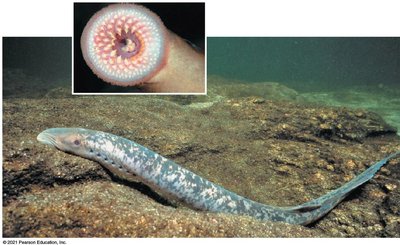
Lampreys (Class Petromyzontida)
Found in marine and freshwater environments.
Larvae are suspension feeders; adults may be parasitic or free-living.
Possess a notochord and rudimentary vertebrae.
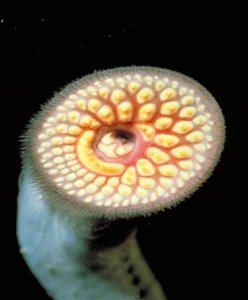
Parasitic species attach to fish with a round, suction-cup mouth and feed on blood and tissue.
Evolution of the Vertebral Column
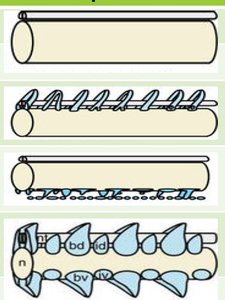
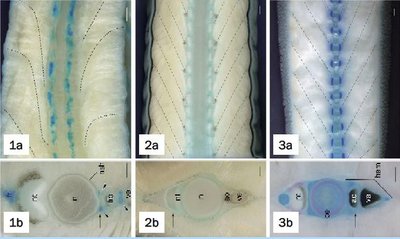
The vertebral column evolved from the notochord, with increasing complexity and mineralization in different vertebrate groups. This provided greater support, protection, and muscle attachment points.
Group | State of Endoskeleton |
|---|---|
Lancelet | Flexible notochord |
Tunicate | Flexible notochord |
Lamprey | Cartilaginous vertebrae-like structures (no collagen) |
Hagfish | Cartilaginous vertebrae-like structures (with collagen) |
Cartilaginous fish | Mineralized cartilaginous vertebrae |
Bony fish | Mineralized bony vertebrae |
Evolution of Jaws: Gnathostomes
The evolution of jaws from modified gill arches (~450 mya) allowed vertebrates to exploit new feeding strategies and habitats. Jawed vertebrates (gnathostomes) include the majority of modern fish and all tetrapods.
Jaws enabled biting, chewing, and predation on larger prey.
Gnathostomes outnumber jawless vertebrates and display greater diversity.
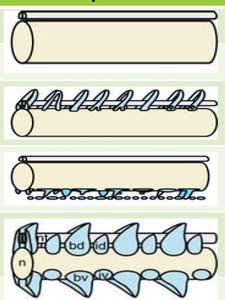
Major Groups of Fish
Fish are divided into two major groups: cartilaginous fish (Chondrichthyes) and bony fish (Osteichthyes). Each group exhibits unique adaptations for aquatic life.
Chondrichthyes: Cartilaginous skeleton, includes sharks, skates, and rays.
Osteichthyes: Bony skeleton, includes ray-finned (Actinopterygii) and lobe-finned (Sarcopterygii) fish.
Summary Table: Major Vertebrate Groups
Group | Key Features |
|---|---|
Cephalochordata | Lancelets; retain all chordate features as adults |
Urochordata | Tunicates; chordate features in larvae |
Myxini | Hagfish; jawless, slime-producing, no true vertebrae |
Petromyzontida | Lampreys; jawless, parasitic or free-living, rudimentary vertebrae |
Chondrichthyes | Sharks, rays; cartilaginous skeleton, jaws |
Actinopterygii | Ray-finned fish; bony skeleton, diverse |
Actinistia | Coelacanths; lobe-finned fish |
Dipnoi | Lungfish; lobe-finned, lungs and gills |
Amphibia | Frogs, salamanders; first tetrapods |
Reptilia | Turtles, snakes, crocodiles, birds; amniotic egg |
Mammalia | Mammals; milk production |
Conclusion
The conquest of aquatic environments by early vertebrates set the stage for the vast diversity of fish and the eventual invasion of land by tetrapods. Key evolutionary innovations such as the notochord, vertebral column, jaws, and paired appendages underlie the success of vertebrates in a wide range of habitats.
