 Back
BackFlower Structure and Identification Using Dichotomous Keys
Study Guide - Smart Notes
 Tailored notes based on your materials, expanded with key definitions, examples, and context.
Flower Structure and Identification
Introduction to Flowering Plants (Angiosperms)
Flowering plants, or angiosperms, are the most diverse group of plants on Earth, with approximately 300,000 species. Their evolutionary success is largely attributed to the development of flowers, which facilitate sexual reproduction and genetic diversity through pollination. Most angiosperms rely on animals for pollination, leading to coevolution between plants and their pollinators.
Pollination: The transfer of pollen from the male anther to the female stigma, often mediated by insects, birds, bats, and other animals.
Coevolution: Flowers and pollinators often evolve together, resulting in specialized adaptations that enhance reproductive success for both organisms.
Outcrossing: Pollination between unrelated individuals increases genetic diversity and population fitness.
Structures of a Flower
Basic Anatomy of a Flower
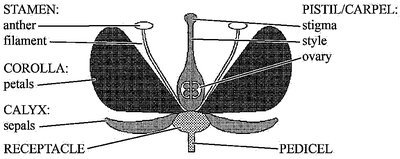
Understanding flower anatomy is essential for plant identification and for grasping the mechanisms of plant reproduction. The main parts of a flower include:
Stamen (Male Structure): Consists of the anther (produces pollen) and filament (supports the anther).
Pistil/Carpel (Female Structure): Composed of the stigma (receives pollen), style (connects stigma to ovary), and ovary (contains ovules).
Corolla: The collective term for all petals, often colorful to attract pollinators.
Calyx: The collective term for all sepals, which protect the flower bud before it opens.
Receptacle: The part of the stem where floral organs are attached.
Pedicel: The stalk that supports the flower.
Key Botanical Terms
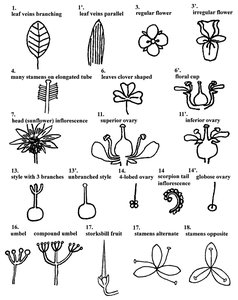
Inflorescence: A cluster or group of flowers arranged on a stem.
Ovary Position:
Superior Ovary: Ovary is above the attachment of petals and sepals.
Inferior Ovary: Ovary is below the attachment of petals and sepals, offering more protection.
Capsule: A dry fruit that releases seeds when mature.
Bracts: Small, leaf-like structures beneath a flower or inflorescence.
Umbel: A flower cluster with stalks of nearly equal length that spread from a common point, resembling an umbrella.
Using a Dichotomous Key for Flower Identification
Principles of Dichotomous Keys
A dichotomous key is a tool that allows the identification of organisms by making a series of choices between two contrasting statements. Each choice leads to another pair of statements until the correct identification is reached. In plant identification, dichotomous keys often focus on flower structure, leaf arrangement, and other morphological features.
Monocots vs. Dicots:
Monocots: Flower parts in multiples of three; parallel leaf veins.
Dicots: Flower parts in multiples of four or five; branching leaf veins.
Symmetry:
Regular (Radial) Symmetry: Flower can be divided into similar halves by multiple planes.
Irregular (Bilateral) Symmetry: Flower can be divided into similar halves by only one plane.
Inflorescence Types: Dense heads (e.g., Asteraceae), umbels (e.g., Apiaceae), and others.
Ovary Position: Superior or inferior, as described above.
Sample Families Identified by the Key
Fabaceae (Pea Family): Bilateral flowers, pea-shaped ovary, fruit is a pod.
Asteraceae (Sunflower Family): Dense head of tiny flowers (inflorescence).
Lamiaceae (Mint Family): Aromatic leaves, square stems, deeply 4-lobed ovary.
Poaceae (Grass Family): No petals or sepals, inflorescence usually green.
Orchidaceae (Orchid Family): Irregular flowers, one modified fertile stamen.
Worksheet Questions and Key Concepts
Review Questions
Radial flowers are regular (symmetrical in multiple planes).
Monocots have floral parts in multiples of three.
Dicots have floral parts in multiples of four or five.
Monocot leaf veins are parallel.
Dicot leaf veins are branching.
The male reproductive structure of the flower is the stamen.
The two parts of the stamen are the anther and filament.
The female reproductive structure is the pistil (or carpel).
The three parts of the pistil are the stigma, style, and ovary.
The shape of mint family stems is usually square in cross-section.
The tiny leaf-like structure covering the receptacle of a daisy-type flower is called a bract.
The family with no petals or sepals is Poaceae (grasses).
An ovary above the petals is superior.
Orchids are monocots.
A dense head of tiny flowers is called an inflorescence (specifically, a head).
Fertilized ovules become seeds.
The ovary may turn into a fruit after the flower is gone.
Summary Table: Monocots vs. Dicots
Feature | Monocots | Dicots |
|---|---|---|
Floral Parts | Multiples of 3 | Multiples of 4 or 5 |
Leaf Veins | Parallel | Branching |
Examples | Grasses, Lilies, Orchids | Roses, Sunflowers, Peas |
Conclusion
Understanding flower structure and using dichotomous keys are fundamental skills in botany. These tools allow for the accurate identification of plant families and provide insight into the evolutionary adaptations of flowering plants. Mastery of these concepts is essential for further study in plant biology, ecology, and evolution.
