 Back
BackFlowering Plant Reproduction and Development
Study Guide - Smart Notes
 Tailored notes based on your materials, expanded with key definitions, examples, and context.
Flowering Plant Reproduction and Development
Overview of Plant Reproduction
Flowering plants (angiosperms) can reproduce both sexually and asexually, each method offering distinct advantages and disadvantages. Understanding these processes is essential for grasping plant diversity, adaptation, and evolution.
Asexual reproduction: Involves structures like rhizomes; efficient for rapid colonization but produces genetically identical offspring.
Sexual reproduction: Involves the formation of gametes and fertilization; increases genetic diversity, which is crucial for adaptation.
Gymnosperms: Plants without flowers or fruit; rely on wind pollination.
Angiosperms: Plants with flowers and fruit; often rely on animal pollinators.
Structure of a Generic Flower
Flowers are the reproductive organs of angiosperms, containing both male and female structures.
Stamen: Male part, consists of anther (produces pollen) and filament.
Carpel (Pistil): Female part, consists of stigma (receives pollen), style, and ovary (contains ovules).
Formation of Male Gametophyte (Pollen)
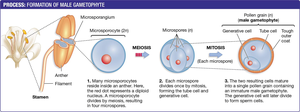
The male gametophyte develops within the anther through a series of meiotic and mitotic divisions, resulting in pollen grains that carry sperm cells.
Microsporangia in the anther produce microsporocytes (2n).
Microsporocytes undergo meiosis to form four microspores (n).
Each microspore divides mitotically to produce a generative cell and a tube cell.
The mature pollen grain (male gametophyte) contains these two cells, protected by a tough outer coat.
Formation of Female Gametophyte (Embryo Sac)
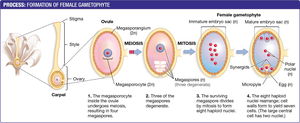
The female gametophyte develops within the ovule, involving meiosis and mitosis to produce the embryo sac, which contains the egg cell and other nuclei.
Megasporocyte (2n) in the ovule undergoes meiosis to produce four megaspores (n), three of which degenerate.
The surviving megaspore undergoes mitosis to form the embryo sac with eight nuclei (including the egg cell and polar nuclei).
Pollination and Coevolution
Pollination is the transfer of pollen from the anther to the stigma. Many angiosperms have coevolved with animal pollinators, leading to rapid speciation and specialized flower traits.
Pollen adaptation: Protects sperm, allows colonization of dry environments, and eliminates the need for water for fertilization.
Coevolution: Flowers and pollinators adapt to each other (e.g., scent for flies, size and color for bees).
Double Fertilization
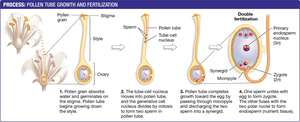
Double fertilization is a unique process in angiosperms where one sperm fertilizes the egg to form a zygote, and another sperm fuses with two polar nuclei to form the triploid endosperm, which nourishes the developing embryo.
Pollen grain lands on stigma and germinates.
Pollen tube grows down the style, carrying two sperm cells.
One sperm fertilizes the egg (forms zygote, 2n).
Other sperm fuses with two polar nuclei (forms endosperm, 3n).
Dispersal by Spores vs. Seeds
Both spores and seeds are reproductive structures adapted for dispersal, but they differ in complexity and survival strategies.
Feature | Spore | Seed |
|---|---|---|
Cellularity | Uni- or bicellular | Multicellular, complex |
Ploidy | Haploid | Multigenerational (contains embryo, nutritive tissue, seed coat) |
Survival | Durable, can survive harsh conditions | Durable, contains food reserves for embryo |
Dispersal | Wind, water, animals | Often animal-mediated, can escape competition and inbreeding |
Fruits and Seeds
Fruits develop from the ripened ovary after fertilization. They aid in seed dispersal and protect the developing seeds.
Ovules become seeds; ovary becomes fruit.
Fruits help seeds escape deteriorating environments, avoid competition, and reduce inbreeding.
Roles of Animals in Pollination vs. Dispersal
Animals play different roles in the plant life cycle: pollinators transfer pollen, while dispersers move seeds to new locations.
Pollination: Animals (insects, birds, bats) transfer pollen between flowers, facilitating fertilization.
Dispersal: Animals eat fruits and disperse seeds via feces or by carrying them on their bodies.
Seed Germination and Early Development
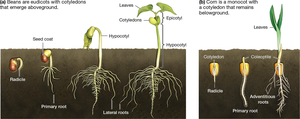
Germination is the process by which a seed resumes growth, leading to the emergence of the seedling. Key structures and steps are involved in this process.
Radicle: The embryonic root, emerges first to anchor the plant and absorb water.
Hypocotyl/hook: Protects the emerging shoot as it pushes through the soil.
Cotyledon/endosperm: Provides nutrients to the developing seedling.
Water uptake: Triggers oxygen consumption, protein synthesis, and production of new mRNA for growth.
Summary Table: Key Differences Between Gymnosperms and Angiosperms
Feature | Gymnosperms | Angiosperms |
|---|---|---|
Flowers | No | Yes |
Fruit | No | Yes |
Pollination | Wind | Often animal-mediated |
Additional info: The above notes integrate textbook-level explanations and context for each process, expanding on the brief points in the original material for clarity and completeness.
