 Back
Flowering Plant Reproduction and Development: Structure, Life Cycle, and Fruit Formation
Study Guide - Smart Notes
 Tailored notes based on your materials, expanded with key definitions, examples, and context.
Flower Structure and Function
Floral Anatomy
Flowering plants (angiosperms) possess complex reproductive structures called flowers, which are organized into distinct whorls. Each whorl contains specific organs that play roles in reproduction and protection.
Calyx: The outermost whorl, composed of sepals, protects the developing flower bud.
Corolla: The second whorl, made up of petals, attracts pollinators with color and scent.
Androecium: The third whorl, consisting of stamens (anther and filament), is the "male house" where pollen is produced.
Gynoecium: The innermost whorl, made up of carpels (stigma, style, ovary), is the "female house" where ovules are formed.
Perianth: Collective term for calyx and corolla.
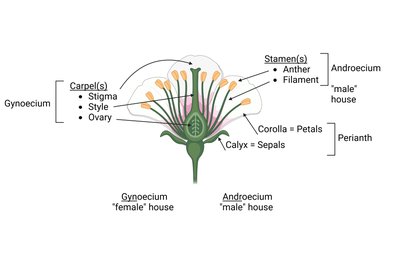
Perfect flowers contain both androecium and gynoecium, while imperfect flowers have only one type of reproductive organ. Monoecious plants bear both male and female flowers on the same individual, whereas dioecious plants have separate male and female individuals.
Angiosperm Life Cycle and Alternation of Generations
Overview of Life Cycle
Angiosperms exhibit alternation of generations, alternating between a diploid sporophyte and a haploid gametophyte stage. The visible plant is the sporophyte, while gametophytes are microscopic and develop within the flower.
Sporophyte (2n): Produces haploid spores by meiosis in sporangia (anther and ovule).
Gametophyte (n): Spores undergo mitosis to form multicellular gametophytes (male: pollen grain; female: embryo sac).
Pollination: Transfer of pollen to the stigma, leading to fertilization.
Fertilization: Fusion of gametes forms a diploid zygote.
Seed and Fruit Development: Zygote develops into an embryo, ovule becomes the seed, and ovary becomes the fruit.
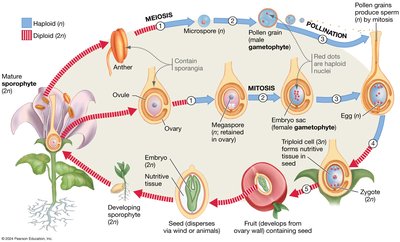
Key Terms: - Microspore: Haploid spore that develops into the male gametophyte (pollen grain). - Megaspore: Haploid spore that develops into the female gametophyte (embryo sac).
Double Fertilization in Angiosperms
Mechanism and Significance
Double fertilization is a unique process in angiosperms where two sperm cells from the pollen grain participate in two separate fertilization events:
Sperm + Egg: Forms the diploid zygote (2n), which develops into the embryo.
Sperm + Central Cell (with two polar nuclei): Forms the triploid endosperm (3n), a nutrient-rich tissue that nourishes the developing embryo.
This process ensures that the next generation is provided with a built-in food supply, solving two evolutionary challenges simultaneously.
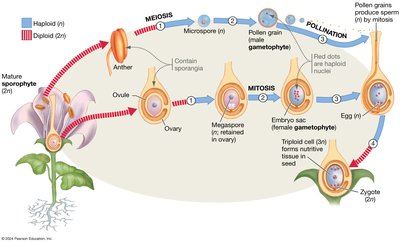
Equation:
Development of Seeds and Fruits
Seed and Fruit Formation
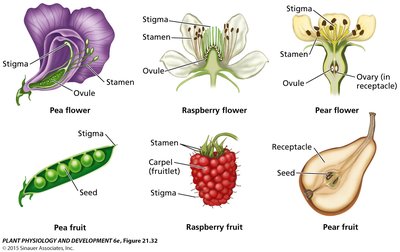
After fertilization, the ovule transforms into a seed, and the ovary wall develops into a fruit (pericarp) that surrounds the seeds. Fruits play a crucial role in protecting seeds and aiding in their dispersal.
Seed: Contains the embryo and endosperm, surrounded by a tough seed coat.
Fruit: Develops from the ovary wall, often modified to facilitate dispersal by animals, wind, or water.
Pericarp: The part of the fruit derived from the ovary wall.

Types of Fruits:
Simple Fruits: Develop from a single ovary (e.g., tomato).
Aggregate Fruits: Develop from a single flower with multiple ovaries (e.g., strawberry).
Multiple Fruits: Develop from many flowers fused together (e.g., pineapple).
Strawberry Fruit Structure
Aggregate Fruit Example
Strawberries are aggregate fruits, meaning they develop from a single flower with many carpels. The fleshy part of the strawberry is the enlarged receptacle, while each carpel forms a small fruit (achene) containing a seed.
Sepals: 5
Petals: 5
Stamens: 20-35
Carpels: Variable, often >350
Receptacle: Supports the achenes (seeds)
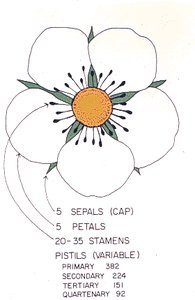
Example: The fleshy part of the strawberry is the receptacle, and the seeds are achenes supported by it.
Seed Dispersal and Germination
Mechanisms and Importance
Plants have evolved various mechanisms to disperse their seeds away from the parent plant, increasing the chances of successful germination and growth. Seed dispersal can occur via wind, water, animals, or mechanical means.
Wind dispersal: Seeds are lightweight or have structures like wings.
Animal dispersal: Fruits are fleshy and attractive, or seeds attach to animal fur.
Water dispersal: Seeds float and are carried by water.
Germination sequence varies among species, and the endosperm supports the developing embryo during this process.
Variability in Floral Form and Evolutionary Adaptations
Adaptive Significance
Floral structure varies in size, color, and inflorescence arrangement, shaped by natural selection to optimize pollination and seed dispersal. Flowers may be adapted for abiotic pollination (wind, rain) or biotic pollination (insects, birds, animals), with corresponding structural modifications.
Abiotic pollination: Flowers are small, lack nectar, and produce lightweight pollen.
Biotic pollination: Flowers are showy, pigmented, and offer rewards to pollinators.
Protection: Sepals, bracts, and thick tissues protect ovules and seeds from predators.
Big Picture: Form and function in flowering plants are products of evolutionary processes, ensuring reproductive success and survival.
Summary Table: Types of Fruits and Their Origins
Fruit Type | Origin | Example |
|---|---|---|
Simple Fruit | Single ovary from one flower | Tomato, pea |
Aggregate Fruit | Multiple ovaries from one flower | Strawberry, raspberry |
Multiple Fruit | Ovaries from multiple flowers fused | Pineapple |
Additional info: Academic context was added to clarify alternation of generations, double fertilization, and fruit types, as well as to provide definitions and examples for key terms.
