 Back
BackFood Processing in Animals: Ingestion, Digestion, Absorption, and Elimination
Study Guide - Smart Notes
 Tailored notes based on your materials, expanded with key definitions, examples, and context.
Food Processing in Animals
Overview of Food Processing
Animals must process food to obtain nutrients essential for survival. Food processing in animals is divided into four main stages: ingestion, digestion, absorption, and elimination. Each stage is specialized to maximize nutrient extraction and minimize waste.
Ingestion: The act of eating or feeding, which introduces food into the digestive system.
Digestion: The breakdown of food into molecules small enough for absorption, involving both mechanical and chemical processes.
Absorption: The uptake of small nutrient molecules by the animal's cells.
Elimination: The removal of undigested material from the digestive system.
Feeding Mechanisms in Animals
Types of Feeding Mechanisms
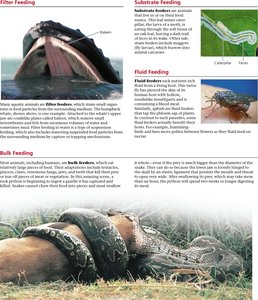
Animals have evolved diverse feeding mechanisms to exploit different food sources. The four main categories are:
Filter Feeding: Animals strain small food particles from water. Example: Baleen whales filter plankton from seawater.
Substrate Feeding: Animals live in or on their food source and eat their way through it. Example: Caterpillars eating leaves.
Fluid Feeding: Animals suck nutrient-rich fluid from a living host. Example: Mosquitoes feeding on blood.
Bulk Feeding: Animals eat relatively large pieces of food. Example: Pythons swallowing large prey whole.
Digestion: Mechanical and Chemical Breakdown
Mechanical vs. Chemical Digestion
Digestion involves two main processes:
Mechanical Digestion: Physical breakdown of food into smaller pieces, increasing surface area for enzymes. Example: Chewing in mammals.
Chemical Digestion: Enzymatic breakdown of macromolecules into absorbable units. Large molecules such as proteins, nucleic acids, fats, and carbohydrates are hydrolyzed into amino acids, nucleotides, fatty acids, and simple sugars, respectively.
Enzymatic hydrolysis is a key process, where digestive enzymes add water to break covalent bonds in macromolecules.
Example: Enzymatic Hydrolysis of Sucrose
The enzyme sucrase catalyzes the hydrolysis of sucrose into glucose and fructose:
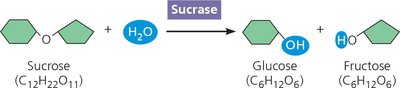
Proteins are similarly broken down into amino acids, and nucleic acids into nucleotides. Some animals rely on symbiotic bacteria for additional chemical digestion.
Digestive Compartments
Intracellular Digestion
In intracellular digestion, food is digested within food vacuoles inside cells. This process begins after phagocytosis or pinocytosis, where food vacuoles fuse with lysosomes containing hydrolytic enzymes. Digestion occurs safely within these compartments, preventing self-digestion. Sponges are an example of animals that rely entirely on intracellular digestion.
Extracellular Digestion
Most animals perform extracellular digestion, where food is broken down in compartments continuous with the outside of the body. This adaptation allows animals to consume larger food items.
Gastrovascular Cavity: A single-opening digestive pouch found in animals with simple body plans (e.g., hydras, flatworms). Functions in both digestion and nutrient distribution.
Alimentary Canal: A complete digestive tract with two openings (mouth and anus), allowing for unidirectional food movement and specialized compartments for sequential digestion and absorption. Found in animals with complex body plans.
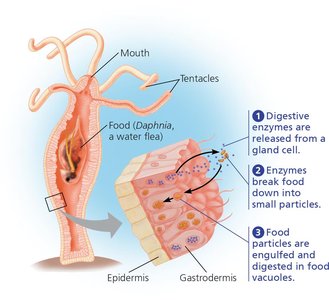
Example: Digestion in a Hydra
Hydras use their tentacles to capture prey and ingest it into the gastrovascular cavity. Digestive enzymes are secreted to break down food, and cells of the gastrodermis engulf the resulting particles for intracellular digestion. Undigested material is expelled through the mouth.
Variation in Alimentary Canals
Animals with alimentary canals exhibit a range of adaptations in their digestive systems, reflecting dietary diversity. Specialized compartments (e.g., crop, gizzard, stomach, intestine) allow for efficient processing of different food types.
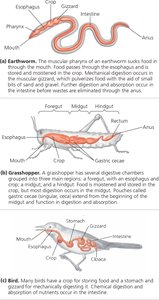
Comparison: Gastrovascular Cavity vs. Alimentary Canal
Feature | Gastrovascular Cavity | Alimentary Canal |
|---|---|---|
Number of Openings | One (mouth) | Two (mouth and anus) |
Direction of Food Movement | Bidirectional | Unidirectional |
Specialization | Limited | Highly specialized compartments |
Example Organisms | Hydra, flatworms | Earthworm, grasshopper, bird, mammals |
Key Questions for Review
Distinguish the overall structure of a gastrovascular cavity from that of an alimentary canal.
In what sense are nutrients from a recently ingested meal not really “inside” your body prior to the absorption stage of food processing?
What similarities can you identify between digestion in an animal body and the breakdown of gasoline in an automobile engine?
Additional info: Nutrients are not considered "inside" the body until they cross the epithelial lining of the digestive tract and enter the internal environment (e.g., bloodstream or cells).
