 Back
BackFossil Fuels: Formation, Extraction, Use, and Environmental Impact
Study Guide - Smart Notes
 Tailored notes based on your materials, expanded with key definitions, examples, and context.
Fossil Fuels: Overview
Definition and Importance
Fossil fuels are energy resources formed from the remains of ancient living organisms over millions of years. They include coal, oil, and natural gas. These fuels are considered non-renewable because their formation takes far longer than the timescale of human use. Since the Industrial Revolution, fossil fuels have been the dominant source of energy, accounting for over 80% of energy consumption in the United States.
Coal: Solid fossil fuel extracted from ground deposits.
Oil: Liquid fossil fuel extracted from underground reservoirs.
Natural Gas: Gaseous fossil fuel, primarily methane, found in underground deposits.
Global Consumption Trends
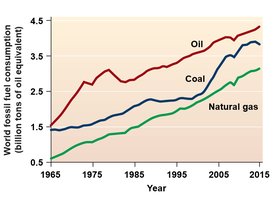
Fossil fuel consumption has increased steadily worldwide, with oil being the most consumed, followed by coal and natural gas. This trend reflects growing industrialization and energy demands.
Fossil Fuel Formation
Geological Processes
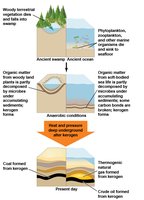
Fossil fuels form from organic material that accumulates in anaerobic environments (lacking oxygen), such as the bottoms of lakes, swamps, and oceans. Over millions of years, heat, pressure, and the absence of decomposers transform this material into coal, oil, or natural gas, depending on the specific conditions.
Coal: Formed mainly from woody plant remains in ancient swamps, compressed under high pressure.
Oil and Natural Gas: Derived from marine organisms (phytoplankton, zooplankton) that settled on ancient ocean floors and were subjected to heat and pressure.
Extraction and Processing of Fossil Fuels
Coal Mining Methods
Coal is extracted using several mining techniques, each with distinct environmental impacts:
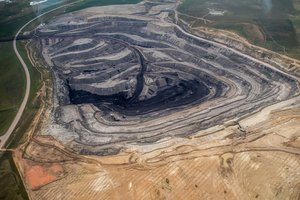
Strip Mining: Removal of surface layers to access near-surface coal deposits.
Subsurface Mining: Extraction of deeper coal deposits through underground tunnels.
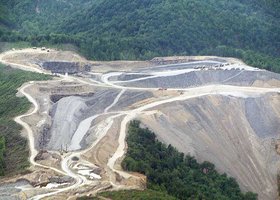
Mountaintop Removal: Blasting away entire mountain tops to reach coal seams, causing severe landscape alteration.

Oil and Natural Gas Extraction
Oil is extracted as crude oil and must be refined before use. Natural gas is primarily methane but may contain other hydrocarbons. Extraction methods include:
Primary Extraction: Initial drilling and pumping of oil or gas.
Secondary Extraction: Advanced techniques (e.g., hydraulic fracturing or "fracking") to extract remaining resources.
Offshore Drilling: Accessing deposits beneath the ocean floor.
Directional Drilling: Allows access to a larger area from a single drill site.
Other Fossil Fuels
Oil Sands: Mixtures of sand, clay, water, and bitumen (degraded crude oil), extracted via strip mining or steam injection.
Oil Shale: Rock containing organic matter that can be processed to produce oil-like substances.
Energy Return on Investment (EROI)
Concept and Importance
The Energy Returned on Investment (EROI) is a measure of the efficiency of energy extraction. It is calculated as:
High EROI values indicate efficient energy production.
As resources become harder to extract, EROI decreases, making energy production less efficient.
Distribution and Use of Fossil Fuels
Major Producers and Consumers
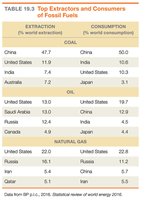
Fossil fuel production and consumption are unevenly distributed globally. The following table summarizes the top extractors and consumers of coal, oil, and natural gas:
Fossil Fuel | Top Extractors | Top Consumers |
|---|---|---|
Coal | China, India, United States, Australia | China, India, United States, Japan |
Oil | United States, Saudi Arabia, Russia, Canada | United States, China, India, Japan |
Natural Gas | United States, Russia, Iran, Qatar | United States, Russia, China, Iran |
Energy Flow and Consumption Sectors
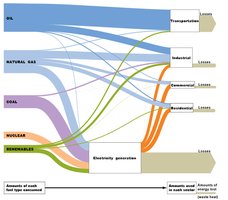
Fossil fuels are used in various sectors, including transportation, industry, commercial, and residential applications. Electricity generation is a major use of coal and natural gas.
Future of Fossil Fuel Supplies
Reserves and Peak Oil
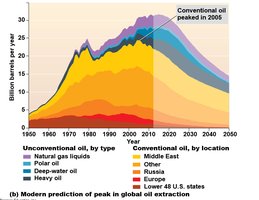
Current estimates suggest about 50 years of oil and 110 years of coal reserves remain at present consumption rates.
Peak Oil: The point at which half of the world’s oil reserves have been used, after which production is expected to decline. Estimates place peak oil around 2035.
New sources (e.g., oil sands) may delay peak oil, but extraction becomes more costly and environmentally damaging.
Environmental Impacts of Fossil Fuel Use
Extraction Impacts
Habitat destruction from strip mining and mountaintop removal.
Water and air pollution from mining and drilling operations.
Fracking can cause water contamination, air pollution, and earthquakes.
Oil sand extraction requires large land areas and significant water use.
Transportation accidents and pipeline spills can cause environmental disasters.
Emissions and Climate Change
Burning fossil fuels releases carbon dioxide (CO2) and methane (CH4), contributing to global warming.
Coal combustion emits sulfur dioxides; oil combustion emits nitrogen oxides.
Non-conventional fossil fuels generally produce more greenhouse gases.
Efforts such as carbon capture and storage are being developed to mitigate emissions.
Dependence and Efficiency
International Dependence
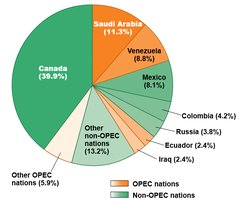
Many nations rely on imports for their fossil fuel needs, leading to geopolitical and economic vulnerabilities.
Energy Efficiency and Conservation
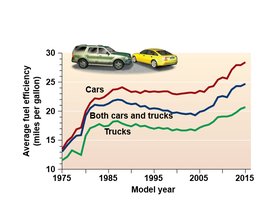
Improving energy efficiency and promoting conservation are essential for reducing fossil fuel use and environmental impact.
Energy Efficiency: Achieving the same output with less energy input (e.g., more efficient vehicles and appliances).
Energy Conservation: Reducing unnecessary or wasteful energy use.
Summary Table: Energy Sources
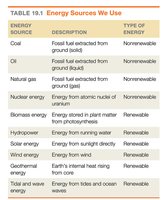
The following table summarizes various energy sources, their descriptions, and whether they are renewable or nonrenewable:
Energy Source | Description | Type of Energy |
|---|---|---|
Coal | Fossil fuel extracted from ground (solid) | Nonrenewable |
Oil | Fossil fuel extracted from ground (liquid) | Nonrenewable |
Natural gas | Fossil fuel extracted from ground (gas) | Nonrenewable |
Nuclear energy | Energy from atomic nuclei of uranium | Nonrenewable |
Biomass energy | Energy stored in plant matter from photosynthesis | Renewable |
Hydropower | Energy from running water | Renewable |
Solar energy | Energy from sunlight directly | Renewable |
Wind energy | Energy from wind movement | Renewable |
Geothermal energy | Earth's internal heat rising energy | Renewable |
Tidal and wave energy | Energy from tides and ocean waves | Renewable |
Key Terms
Fossil Fuels: Energy resources formed from ancient organic matter.
EROI: Energy Returned on Investment, a measure of extraction efficiency.
Peak Oil: The point of maximum global oil production.
Energy Efficiency: Using less energy to perform the same task.
Energy Conservation: Reducing overall energy use.
Conclusion
Fossil fuels have powered modern society but come with significant environmental and sustainability challenges. Understanding their formation, extraction, use, and impacts is essential for making informed decisions about future energy strategies and environmental stewardship.
