 Back
Foundational Concepts in General Biology: Key Terms and Processes
Study Guide - Smart Notes
 Tailored notes based on your materials, expanded with key definitions, examples, and context.
Introduction to Biological Terminology
This study guide covers essential terminology and foundational concepts in General Biology, focusing on metabolism, cell structure, reproduction, macromolecules, and the scientific method. Understanding these terms is crucial for success in introductory biology courses.
Metabolism
Catabolism and Anabolism
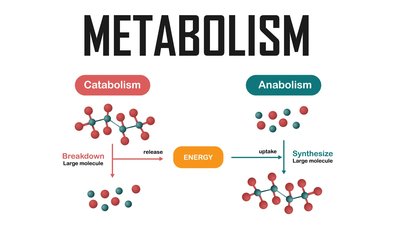
Metabolism refers to all chemical reactions that occur within living organisms to maintain life. It is divided into two main processes:
Catabolic pathways: Break down complex molecules into simpler ones, releasing energy (often stored as ATP).
Anabolic pathways: Use energy to build complex molecules from simpler ones.
ATP (Adenosine Triphosphate) is the primary energy carrier in cells, driving many cellular processes.
Organic Molecules and Macromolecules
Organic Molecules
Organic molecules are compounds containing carbon atoms. They are fundamental to life because all living organisms are composed of carbon-based molecules.
Macromolecules
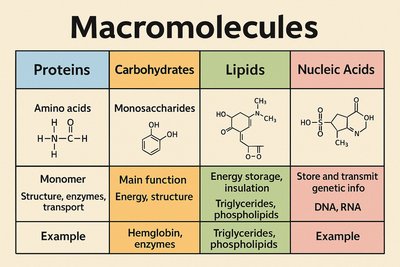
Macromolecules are large, complex molecules essential for cell structure and function. The four major classes are:
Proteins (made of amino acids)
Carbohydrates (made of monosaccharides)
Lipids (made of fatty acids and glycerol)
Nucleic acids (made of nucleotides; e.g., DNA and RNA)
Proteins | Carbohydrates | Lipids | Nucleic Acids |
|---|---|---|---|
Amino acids | Monosaccharides | Fatty acids, glycerol | Nucleotides |
Structure, enzymes, transport | Energy, structure | Energy storage, insulation | Store and transmit genetic info |
Hemoglobin, enzymes | Glucose, starch | Triglycerides, phospholipids | DNA, RNA |
Monosaccharides
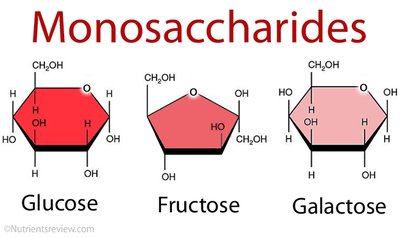
Monosaccharides are the simplest carbohydrates (simple sugars) and serve as building blocks for more complex carbohydrates. Examples include:
Glucose
Fructose
Galactose
Cell Structure: Prokaryotic vs. Eukaryotic Cells
Prokaryotic Cells
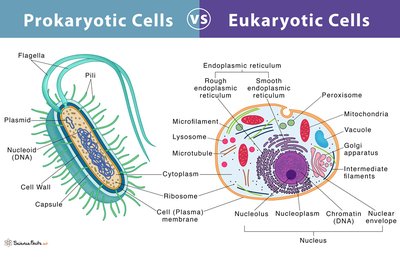
Prokaryotic cells are unicellular organisms that lack a membrane-bound nucleus and organelles. Examples include bacteria and archaea.
Eukaryotic Cells
Eukaryotic cells are usually multicellular, have a distinct membrane-bound nucleus, and contain various organelles (e.g., mitochondria, endoplasmic reticulum).
Cell Reproduction: Binary Fission
Binary Fission
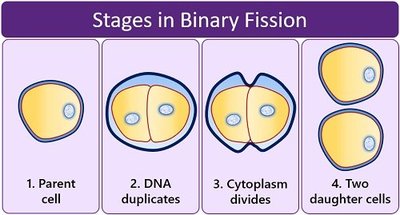
Binary fission is a form of asexual reproduction in single-celled organisms. The process involves:
Parent cell
DNA duplicates
Cytoplasm divides
Two daughter cells are formed
Genetics and Evolution
Speciation
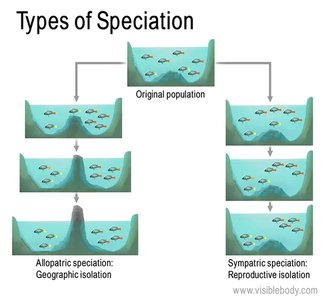
Speciation is the evolutionary process by which populations evolve to become distinct species. It can occur through:
Allopatric speciation: Geographic isolation separates populations.
Sympatric speciation: Reproductive isolation occurs without geographic separation.
Heritable Traits
Heritable traits are characteristics that can be passed from parent to offspring through genes.
Scientific Method and Reasoning
Types of Reasoning
Inductive reasoning: Uses observations to identify patterns and develop general conclusions.
Deductive reasoning: Uses general principles to predict specific results; commonly used in hypothesis testing.
Types of Science
Descriptive science: Involves gathering data to find patterns (often uses inductive reasoning).
Hypothesis-based science: Relies on deductive reasoning to test predictions derived from hypotheses.
Applied science: Applies foundational knowledge to solve practical problems or develop technologies.
Hypotheses in Science
Null hypothesis (H0): States there is no effect or difference; what should be observed if the hypothesis is incorrect.
Alternative hypothesis (HA): Proposed when the null hypothesis is rejected; suggests a new explanation.
Falsifiable: A hypothesis must be testable and able to be proven wrong by experiment or observation.
Feedback Loops and Homeostasis
Feedback Loop
A feedback loop is a biological mechanism that helps organisms maintain stable internal conditions (homeostasis) by regulating processes such as waste removal and temperature control.
Summary Table: Key Terms
Term | Definition |
|---|---|
Catabolic | Breaks down molecules, releases energy as ATP |
Anabolic | Builds molecules, requires energy |
Organic molecules | Contain carbon, fundamental to life |
Binary fission | Asexual reproduction in single-celled organisms |
Feedback loop | Regulates homeostasis |
Speciation | Formation of new species |
Heritable | Passed from parent to offspring |
Inductive reasoning | Generalizes from observations |
Deductive reasoning | Tests predictions from general principles |
Descriptive science | Data collection to find patterns |
Hypothesis-based science | Tests predictions using hypotheses |
Applied science | Solves practical problems |
Null hypothesis | No effect or difference expected |
Alternative hypothesis | New explanation if null is rejected |
Falsifiable | Can be proven wrong |
Metabolism | All chemical reactions in cells |
Monosaccharides | Simple sugars, building blocks of carbohydrates |
Prokaryotic | No nucleus, unicellular |
Eukaryotic | Membrane-bound nucleus, multicellular |
Macromolecules | Large molecules essential for life |
ATP | Energy carrier in cells |
