Back
Foundational Concepts in General Biology: Levels of Organization, Cell Structure, and Chemical Groups
Study Guide - Smart Notes
 Tailored notes based on your materials, expanded with key definitions, examples, and context.
Levels of Biological Organization
Hierarchy of Life
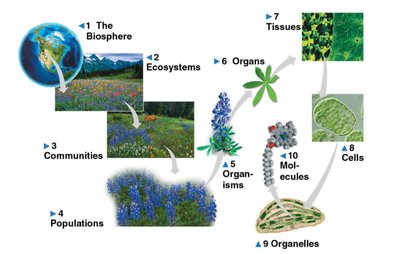
The study of biology involves understanding the organization of life from the smallest molecular components to the largest ecological systems. Each level builds upon the previous, creating complex structures and functions.
The Biosphere: The global sum of all ecosystems, including all living organisms and their environments.
Ecosystems: Communities of living organisms interacting with their physical environment.
Communities: Different populations of species living together in a defined area.
Populations: Groups of individuals of the same species living in a specific area.
Organisms: Individual living entities.
Organs: Structures composed of tissues that perform specific functions.
Tissues: Groups of similar cells working together to perform a function.
Cells: The basic unit of life; all living things are composed of cells.
Organelles: Specialized structures within cells that perform distinct processes.
Molecules: Chemical structures consisting of two or more atoms bonded together.
Cell Structure: Eukaryotic vs. Prokaryotic Cells
Comparing Cell Types
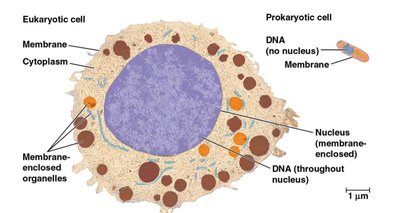
Cells are classified into two main types: eukaryotic and prokaryotic. Understanding their differences is fundamental to cell biology.
Eukaryotic Cells: Contain membrane-enclosed organelles, including a nucleus that houses DNA.
Prokaryotic Cells: Lack a nucleus and membrane-bound organelles; DNA is located in the cytoplasm.
Membrane: Both cell types have a plasma membrane that regulates entry and exit of substances.
Cytoplasm: The region between the membrane and nucleus (or nucleoid) containing organelles and molecules.
The Chemical Context of Life
Origin of Organic Molecules
The formation of organic molecules is essential for life. Experiments simulating early Earth conditions demonstrate how simple molecules can combine to form more complex compounds.
Heated Water ("Ocean"): Provides a source of energy and medium for reactions.
Atmosphere: Contains gases such as CH4, NH3, H2, and H2O.
Electrical Spark ("Lightning"): Simulates energy input, driving chemical reactions.
Condenser: Collects products formed from these reactions, including organic molecules.

Isomers and Chirality in Biological Molecules
D- and L- Isomers
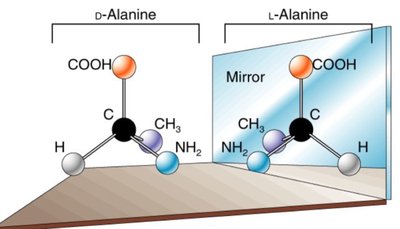
Many biological molecules exist as isomers, which are compounds with the same formula but different structures. Chirality is a property where molecules are mirror images of each other, such as D- and L-alanine.
Chiral Molecules: Have non-superimposable mirror images.
D-Alanine and L-Alanine: Example of amino acid isomers; only L-amino acids are used in proteins.
Biological Significance: Enzymes and receptors are specific to the chirality of molecules.
Functional Groups in Organic Molecules
Chemical Groups and Their Properties
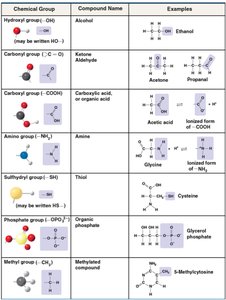
Functional groups are specific groups of atoms within molecules that determine their chemical properties and reactivity. Understanding these groups is crucial for studying biological molecules.
Hydroxyl Group (–OH): Found in alcohols; increases solubility in water.
Carbonyl Group (C=O): Found in ketones and aldehydes; important in sugars.
Carboxyl Group (–COOH): Found in carboxylic acids; acts as an acid.
Amino Group (–NH2): Found in amines; acts as a base.
Sulfhydryl Group (–SH): Found in thiols; forms disulfide bonds in proteins.
Phosphate Group (–PO4): Found in organic phosphates; important in energy transfer (e.g., ATP).
Methyl Group (–CH3): Found in methylated compounds; affects gene expression.
Chemical Group | Compound Name | Examples |
|---|---|---|
Hydroxyl (–OH) | Alcohol | Ethanol |
Carbonyl (C=O) | Ketone/Aldehyde | Acetone, Propanal |
Carboxyl (–COOH) | Carboxylic acid | Acetic acid, ionized form |
Amino (–NH2) | Amine | Glycine, ionized form |
Sulfhydryl (–SH) | Thiol | Cysteine |
Phosphate (–PO4) | Organic phosphate | Glycerol phosphate |
Methyl (–CH3) | Methylated | 5-methylcytosine |