 Back
BackFoundations of Biology: Characteristics of Life, Scientific Method, and Cell Structure
Study Guide - Smart Notes
 Tailored notes based on your materials, expanded with key definitions, examples, and context.
Characteristics of Life
Basic Characteristics of All Living Things
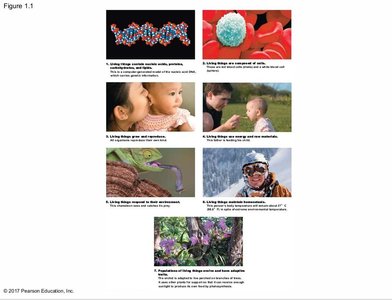
All living organisms share a set of fundamental characteristics that distinguish them from nonliving matter. These characteristics are essential for the maintenance and perpetuation of life.
Contain molecules of life: All living things are composed of four major macromolecules: nucleic acids, proteins, carbohydrates, and lipids.
Cellular organization: Living things are made up of cells, which are the smallest units of life. All cells arise from preexisting cells.
Growth and reproduction: Living organisms grow and are capable of reproduction, ensuring the continuation of their species.
Metabolism: Living things use energy and raw materials to carry out metabolism, which encompasses all chemical reactions within cells.
Response to environment: Organisms can respond to environmental stimuli.
Homeostasis: The maintenance of a relatively constant internal environment.
Adaptation and evolution: Organisms possess adaptive traits that allow them to survive and reproduce; populations evolve over time.
Evolution and Classification
Evolution: A Unifying Theme in Biology
Evolution explains the diversity of life and the relationships among organisms. Classification systems reflect evolutionary relationships, grouping organisms by similarities.
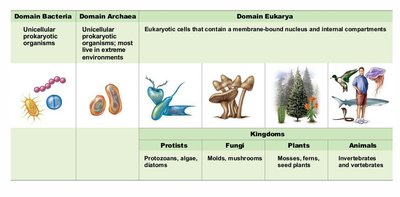
Three-domain system: The most current classification system divides life into three domains: Bacteria, Archaea, and Eukarya.
Domain Bacteria: Unicellular prokaryotic organisms.
Domain Archaea: Unicellular prokaryotic organisms, often found in extreme environments.
Domain Eukarya: Eukaryotic cells with membrane-bound nuclei and organelles; includes protists, fungi, plants, and animals.
Levels of Biological Organization
Hierarchy of Organization
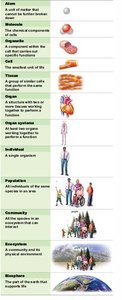
Biological systems are organized in a hierarchy from the smallest chemical units to the entire biosphere.
Atom: Smallest unit of matter.
Molecule: Chemical components of cells.
Organelle: Specialized structures within cells.
Cell: Smallest unit of life.
Tissue: Group of similar cells performing a function.
Organ: Structure composed of two or more tissues.
Organ system: Two or more organs working together.
Individual: A single organism.
Population: Members of the same species in a given area.
Community: Interacting populations in an area.
Ecosystem: Community plus its physical environment.
Biosphere: All life and environments on Earth.
The Scientific Method
Steps of the Scientific Method
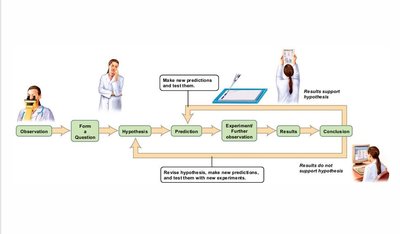
The scientific method is a systematic approach to investigating questions and acquiring knowledge through observation and experimentation.
Observation: Make careful observations and ask questions.
Hypothesis: Formulate a testable explanation.
Prediction: Make predictions based on the hypothesis.
Experiment: Design experiments with control and experimental groups to test the hypothesis.
Results: Collect and analyze data.
Conclusion: Draw conclusions and refine hypotheses as needed.
Experimental Design Example
Experiments often involve comparing an experimental group to a control group to determine the effect of a variable.
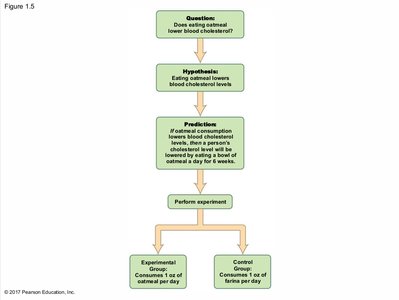
Question: Does eating oatmeal lower blood cholesterol?
Hypothesis: Eating oatmeal lowers blood cholesterol levels.
Prediction: If oatmeal consumption lowers cholesterol, then a person's cholesterol will be reduced by eating oatmeal daily.
Experiment: Compare groups consuming different amounts of oatmeal to a control group.
Data Interpretation Example
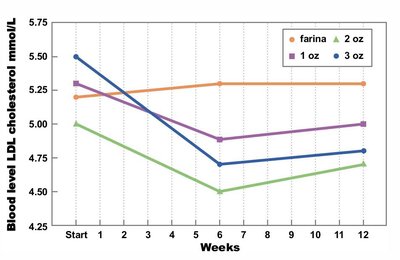
Results from experiments are often displayed in graphs to show trends and support or refute hypotheses.
Example: A graph showing blood LDL cholesterol levels over 12 weeks for groups consuming different amounts of oatmeal and a control group (farina).
Interpretation: Groups consuming more oatmeal show a greater reduction in LDL cholesterol compared to the control.
Drug Testing and Clinical Trials
Phases of Drug Testing
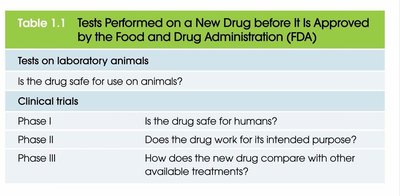
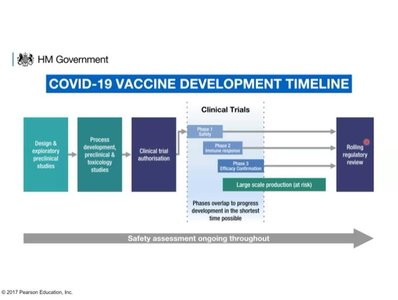
Before a new drug is approved, it undergoes rigorous testing in both animals and humans to ensure safety and efficacy.
Stage | Description |
|---|---|
Laboratory Animals | Is the drug safe for use on animals? |
Phase I (Clinical) | Is the drug safe for humans? |
Phase II (Clinical) | Does the drug work for its intended purpose? |
Phase III (Clinical) | How does the new drug compare with other available treatments? |
Critical Thinking and Evaluating Scientific Claims
Evaluating Information Sources
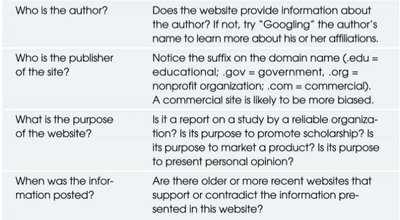
Critical thinking is essential for evaluating scientific claims and information found online. Reliable sources are peer-reviewed and transparent about authorship, purpose, and publication date.
Question | What to Look For |
|---|---|
Who is the author? | Is the author's background or affiliation provided? |
Who is the publisher? | Is the site educational, governmental, or commercial? |
What is the purpose? | Is the information scholarly, promotional, or opinion-based? |
When was it posted? | Is the information current and supported by recent evidence? |
Cell Structure and Classification
Prokaryotic vs. Eukaryotic Cells
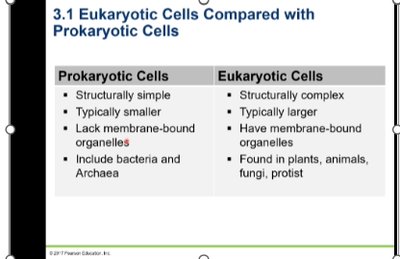
Cells are classified as prokaryotic or eukaryotic based on their structural features.
Prokaryotic cells: Structurally simple, lack membrane-bound organelles, include Bacteria and Archaea.
Eukaryotic cells: Structurally complex, have membrane-bound organelles, found in plants, animals, fungi, and protists.
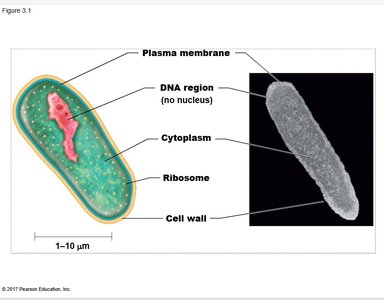
Prokaryotic Cell Structure
Plasma membrane: Regulates movement of materials.
DNA region: No nucleus; genetic material is in a nucleoid region.
Cytoplasm: Contains ribosomes and other molecules.
Cell wall: Provides structural support.
Eukaryotic Cell Structure
Plasma membrane: Regulates movement of materials.
Nucleus: Contains DNA and controls cell activity.
Organelles: Specialized structures such as mitochondria, lysosomes, endoplasmic reticulum, and Golgi apparatus perform specific functions.
Cytoskeleton: Provides shape and aids in movement.
Additional info: These foundational concepts are essential for understanding more advanced topics in biology, including genetics, physiology, and ecology.
