 Back
BackFoundations of Biology: Chemistry of Life, Macromolecules, and Molecular Genetics
Study Guide - Smart Notes
 Tailored notes based on your materials, expanded with key definitions, examples, and context.
Introduction: Evolution and the Foundations of Biology
Levels of Biological Organization
Biology studies life across a hierarchy of structural levels, from the biosphere to molecules. Understanding these levels is essential for grasping how complex biological systems function.
Biosphere: All environments on Earth inhabited by life.
Ecosystems: Communities of living organisms and their physical environments.
Communities: Different populations living together in a defined area.
Populations: Groups of individuals of the same species.
Organisms: Individual living entities.
Organs and Organ Systems: Body parts with specific functions.
Tissues: Groups of similar cells performing a function.
Cells: Basic units of life.
Organelles: Functional components within cells.
Molecules: Chemical structures consisting of two or more atoms.
The Chemical Context of Life
Atoms, Elements, and Compounds
All matter is composed of atoms, which combine to form elements and compounds. The chemical properties of life depend on the structure and interactions of these atoms.
Atom: Smallest unit of matter, composed of protons, neutrons, and electrons.
Element: Substance that cannot be broken down by chemical means.
Compound: Substance consisting of two or more elements in a fixed ratio.
Energy Levels and Electron Configuration
Electrons occupy energy levels (shells) around the nucleus. The arrangement of electrons determines an atom's chemical behavior.
Valence electrons (outermost shell) are most reactive.
Atoms with incomplete valence shells tend to form chemical bonds.
Chemical Bonds
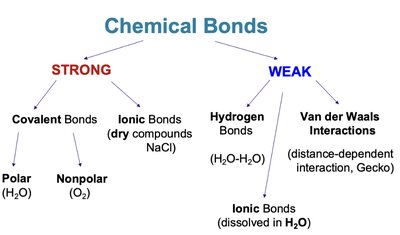
Chemical bonds hold atoms together in molecules and compounds. They can be classified as strong or weak, influencing molecular structure and function.
Covalent Bonds: Sharing of electron pairs between atoms. Can be polar (unequal sharing, e.g., H2O) or nonpolar (equal sharing, e.g., O2).
Ionic Bonds: Transfer of electrons from one atom to another, forming ions (e.g., NaCl).
Hydrogen Bonds: Weak attractions between a hydrogen atom and an electronegative atom (e.g., between water molecules).
Van der Waals Interactions: Weak, distance-dependent attractions between molecules.
Water: Structure and Properties
Water is essential for life due to its unique chemical and physical properties, which arise from its polar structure and hydrogen bonding.
Cohesion and Adhesion: Water molecules stick to each other (cohesion) and to other substances (adhesion), aiding processes like water transport in plants.
Expansion Upon Freezing: Ice is less dense than liquid water, allowing it to float and insulate aquatic life.
Temperature Moderation: High specific heat allows water to buffer temperature changes.
Versatility as a Solvent: Water dissolves many substances due to its polarity, facilitating biochemical reactions.
Carbon and the Molecular Diversity of Life
Organic Molecules and Functional Groups
Life is carbon-based, and organic molecules exhibit diversity due to carbon's bonding versatility and the presence of functional groups.
Hydrocarbons: Molecules consisting only of carbon and hydrogen; nonpolar and energy-rich.
Functional Groups: Specific groups of atoms that confer distinct chemical properties (e.g., hydroxyl, carboxyl, amino, phosphate, methyl).
Macromolecules: Carbohydrates, Lipids, Proteins, and Nucleic Acids
Carbohydrates
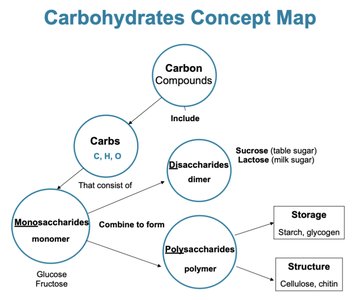
Carbohydrates are sugars and their polymers, serving as energy sources and structural materials.
Monosaccharides: Simple sugars (e.g., glucose, fructose).
Disaccharides: Two monosaccharides joined by a glycosidic bond (e.g., sucrose, lactose).
Polysaccharides: Long chains of monosaccharides; storage (starch, glycogen) or structural (cellulose, chitin).
Lipids
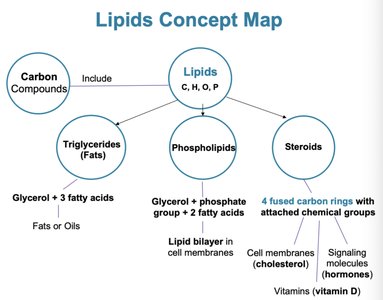
Lipids are hydrophobic molecules, including fats, phospholipids, and steroids, with roles in energy storage, membrane structure, and signaling.
Fats (Triglycerides): Glycerol + 3 fatty acids; energy storage.
Phospholipids: Glycerol + phosphate group + 2 fatty acids; form cell membranes.
Steroids: Four fused carbon rings; include cholesterol and hormones.
Saturated vs. Unsaturated Fats
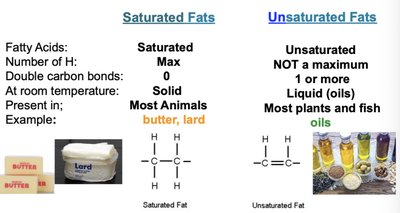
Saturated Fats: No double bonds, solid at room temperature, found in animal products.
Unsaturated Fats: One or more double bonds, liquid at room temperature, found in plants and fish oils.
Proteins
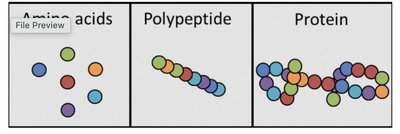
Proteins are polymers of amino acids, performing diverse functions such as catalysis, transport, defense, and structure.
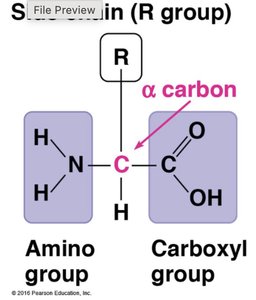
Amino Acids: 20 types, each with a central carbon, amino group, carboxyl group, hydrogen, and variable R group.
Polypeptides: Chains of amino acids linked by peptide bonds.
Protein Structure: Four levels—primary (sequence), secondary (α-helix, β-sheet), tertiary (3D folding), quaternary (multiple polypeptides).
Nucleic Acids
Nucleic acids (DNA and RNA) store and transmit genetic information. They are polymers of nucleotides, each consisting of a sugar, phosphate, and nitrogenous base.
DNA: Double-stranded, deoxyribose sugar, bases A, T, C, G.
RNA: Single-stranded, ribose sugar, bases A, U, C, G.
The Molecular Basis of Inheritance
Structure of DNA
DNA is a double helix with antiparallel strands, held together by complementary base pairing (A=T, G≡C) via hydrogen bonds.
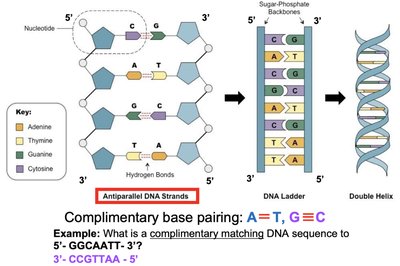
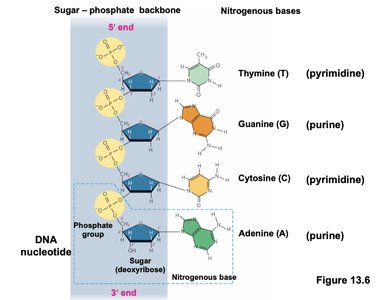
Nucleotides: Composed of a phosphate group, deoxyribose sugar, and a nitrogenous base (purine or pyrimidine).
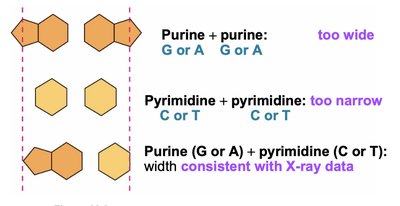
Base Pairing: Purines (A, G) pair with pyrimidines (T, C) to maintain uniform helix width.
Experimental Evidence for DNA as Genetic Material
Key experiments established DNA as the hereditary material.
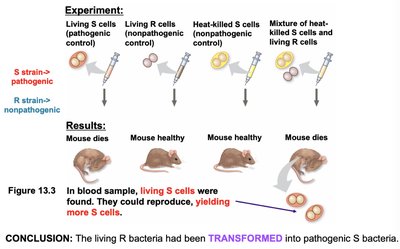
Griffith's Transformation Experiment: Showed that a 'transforming principle' from dead pathogenic bacteria could make harmless bacteria pathogenic.
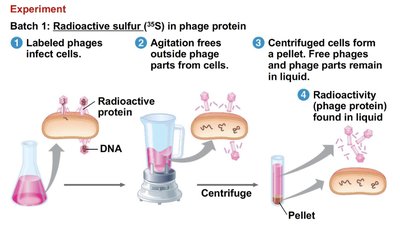
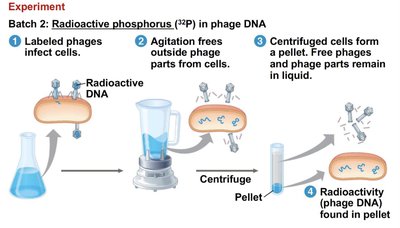
Hershey-Chase Experiment: Used radioactive labeling to show that DNA, not protein, enters bacterial cells during viral infection, confirming DNA as genetic material.
Chargaff's Rules
Erwin Chargaff discovered that DNA from any cell of any organism has a 1:1 ratio of purines to pyrimidines (A=T, G=C), supporting the double helix model.
DNA Replication
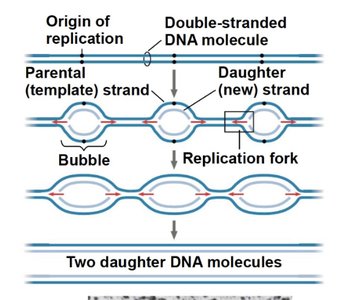
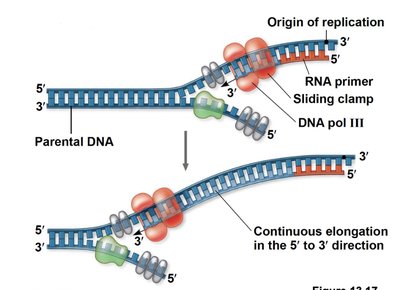
DNA replication is semiconservative: each new DNA molecule consists of one parental and one new strand. The process is highly accurate and involves multiple enzymes.
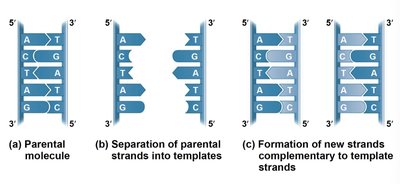
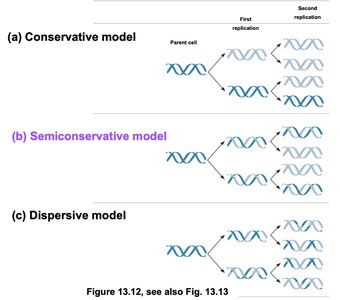
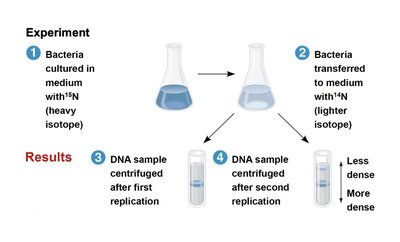
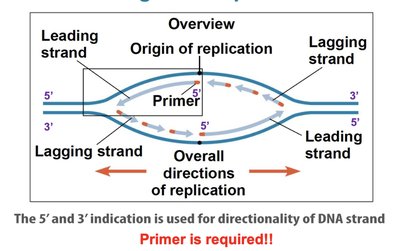
Initiation: Begins at origins of replication, forming replication bubbles and forks.
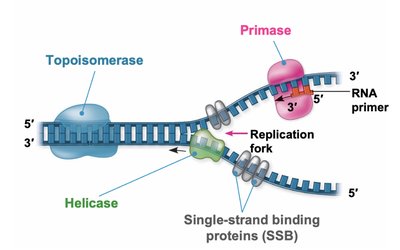
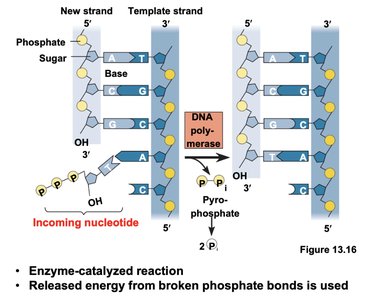
Enzymes: Helicase unwinds DNA, single-strand binding proteins stabilize strands, primase synthesizes RNA primers, DNA polymerase adds nucleotides, ligase joins fragments.
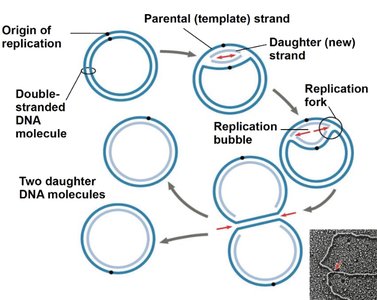
Proofreading and DNA Repair
DNA polymerases proofread and correct errors during replication. Additional repair mechanisms (e.g., nucleotide excision repair) maintain genetic integrity. Mutations that escape repair contribute to genetic variation and evolution.
Gene Expression: From Gene to Protein
Central Dogma: DNA → RNA → Protein
Genetic information flows from DNA to RNA (transcription) and from RNA to protein (translation). This process is fundamental to all living organisms.
Transcription: Synthesis of RNA from a DNA template by RNA polymerase.
Translation: Synthesis of a polypeptide at the ribosome, using mRNA as a template and tRNA for amino acid delivery.
Transcription
Initiation: RNA polymerase binds to promoter regions (e.g., TATA box in eukaryotes).
Elongation: RNA polymerase synthesizes RNA in the 5' to 3' direction.
Termination: Transcription ends at specific sequences; mechanisms differ between prokaryotes and eukaryotes.
RNA Processing (Eukaryotes)
5' Cap and 3' Poly-A Tail: Added to protect mRNA and facilitate export and translation.
Splicing: Removal of introns and joining of exons to produce mature mRNA.
Translation
Ribosome Structure: Composed of large and small subunits; sites for tRNA binding (A, P, E sites).
Initiation: Assembly of ribosome, mRNA, and initiator tRNA at the start codon (AUG).
Elongation: Sequential addition of amino acids via codon-anticodon pairing.
Termination: Stop codon triggers release of the polypeptide.
Mutations
Point Mutations: Single nucleotide changes; can be silent, missense, or nonsense.
Insertions/Deletions: Can cause frameshift mutations, altering downstream amino acid sequence.
Mutagens: Physical or chemical agents that increase mutation rates; many are carcinogenic.
