 Back
Foundations of Biology: Properties, Classification, and Themes
Study Guide - Smart Notes
 Tailored notes based on your materials, expanded with key definitions, examples, and context.
Foundations of Biology
Properties of Living Organisms
Living organisms share several defining properties that distinguish them from non-living matter. These properties are essential for the maintenance and perpetuation of life.
Order: Living things exhibit complex but ordered organization, from molecules to entire organisms.
Regulation: Organisms maintain stable internal conditions (homeostasis) despite external changes.
Growth and Development: Organisms grow and develop according to specific instructions coded in their DNA.
Energy Processing: Living things acquire and use energy to power their activities and chemical reactions.
Response to Environment: Organisms respond to environmental stimuli.
Reproduction: Organisms reproduce their own kind, passing genetic information to offspring.
Evolutionary Adaptation: Populations evolve over generations through adaptations that enhance survival and reproduction.
Major Taxonomic Groups of Living Organisms
All living organisms are classified into hierarchical groups based on shared characteristics and evolutionary history. The highest levels of classification are domains and kingdoms.
Three Domains:
Bacteria: Single-celled prokaryotes with diverse metabolic capabilities.
Archaea: Single-celled prokaryotes, often found in extreme environments, genetically distinct from bacteria.
Eukarya: Organisms with eukaryotic cells (cells containing a nucleus and organelles).
Four Kingdoms of Eukarya:
Plantae: Multicellular, photosynthetic organisms (plants).
Animalia: Multicellular, heterotrophic organisms (animals).
Fungi: Mostly multicellular, decomposers (mushrooms, molds, yeasts).
Protists: Diverse group of mostly unicellular eukaryotes.
Genus and Species: The smallest levels of classification, used in binomial nomenclature (e.g., Homo sapiens).
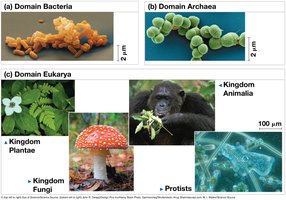
Example: The chimpanzee belongs to Domain Eukarya, Kingdom Animalia, Genus Pan, Species troglodytes.
Additional info: Estimates suggest about 8 million animal species exist, but fewer than 2 million have been described.
The Scientific Method in Biology
The scientific method is a systematic approach used to investigate biological questions and test hypotheses.
Observation: Noticing phenomena or patterns (e.g., different coloration in beach and inland mice).
Question: Formulating a question based on observations (e.g., Does camouflage affect predation rates?).
Hypothesis: Proposing a tentative explanation (e.g., Coloration affects predation rates).
Prediction: Making a specific, testable prediction (e.g., Non-camouflaged mice will experience higher predation rates).
Experiment: Designing and conducting experiments to test the prediction, identifying independent (manipulated) and dependent (measured) variables, and using control and experimental groups.
Measurement and Evaluation: Collecting and analyzing data to determine if the results support or refute the hypothesis.
Conclusion: Drawing conclusions and refining hypotheses as needed.
Example: In a study of mouse predation, the independent variable could be fur coloration, and the dependent variable could be predation rate.
Themes of Biology
Organization and Levels of Biological Organization
Biological systems are organized into hierarchical levels, each with emergent properties that arise from the interactions of their parts.
Levels Critical to Molecular and Cellular Biology:
Populations
Organisms
Cells
Organelles
Molecules (and atoms)
Emergent Properties: New properties arise at each level due to the arrangement and interactions of parts (e.g., mitochondria's structure enables efficient energy production).
Structure and Function
The structure of biological components provides insight into their function. For example, the shape of leaves maximizes sunlight capture, and the structure of proteins determines their role in transport across membranes.
Example: "Barrel" proteins form channels in membranes, allowing selective transport of molecules.
Cells: The Basic Units of Life
All living things are composed of cells, which are the fundamental units of structure and function.
Eukaryotic Cells: Large, contain a nucleus and membrane-bound organelles.
Prokaryotic Cells: Small, lack a nucleus, include Bacteria and Archaea.
Both: Possess DNA and an outer membrane.
Evolution: The Unifying Theme of Biology
Evolution explains the diversity and unity of life. It is the process by which populations change over time, sometimes resulting in new species. Classification systems reflect evolutionary relationships.
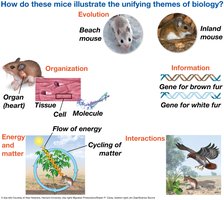
Example: Beach and inland mice have evolved different coloration as adaptations to their environments.
Information: Heredity and DNA
Genetic information is stored in DNA, which determines the traits of organisms. The sequence of nucleotide bases (A, T, C, G) encodes instructions for building and maintaining an organism.
Example: Genes for fur color in mice determine whether they have brown or white fur.
Energy and Matter
Living systems require energy to maintain order and carry out life processes. Energy flows through ecosystems, while matter cycles within them.
Energy Flow: Sunlight is converted to chemical energy (glucose) by producers, which is then used by organisms for work and lost as heat.
Chemical Cycling: Elements such as carbon and nitrogen are recycled between living and nonliving components of ecosystems.
Interactions
Organisms interact with each other and their environment, affecting survival and reproduction. These interactions drive ecological and evolutionary processes.
Example: Predation, competition, and symbiosis are all forms of biological interactions.
