 Back
Foundations of Biology: Scientific Inquiry, Chemistry of Life, and Cell Structure
Study Guide - Smart Notes
 Tailored notes based on your materials, expanded with key definitions, examples, and context.
Introduction to Biology and Scientific Inquiry
Adaptation and the Nature of Science
Biology is the study of living organisms and their interactions with the environment. Adaptation refers to the process by which organisms develop traits that enhance their survival and reproduction in specific environments over generations. Science, derived from the Latin word meaning "to know," is a systematic approach to understanding the natural world through observation, inquiry, and experimentation.
Inquiry: The search for information and explanations about natural phenomena.
Hypothesis: A rational explanation for a set of observations, which must be testable and falsifiable.
Inductive reasoning: Drawing general conclusions from specific observations.
Deductive reasoning: Making specific predictions based on general premises.
Example of a Hypothesis: Fertilized plants will grow larger than unfertilized plants because the soil does not have enough nitrogen.
Controlled experiment: Compares a control group (unmanipulated) with one or more experimental groups (manipulated).
Variables:
Independent variable: The factor being manipulated.
Dependent variable: The effect measured in response to the independent variable.
Controlled variables: Factors kept constant to ensure a fair test.
The Chemical Context of Life
Atoms, Elements, and Chemical Bonds
All matter is composed of elements, substances that cannot be broken down by chemical reactions. Atoms are the smallest units of matter, consisting of protons, neutrons, and electrons.
Atomic number: Number of protons in the nucleus.
Atomic mass: Sum of protons and neutrons.
Valence electrons: Electrons in the outermost shell, determining chemical reactivity.
Atoms achieve stability by gaining, losing, or sharing electrons to fill their valence shell, forming ions or molecules through different types of bonds:
Ionic bonds: Attraction between oppositely charged ions (no electron sharing).
Covalent bonds: Sharing of electron pairs between atoms (single, double, or triple bonds).
Electronegativity: The tendency of an atom to attract electrons; increases up and to the right on the periodic table.
Nonpolar covalent bonds: Equal sharing of electrons (small electronegativity difference).
Polar covalent bonds: Unequal sharing of electrons (large electronegativity difference), resulting in partial charges.
Van der Waals interactions: Weak attractions between molecules in close proximity.
Hydrogen bonds: Temporary bonds between polar molecules, involving partial positive and negative regions.
Water and Its Properties
Emergent Properties of Water
Water's unique properties make it essential for life on Earth. These properties arise from its polar covalent bonds and ability to form hydrogen bonds.
Cohesion: Water molecules stick together, resulting in high surface tension.
Adhesion: Water molecules stick to other substances.
High specific heat: Water resists temperature changes, stabilizing environments.
Expansion upon freezing: Ice is less dense than liquid water, allowing it to float.
Versatility as a solvent: Water dissolves many substances due to its polarity.
Solution: Homogeneous mixture of substances (e.g., salt water). Solvent: The dissolving agent (e.g., water). Solute: The substance dissolved (e.g., salt).
Hydrophilic: Molecules that dissolve in water (polar or ionic).
Hydrophobic: Molecules that do not dissolve in water (nonpolar).
Amphipathic: Molecules with both hydrophilic and hydrophobic regions.
pH: Measures the concentration of H+ ions in a solution.
Each unit change in pH represents a tenfold change in H+ concentration.
Buffers: Substances that minimize changes in pH by accepting or donating H+ ions.
Example: The carbonic acid/bicarbonate buffer system in blood helps maintain pH at 7.4.
Carbon and the Molecular Diversity of Life
Organic Molecules and Macromolecules
Carbon's four unpaired valence electrons allow it to form up to four covalent bonds, enabling the diversity of organic molecules.
Hydrocarbons: Molecules consisting only of carbon and hydrogen.
Macromolecules: Large molecules essential for life, including carbohydrates, lipids, proteins, and nucleic acids.
Polymers: Chains of repeating units (monomers) formed by dehydration reactions.
Carbohydrates
Monosaccharides: Simple sugars (e.g., glucose, fructose).
Disaccharides: Two monosaccharides linked together (e.g., sucrose, lactose).
Polysaccharides: Long chains of monosaccharides (e.g., starch, glycogen).
Lipids
Hydrophobic molecules (mainly hydrocarbons, nonpolar).
Fats: Glycerol + three fatty acids (ester linkages).
Saturated fats: No double bonds (solid at room temperature, e.g., butter).
Unsaturated fats: One or more double bonds (liquid at room temperature, e.g., oils).
Phospholipids: Major component of cell membranes (amphipathic).
Steroids: Four fused rings (e.g., cholesterol, steroid hormones).
Nucleic Acids
Monomer: Nucleotide (phosphate group, 5-carbon sugar, nitrogenous base).
Function: Store and transmit genetic information (DNA, RNA).
ATP: Adenosine triphosphate, an energy carrier with three phosphate groups.
Proteins
Monomer: Amino acid.
Functions: Enzymatic, defensive, storage, transport, hormonal, receptor, contractile, motor, and structural roles.
Levels of structure:
Primary: Sequence of amino acids.
Secondary: Coils and folds (hydrogen bonds).
Tertiary: 3D shape from side chain interactions.
Quaternary: Association of multiple polypeptide chains.
A Tour of the Cell
Prokaryotic and Eukaryotic Cells
Cells are the basic units of life, classified as prokaryotic or eukaryotic based on structural differences.
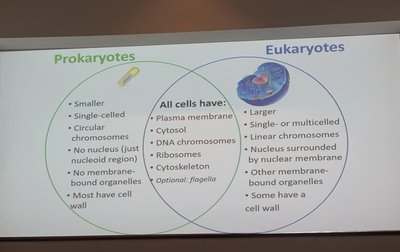
All cells have: DNA, plasma membrane, cytosol, ribosomes, and sometimes flagella.
Prokaryotes: Bacteria and Archaea; smaller, single-celled, circular chromosomes, no nucleus, no membrane-bound organelles, most have cell walls.
Eukaryotes: Protists, fungi, plants, animals; larger, single or multicellular, linear chromosomes, nucleus, membrane-bound organelles, some have cell walls.
Animal and Plant Cells
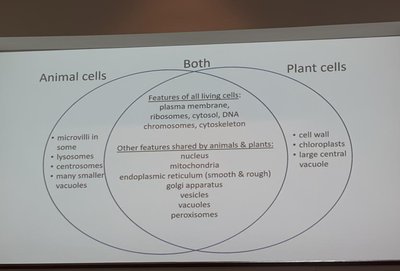
Animal and plant cells share many features but also have distinct differences.
Animal cells: May have microvilli, lysosomes, centrosomes, and many small vesicles.
Plant cells: Have a cell wall, chloroplasts, and a large central vacuole.
Both: Nucleus, mitochondria, endoplasmic reticulum, Golgi apparatus, vesicles, vacuoles, peroxisomes, and other features of eukaryotic cells.
Cell Structure and Function
Plasma membrane: Phospholipid bilayer with embedded proteins, regulates transport and communication.
Cytoskeleton: Network of protein filaments providing structure, shape, and movement within the cell.
Extracellular matrix (ECM): In animal cells, a network of glycoproteins that supports and communicates with the cell.
Cell wall: In plants, a rigid structure made of cellulose and proteins, providing support and regulating water uptake.
Endomembrane System
The endomembrane system is a network of membranes within eukaryotic cells that compartmentalizes functions and facilitates the transport of molecules.
Nuclear envelope: Surrounds the nucleus, separating genetic material from the cytoplasm.
Endoplasmic reticulum (ER):
Smooth ER: Synthesizes lipids, metabolizes carbohydrates, stores Ca2+, detoxifies poisons.
Rough ER: Studded with ribosomes, aids in protein synthesis.
Golgi apparatus: Modifies, sorts, and packages proteins and lipids for export.
Lysosomes: Contain digestive enzymes to break down macromolecules and organelles.
Vacuoles: Storage, digestion, waste disposal, and plant growth (central vacuole in plants).
Plasma membrane: Regulates entry and exit of substances.
