 Back
Foundations of Biology: Themes, Organization, and Evolution
Study Guide - Smart Notes
 Tailored notes based on your materials, expanded with key definitions, examples, and context.
Science and Life
What is Biology?
Biology is the scientific study of living organisms, encompassing their origin, distribution, morphology, anatomy, physiology, and behavior. The term derives from the Greek words bio (life) and logy (study of). Biology is an ongoing inquiry into the nature of life, seeking to understand the mechanisms and principles underlying living systems.
What is Life?
Life is a phenomenon that resists a simple definition. Instead, living organisms are identified by a set of properties and processes that distinguish them from non-living matter. These properties are observable in all living things and are used as criteria for life.
Order: Living organisms exhibit complex but ordered organization, from molecules to entire organisms.
Energy Processing: Organisms obtain and use energy to power their activities and maintain internal order.
Growth and Development: Organisms increase in size and complexity, following specific instructions encoded in their DNA.
Response to the Environment: Living things detect and respond to environmental stimuli.
Regulation (Homeostasis): Organisms regulate their internal environment to maintain stable conditions necessary for life.
Reproduction: Living organisms produce offspring, passing genetic information to the next generation.
Evolutionary Adaptation: Populations of organisms change over generations through adaptations that enhance survival and reproduction.
Levels of Biological Organization
Hierarchy of Life
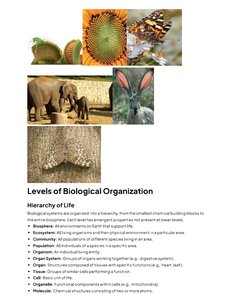
Biological systems are organized into a hierarchy, from the smallest chemical building blocks to the entire biosphere. Each level has emergent properties not present at lower levels.
Biosphere: All environments on Earth that support life.
Ecosystem: All living organisms and their physical environment in a particular area.
Community: All populations of different species living in an area.
Population: All individuals of a species in a specific area.
Organism: An individual living entity.
Organ System: Groups of organs working together (e.g., digestive system).
Organ: Structures composed of tissues with specific functions (e.g., heart, leaf).
Tissue: Groups of similar cells performing a function.
Cell: Basic unit of life.
Organelle: Functional components within cells (e.g., mitochondria).
Molecule: Chemical structures consisting of two or more atoms.
Five Unifying Themes in Biology
Major Themes
Biology is unified by five major themes that provide a framework for understanding life:
Organization: The hierarchy of biological structures and systems.
Information: The storage, transmission, and use of genetic information.
Energy and Matter: The flow and transformation of energy and cycling of matter.
Interactions: The interactions between components at all levels of biological organization.
Evolution: The process that accounts for the unity and diversity of life.
Structure and Function
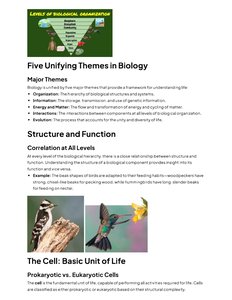
At every level of the biological hierarchy, there is a close relationship between structure and function. Understanding the structure of a biological component provides insight into its function and vice versa.
Example: The beak shapes of birds are adapted to their feeding habits—woodpeckers have strong, chisel-like beaks for pecking wood, while hummingbirds have long, slender beaks for feeding on nectar.

The Cell: Basic Unit of Life
Prokaryotic vs. Eukaryotic Cells
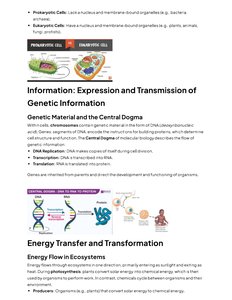
The cell is the fundamental unit of life, capable of performing all activities required for life. Cells are classified as either prokaryotic or eukaryotic based on their structural complexity.
Prokaryotic Cells: Lack a nucleus and membrane-bound organelles (e.g., bacteria, archaea).
Eukaryotic Cells: Have a nucleus and membrane-bound organelles (e.g., plants, animals, fungi, protists).
Information: Expression and Transmission of Genetic Information
Genetic Material and the Central Dogma
Within cells, chromosomes contain genetic material in the form of DNA (deoxyribonucleic acid). Genes, segments of DNA, encode the instructions for building proteins, which determine cell structure and function. The Central Dogma of molecular biology describes the flow of genetic information:
DNA Replication: DNA makes copies of itself during cell division.
Transcription: DNA is transcribed into RNA.
Translation: RNA is translated into protein.
Genes are inherited from parents and direct the development and functioning of organisms.

Energy Transfer and Transformation
Energy Flow in Ecosystems
Energy flows through ecosystems in one direction, primarily entering as sunlight and exiting as heat. During photosynthesis, plants convert solar energy into chemical energy, which is then used by organisms to perform work. In contrast, chemicals cycle between organisms and their environment.
Producers: Organisms (e.g., plants) that convert solar energy to chemical energy.
Consumers: Organisms that obtain energy by eating other organisms.
Decomposers: Organisms that break down dead matter, returning nutrients to the environment.
Biological Interactions
Feedback Regulation and Ecosystem Interactions
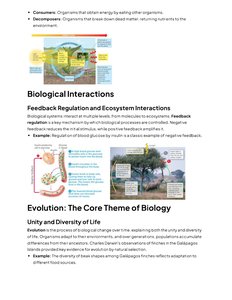
Biological systems interact at multiple levels, from molecules to ecosystems. Feedback regulation is a key mechanism by which biological processes are controlled. Negative feedback reduces the initial stimulus, while positive feedback amplifies it.
Example: Regulation of blood glucose by insulin is a classic example of negative feedback.

Evolution: The Core Theme of Biology
Unity and Diversity of Life
Evolution is the process of biological change over time, explaining both the unity and diversity of life. Organisms adapt to their environments, and over generations, populations accumulate differences from their ancestors. Charles Darwin's observations of finches in the Galápagos Islands provided key evidence for evolution by natural selection.
Example: The diversity of beak shapes among Galápagos finches reflects adaptation to different food sources.
