 Back
Foundations of General Biology: Properties of Life, Biomolecules, and Chemical Bonds
Study Guide - Smart Notes
 Tailored notes based on your materials, expanded with key definitions, examples, and context.
Introduction to Biology
Defining Life and Its Properties
Biology is the scientific study of life, focusing on the characteristics and processes that define living systems. Understanding what constitutes life is fundamental to the study of biology.
Life is evolving: Living organisms change over time through evolution.
Membrane delimited: All living cells are surrounded by membranes that control functions and responses to the environment.
Self-replicating: Life forms can reproduce themselves.
Cell is the smallest unit of life: All living things are composed of cells.
Stores and follows instructions: Genetic information is stored and used to direct cellular activities.
Uses and stores energy: Organisms require energy for growth, maintenance, and reproduction.
Controls functions and responds to environment: Regulation and adaptation are key features.
Example: Not all entities that appear alive possess every property listed above; viruses, for instance, lack self-replication and typical membranes.
Scientific Method
Experimental Design and Hypothesis Testing
The scientific method is a systematic approach to understanding natural phenomena. It involves observation, hypothesis formation, prediction, and experimentation.
Observation: Gathering data about the natural world.
Hypothesis: A testable explanation for observations.
Prediction: A specific outcome expected if the hypothesis is correct.
Controlled experiment: Isolates the independent variable to determine its effect on the dependent variable.
Example: In a class experiment, the independent variable might be days absent, and the dependent variable could be average percentage grade.
Biomolecules
Main Classes and Their Functions
Biomolecules are essential for life, facilitating its properties and functions. There are four main classes:
Lipids: Form membranes; hydrophilic and hydrophobic regions allow compartmentalization.
Carbohydrates: Provide energy and structural support.
Nucleic acids: Store and transmit genetic information (DNA and RNA).
Proteins: Perform a wide range of functions, including catalysis, structure, and regulation.
Example: Lipids are most abundant in cell membranes, while proteins are found throughout the cell.
Chemistry of Life
Atoms, Elements, and Bonds
Life is composed primarily of a few elements: hydrogen, oxygen, nitrogen, carbon, and phosphorus (HONC P). The chemical properties of these elements are determined by their atomic structure and bonding behavior.
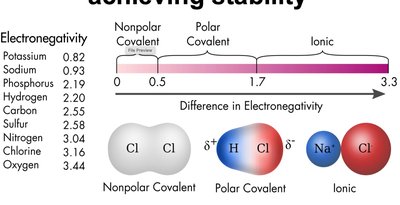
Covalent bond: Electrons are shared between atoms (difference in electronegativity: 0.0–0.5).
Polar covalent bond: Electrons are shared unequally, resulting in partial charges (difference: 0.51–1.7).
Ionic bond: Electrons are transferred, creating full positive and negative charges (difference: 1.71–3.3).
Hydrogen bond: Attraction between partial positive and negative charges, often between molecules.
Electronegativity: The tendency of an atom to attract electrons; higher values indicate stronger attraction.
Example: Oxygen has a high electronegativity (3.44), making it strongly attractive to electrons.
Water
Properties and Biological Importance
Water is vital for life due to its unique chemical properties. It acts as a solvent, participates in chemical reactions, and helps regulate temperature.
Surface tension: Water molecules resist breaking or stretching at the surface.
Cohesion and adhesion: Water molecules attract each other (cohesion) and other polar molecules (adhesion).
Heat and evaporation: High temperatures break hydrogen bonds, leading to evaporation and cooling.
Solvent properties: Water dissolves polar (hydrophilic) molecules; nonpolar (hydrophobic) molecules do not dissolve.
Example: Water is the solvent in blood, cells, and plant sap.
Chemical Bonds and Electronegativity
Bond Types and Their Biological Relevance
The type of chemical bond formed between atoms depends on their electronegativity difference. This influences molecular structure and function.
Nonpolar covalent bonds: Equal sharing of electrons (e.g., Cl2).
Polar covalent bonds: Unequal sharing, resulting in partial charges (e.g., H2O).
Ionic bonds: Complete transfer of electrons, forming ions (e.g., NaCl).
Formula: Electronegativity difference determines bond type:
pH and Buffers
Acids, Bases, and pH Regulation
pH measures the concentration of hydrogen ions in solution, affecting biological processes. Buffers help maintain stable pH in cells and organisms.
pH formula:
Acids: Donate protons (H+).
Bases: Accept protons.
Buffers: Chemicals that resist changes in pH.
Example: Blood contains buffers to maintain a stable pH despite metabolic activity.
Biological Macromolecules
Structure and Synthesis
Cells build large organic molecules (macromolecules) from smaller units (monomers). The four main classes are carbohydrates, lipids, proteins, and nucleic acids.
Dehydration synthesis: Forms bonds by removing water.
Hydrolysis: Breaks bonds by adding water.
Carbohydrates: Monosaccharides form polysaccharides.
Lipids: Glycerol and fatty acids (not true polymers).
Proteins: Amino acids form polypeptides.
Nucleic acids: Nucleotides form DNA and RNA.
Example: Carbon's ability to form four bonds makes it the backbone of organic molecules.
Protein Structure
Levels of Organization
Protein function depends on its structure, which is organized into four levels:
Primary structure: Sequence of amino acids (peptide bonds).
Secondary structure: Hydrogen bonding between backbone groups (amide and carbonyl).
Tertiary structure: Interactions between side chains (functional groups).
Quaternary structure: Association of multiple polypeptide subunits.
Example: Denaturing a protein changes its shape and function.
Nucleic Acids
DNA and RNA Structure
Nucleic acids store and transmit genetic information. They are polymers of nucleotides, each with directionality determined by the carbon atoms in the sugar.
DNA: Stores genetic information; has a hydrogen at the 2' carbon.
RNA: Involved in gene expression; has a hydroxyl group at the 2' carbon.
Directionality: 5' carbon sticks out, 3' is where the next nucleotide attaches, 1' is attached to the nitrogenous base.
Example: The sequence of nucleotides in DNA determines the instructions for building proteins.
Additional info: Academic context was added to clarify and expand on brief points, ensuring completeness and self-contained explanations for exam preparation.
