 Back
Foundations of General Biology: Themes, Chemistry, and Molecular Structure
Study Guide - Smart Notes
 Tailored notes based on your materials, expanded with key definitions, examples, and context.
Introduction to Biology
Unifying Themes of Life
Biology is the scientific study of life, unified by several major themes that help organize our understanding of living systems:
Organization: Life is structured in a hierarchy from the biosphere down to atoms.
Expression and Transmission of Information: Genetic information is stored in DNA and transmitted across generations.
Transfer and Transformation of Energy and Matter: Life depends on the flow of energy and cycling of matter.
Interactions: Living systems interact at all levels, from molecules to ecosystems.
Evolution: Evolution explains both the unity and diversity of life.
Biological Organization (Largest to Smallest)
Biosphere: All life on Earth and the places where life exists.
Ecosystems: All living and nonliving things in a particular area.
Communities: All living organisms in an area.
Populations: All individuals of a species in an area.
Organisms: Individual living things.
Organs: Body parts made of tissues with specific functions.
Tissues: Groups of cells working together.
Cells: Fundamental units of structure and function in living things.
Organelles: Membrane-bound structures with specialized functions.
Molecules: Two or more atoms held together by covalent bonds.
Atoms: Smallest units of matter retaining element properties.
Structure and Function
At every level of the biological hierarchy, there is a correlation between structure and function. Analyzing the structure of a biological component can reveal its function.
The Cell: Basic Unit of Life
Smallest unit capable of all life activities.
Enclosed by a membrane that regulates material passage.
Two main types: Prokaryotic (no nucleus, no membrane-bound organelles, smaller, less complex) and Eukaryotic (nucleus, membrane-bound organelles, larger, more complex).
Expression and Transmission of Genetic Information
DNA Structure and Function
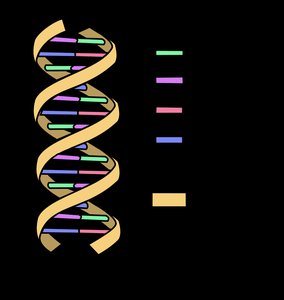
Genetic information is stored in deoxyribonucleic acid (DNA), which is organized into chromosomes. Each chromosome contains one long DNA molecule with hundreds of genes, the units of inheritance.
DNA is composed of two long chains forming a double helix.
Each chain is made of nucleotides (nitrogenous base, phosphate group, sugar).
DNA is transcribed into mRNA, which is then translated into proteins (gene expression).
Transfer and Transformation of Energy and Matter
Energy Flow and Chemical Cycling
Life depends on the transfer and transformation of energy and matter. Energy flows through ecosystems, while chemicals cycle within them.
Producers: Organisms that make their own food (e.g., plants via photosynthesis).
Consumers: Organisms that feed on other organisms.
Decomposers: Organisms that absorb nutrients from nonliving matter.
Energy enters as light, is converted to chemical energy, and exits as heat.
Interactions in Living Systems
Feedback Regulation
Biological processes are regulated by feedback mechanisms. The most common is negative feedback, where the end product slows its own production.
Abiotic factors: Nonliving components of the environment.
Biotic factors: Living components.
Human activities, such as burning fossil fuels, contribute to climate change (directional changes in climate lasting at least 30 years).
Evolution: Unity and Diversity of Life
Evolutionary Theory
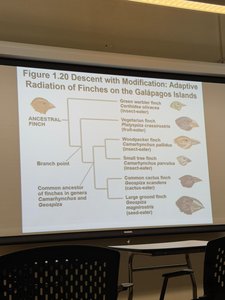
Evolution is the process by which species accumulate changes from their ancestors, adapting to their environments. It explains both the unity and diversity of life.
Each species is given a two-part scientific name (e.g., Homo sapiens).
Taxonomic classification: Domain, Kingdom, Phylum, Class, Order, Family, Genus, Species.
Three domains: Bacteria, Archaea (both prokaryotic), and Eukarya (includes animals, plants, fungi, protists).
Kingdoms are distinguished by modes of nutrition.
Natural Selection
Charles Darwin's theory of natural selection explains how populations evolve:
Populations have varied inherited traits.
Individuals with less advantageous traits are eliminated.
Survivors reproduce, increasing the frequency of beneficial traits.
The Chemical Context of Life
Elements and Atoms
Matter is composed of elements, substances that cannot be broken down by chemical reactions. Compounds are substances consisting of two or more elements in fixed ratios. Four elements make up 96% of living matter: carbon, oxygen, hydrogen, and nitrogen.
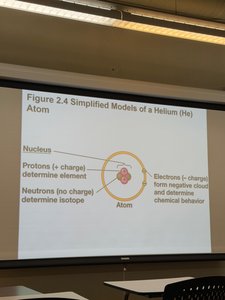
Atom: Smallest unit of an element, composed of protons (+), neutrons (0), and electrons (-).
Atomic number: Number of protons.
Mass number: Protons + neutrons.
Isotopes: Atoms of the same element with different numbers of neutrons.
Radioactive isotopes: Unstable, decay spontaneously.
Electron Configuration and Chemical Bonds
Electrons are arranged in shells around the nucleus. The chemical behavior of an atom is determined by the number of valence electrons (outermost shell). Atoms with incomplete valence shells can share or transfer electrons, forming chemical bonds.
Covalent bonds: Atoms share electrons (single, double bonds).
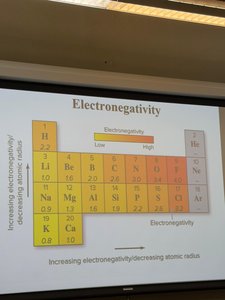
Electronegativity: Atom's attraction for electrons in a bond. Higher electronegativity means stronger pull.
Nonpolar covalent bond: Electrons shared equally.
Polar covalent bond: Electrons shared unequally, creating partial charges.
Ionic bonds: Attraction between oppositely charged ions (cation and anion).
Hydrogen bonds: Weak attractions between a partially positive hydrogen and a partially negative atom.
Van der Waals interactions: Weak attractions due to transient partial charges.
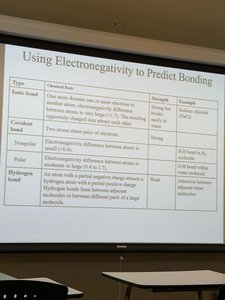
Using Electronegativity to Predict Bonding
Electronegativity differences between atoms help predict the type of bond formed. The following table summarizes the main types of bonds:
Type | Chemical Basis | Strength | Example |
|---|---|---|---|
Ionic bond | One atom donates one or more electrons to another atom; large electronegativity difference | Strong (dry), weak (wet) | Sodium chloride (NaCl) |
Covalent bond (Nonpolar) | Two atoms share pairs of electrons equally | Strong | H2, O2 |
Covalent bond (Polar) | Electronegativity difference between atoms; unequal sharing | Strong | H2O |
Hydrogen bond | Attraction between partial charges; H atom covalently bonded to electronegative atom is attracted to another electronegative atom | Weak | Between water molecules |
Water and Life
Properties of Water
Water is essential for life due to its unique properties, which arise from its polar structure and ability to form hydrogen bonds:
Cohesion: Water molecules stick together, creating surface tension.
Moderation of Temperature: High specific heat allows water to buffer temperature changes.
Expansion upon Freezing: Ice is less dense than liquid water, so it floats.
Versatility as a Solvent: Water dissolves many substances due to its polarity.
Acids, Bases, and Buffers
Acids: Increase hydrogen ion concentration (pH < 7).
Bases: Decrease hydrogen ion concentration (pH > 7).
Buffers: Minimize changes in pH; important for maintaining homeostasis.
Carbon and the Molecular Diversity of Life
Organic Chemistry and Carbon Compounds
Living organisms are composed mainly of carbon-based compounds. Carbon's ability to form four covalent bonds leads to a diversity of organic molecules, including proteins, DNA, and carbohydrates.
Hydrocarbons: Molecules made only of hydrogen and carbon.
Isomers: Compounds with the same formula but different structures (structural, cis-trans, enantiomers).
Functional Groups: Groups of atoms attached to carbon skeletons that participate in chemical reactions (e.g., hydroxyl, carbonyl, carboxyl, amino, sulfhydryl, phosphate, methyl).
ATP: An important organic phosphate group that stores energy for cellular processes.
