 Back
Foundations of Genetics: Mendel, Galton, and the Study of Variation
Study Guide - Smart Notes
 Tailored notes based on your materials, expanded with key definitions, examples, and context.
Genetics: Historical Foundations
Introduction to the Study of Variation
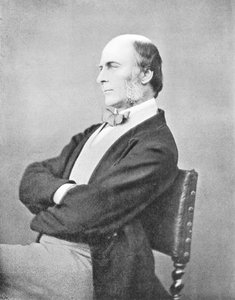
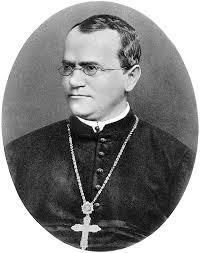
The study of genetics began with questions about how traits are transmitted from one generation to the next and what causes variation among individuals. Two key figures, working in the 19th century, were instrumental in shaping our understanding: Sir Francis Galton and Johann Gregor Mendel. Their work laid the foundation for modern genetics, distinguishing between quantitative and qualitative traits and introducing mathematical approaches to heredity.
Galton and Mendel: Approaches to Variation
Both Galton and Mendel studied variation, but their approaches differed significantly. Galton focused on quantitative traits, such as size and intelligence, and sought to understand inheritance through statistical methods. Mendel, on the other hand, investigated discrete, binary traits in pea plants (Pisum sativum), establishing the laws of inheritance.
Quantitative Traits: Traits that vary continuously (e.g., height, seed diameter).
Qualitative Traits: Traits with distinct categories (e.g., flower color, seed shape).
Binary Traits: Traits with two possible states (e.g., tall vs. short).

Sir Francis Galton: Quantitative Genetics
Galton's Contributions
Galton was a pioneer in applying statistical analysis to biological inheritance. He studied the inheritance of size in peas and human stature, introducing the concept of correlation and regression. He also conducted experiments with rabbits and blood transfusions to test inheritance mechanisms.
Correlation: A statistical measure of the relationship between two variables.
Regression: The tendency of offspring to exhibit traits closer to the population mean than their parents (regression toward the mean).
Biomarkers: Galton established fingerprinting as a unique identifier.

Galton's Theory of Mediocrity
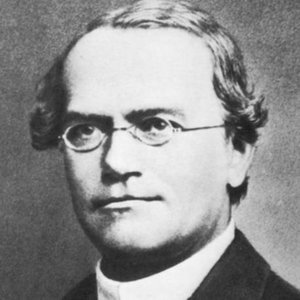
Galton observed that extreme traits in parents tend to regress toward the average in their offspring. This concept, known as "regression toward the mean," is fundamental in quantitative genetics.
Regression Equation: (where y is offspring trait, x is parental trait, m is slope, b is intercept)
Application: Used to predict inheritance patterns for continuous traits.
Johann Gregor Mendel: Qualitative Genetics
Mendel's Experiments with Pea Plants
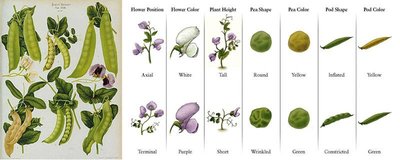
Mendel conducted systematic experiments on pea plants, focusing on seven discrete traits, each with two variants. He studied individual plants rather than populations, applying mathematical analysis to his results. Mendel's work established the laws of inheritance for binary traits.
Discrete Traits Studied: Flower color, seed shape, pod shape, plant height, etc.
Mendelian Laws: Law of Segregation and Law of Independent Assortment.
Novelty: Mendel's approach was unique in its focus on clear, binary traits and mathematical rigor.
Comparison: Galton vs. Mendel
Galton and Mendel measured different types of traits, leading to the distinction between quantitative and qualitative genetics. Mendel's laws apply to all traits, but the mode of measurement differs.
Aspect | Galton | Mendel |
|---|---|---|
Trait Type | Quantitative (continuous) | Qualitative (discrete) |
Measurement | Variable | Either/Or |
Method | Statistical analysis | Algebraic formulae |
Eugenics and Social Policy
Galton's Influence and Eugenics
Galton's interest in "bettering man" led to the development of eugenics, the idea of perpetuating "good genes" through selective breeding. This concept influenced social policy, including laws on marriage and sterilization, and had far-reaching consequences.
Eugenics: The practice of improving the genetic quality of the human population.
Social Impact: Policies such as the Virginia Racial Integrity Act and forced sterilization.
Historical Consequences: Inspired similar practices in other countries, including Nazi Germany.
Key Concepts in Genetics
Qualitative vs. Quantitative Genetics
Genetic traits can be classified as qualitative (discrete) or quantitative (continuous). Mendelian laws underlie the inheritance of all traits, but the expression and measurement differ.
Qualitative Genetics: Traits with distinct categories, governed by single genes.
Quantitative Genetics: Traits with a range of values, often influenced by multiple genes.
Continuous Traits: Traits such as height or seed diameter, showing a spectrum of variation.
Questions for Review
Design an experiment to determine the minimum number of genes required for an organism to exist and reproduce.
Speculate on how Wallace’s life events led to his unique perspective on evolution.
Argue why Wallace’s proposal is a stronger theory to explain species evolution compared to Darwin’s.
Explain how Darwin’s theory of evolution led to the birth of Eugenics.
Describe how a single gene can lead to the production of a continuous trait.
Compare Galton’s and Mendel’s results in studying inheritance in peas.
Additional info: Academic context was added to clarify the distinction between qualitative and quantitative genetics, the historical impact of eugenics, and the mathematical basis of Galton's regression analysis.
