 Back
Free Energy, Spontaneity, and Metabolism in Biological Systems
Study Guide - Smart Notes
 Tailored notes based on your materials, expanded with key definitions, examples, and context.
Free Energy and Spontaneous Reactions
Gibbs Free Energy (G) and Its Biological Importance
The concept of free energy is central to understanding which chemical reactions in living systems occur spontaneously and which require energy input. Gibbs free energy (G) is the portion of a system’s energy that can perform work when temperature and pressure are uniform, as in a cell. The change in free energy (ΔG) during a reaction determines whether the process is spontaneous.
ΔG Equation: The change in free energy is calculated as: where:
ΔH = change in enthalpy (total energy)
ΔS = change in entropy (disorder)
T = absolute temperature in Kelvin
Spontaneity: Only reactions with a negative ΔG (ΔG < 0) are spontaneous.
Biological Relevance: Spontaneous reactions can be harnessed by cells to perform work, such as powering metabolic pathways.
Free Energy, Stability, and Equilibrium
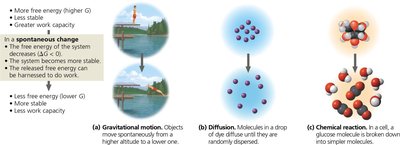
Free energy is a measure of a system’s instability. Systems with higher G are less stable and tend to change spontaneously to lower G, becoming more stable. At equilibrium, G is at its minimum, and no work can be done.
ΔG and Stability:
Unstable systems (high G) move toward stability (low G).
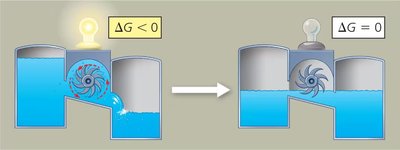
At equilibrium, ΔG = 0 and the system cannot do work.
Equilibrium: Forward and reverse reactions occur at the same rate; no net change in reactant/product concentrations.
Exergonic and Endergonic Reactions
Classification of Metabolic Reactions
Metabolic reactions are classified based on their free-energy changes:
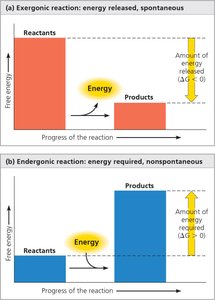
Exergonic Reactions:
"Energy outward"
Net release of free energy (ΔG < 0)
Spontaneous
Example: Cellular respiration
Endergonic Reactions:
"Energy inward"
Absorbs free energy (ΔG > 0)
Non-spontaneous
Example: Photosynthesis (CO2 + H2O → glucose + O2)
Example: Cellular Respiration
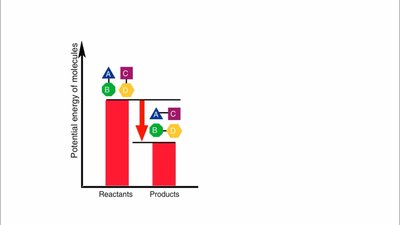
Cellular respiration is a classic exergonic reaction:
Overall reaction: C6H12O6 + 6 O2 → 6 CO2 + 6 H2O
ΔG = -686 kcal/mol (energy released)
Products have lower free energy than reactants
Equilibrium and Metabolism
Work and Equilibrium in Biological Systems
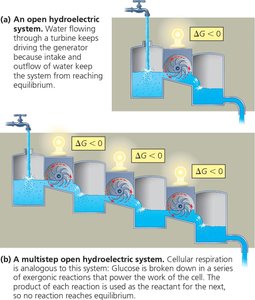
Reactions in isolated systems eventually reach equilibrium and can do no work. Living cells avoid equilibrium by constantly exchanging materials with their surroundings, keeping metabolic pathways active.
Isolated System: Reaches equilibrium (ΔG = 0), no work possible.
Open System: Continuous input/output prevents equilibrium, allowing ongoing work.
Metabolic Pathways: Products of one reaction become reactants for the next, maintaining a "downhill" flow of free energy.
Summary Table: Exergonic vs. Endergonic Reactions
Type of Reaction | ΔG | Spontaneity | Energy Flow | Example |
|---|---|---|---|---|
Exergonic | ΔG < 0 | Spontaneous | Energy released | Cellular respiration |
Endergonic | ΔG > 0 | Non-spontaneous | Energy absorbed | Photosynthesis |
Key Terms and Concepts
Gibbs Free Energy (G): Energy available to do work in a system.
ΔG: Change in free energy; determines spontaneity.
Spontaneous Process: Occurs without energy input; ΔG < 0.
Equilibrium: State of maximum stability; ΔG = 0.
Exergonic Reaction: Releases energy; spontaneous.
Endergonic Reaction: Requires energy; non-spontaneous.
Examples and Applications
Gravitational Motion: Objects move spontaneously from higher to lower altitude.
Diffusion: Molecules spread spontaneously from concentrated to dispersed states.
Chemical Reaction: Glucose breakdown in cells is spontaneous and exergonic.
Additional info:
Cells maintain non-equilibrium by constantly exchanging materials, enabling life processes.
Energy released in exergonic reactions can be used for cellular work, such as ATP synthesis.
