 Back
From Genes to Proteins: Structure and Function of DNA and the Flow of Genetic Information
Study Guide - Smart Notes
 Tailored notes based on your materials, expanded with key definitions, examples, and context.
Overview of Genetic Material
Genes, DNA, and Proteins
Genes are the fundamental units of inheritance, composed of DNA sequences that encode instructions for synthesizing proteins. These proteins are responsible for the vast array of cellular functions and traits observed in living organisms. The flow of genetic information follows the central dogma: DNA is transcribed into RNA, which is then translated into protein.
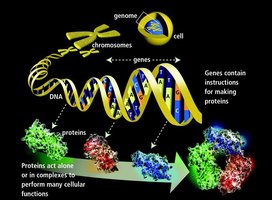
Genome: The complete set of genetic material in an organism.
Chromosomes: Structures within cells that contain DNA and associated proteins.
Genes: Segments of DNA that code for specific proteins.
Proteins: Molecules that perform cellular functions, acting alone or in complexes.
The Search for the Genetic Material
Historical Discoveries
The identification of DNA as the genetic material was a gradual process involving many scientists:
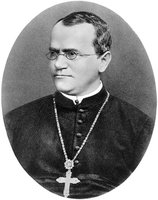
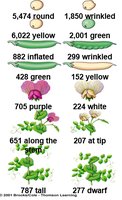
Gregor Mendel: Discovered the basic laws of inheritance through pea plant experiments, proposing that discrete "heritable factors" (now known as genes) control traits.
Friedrich Miescher: First isolated DNA (then called "nuclein") from white blood cells, suggesting its role in heredity.
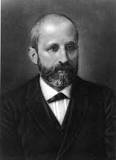
Frederick Griffith: Demonstrated transformation in bacteria, showing that genetic material could be transferred between cells.
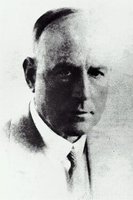
Avery, MacLeod, and McCarty: Proved that DNA, not protein, is the genetic material responsible for transformation.
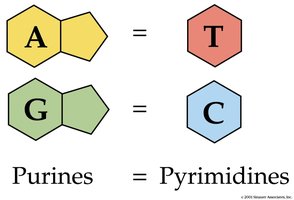
Erwin Chargaff: Established Chargaff's rules, showing that in DNA, the amount of adenine equals thymine and guanine equals cytosine.
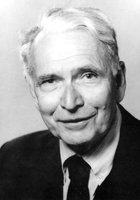
Rosalind Franklin: Used X-ray crystallography to reveal the helical structure of DNA.
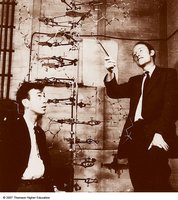
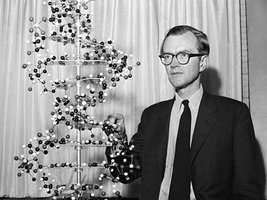
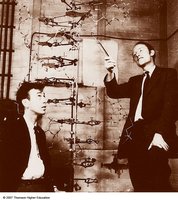
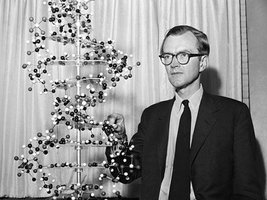
James Watson and Francis Crick: Built the double helix model of DNA, integrating data from Chargaff and Franklin.
Nucleic Acids, Nucleotides, and the Structure of DNA
Nucleic Acids: DNA and RNA
Nucleic acids are large polymers (polynucleotides) made up of nucleotide monomers. There are two main types: DNA (deoxyribonucleic acid) and RNA (ribonucleic acid). Both are found in all living cells, with DNA serving as the genetic blueprint and RNA playing roles in gene expression and protein synthesis.
DNA: Contains deoxyribose sugar; usually double-stranded.
RNA: Contains ribose sugar; usually single-stranded.
Nucleotide Structure
Each nucleotide consists of three components:
Phosphate group (provides acidity and negative charge)
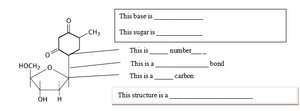
5-carbon sugar (deoxyribose in DNA, ribose in RNA)
Nitrogenous base (adenine, guanine, cytosine, thymine in DNA; uracil replaces thymine in RNA)
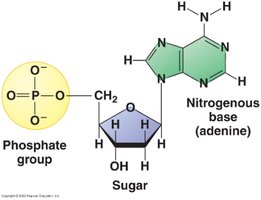
Types of Nitrogenous Bases
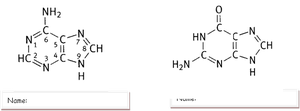
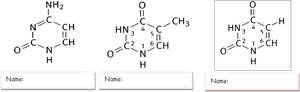
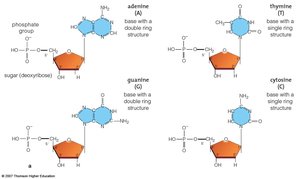
Purines: Double-ring structures (adenine and guanine)
Pyrimidines: Single-ring structures (cytosine, thymine, uracil)
Nucleosides and Nucleotides
A nucleoside consists of a nitrogenous base bonded to a sugar. When one or more phosphate groups are attached to the nucleoside, it becomes a nucleotide.
Polynucleotide Formation
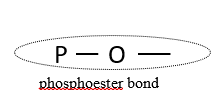
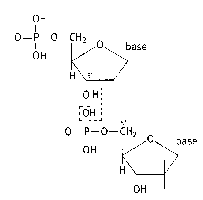
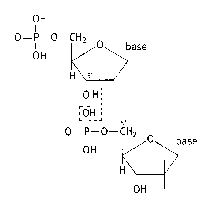
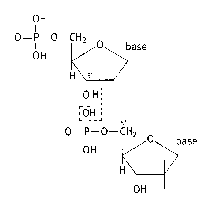
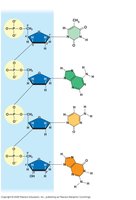
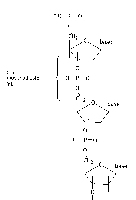
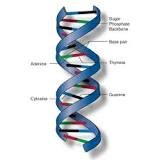
Nucleotides are joined by phosphodiester bonds, linking the 5' phosphate of one nucleotide to the 3' hydroxyl of the next. This forms the sugar-phosphate backbone of DNA and RNA.
Directionality of Polynucleotides
Polynucleotide chains have directionality, with distinct 5' (phosphate) and 3' (hydroxyl) ends. This polarity is essential for DNA replication and transcription.
Double Helix Structure of DNA
DNA consists of two antiparallel polynucleotide strands twisted into a double helix. The strands are held together by specific hydrogen bonds between complementary bases: adenine pairs with thymine (A-T, 2 H bonds), and guanine pairs with cytosine (G-C, 3 H bonds).

The Central Dogma of Molecular Biology
Flow of Genetic Information
The central dogma describes the flow of genetic information within a biological system: DNA is replicated, transcribed into RNA, and translated into protein. This process ensures that genetic information is accurately passed on and expressed as cellular traits.
Replication: Copying DNA before cell division.
Transcription: Synthesis of RNA from a DNA template.
Translation: Synthesis of proteins using the information in RNA.
DNA Replication
Mechanism of Replication
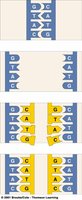
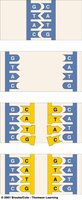
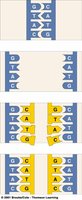
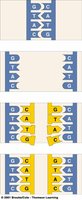
DNA replication is semi-conservative: each new DNA molecule consists of one old (parental) strand and one newly synthesized strand. The process involves unwinding the double helix, separating the strands, and synthesizing new complementary strands using free nucleotides.
Enzymes and Proteins in Replication
Helicase: Unwinds the DNA helix.
Single-strand binding proteins (SSB): Stabilize separated strands.
Topoisomerases: Relieve supercoiling.
Primase: Synthesizes RNA primers.
DNA polymerase III: Main enzyme for DNA synthesis (adds nucleotides to the 3' end).
DNA polymerase I: Removes RNA primers and fills gaps.
DNA ligase: Seals nicks between Okazaki fragments on the lagging strand.
Leading and Lagging Strands
Because DNA polymerase can only add nucleotides in the 5' to 3' direction, replication is continuous on the leading strand and discontinuous on the lagging strand (forming Okazaki fragments).
Leading strand: Synthesized continuously toward the replication fork.
Lagging strand: Synthesized discontinuously away from the fork in short segments.
Proofreading and Fidelity
DNA polymerases have proofreading activity to correct errors during replication, ensuring high fidelity in DNA copying.
Protein Synthesis: Transcription and Translation
Transcription: DNA to RNA
Transcription is the process by which the information in a DNA sequence is copied into a complementary RNA molecule. In bacteria, this involves three main steps: initiation, elongation, and termination.
Initiation: RNA polymerase binds to the promoter region (e.g., Pribnow box at -10, -35 sequence) and unwinds the DNA.
Elongation: RNA polymerase synthesizes the RNA strand in the 5' to 3' direction, using the DNA template strand.
Termination: Specific sequences (e.g., hairpin loops) signal the end of transcription, releasing the RNA transcript.
Translation: RNA to Protein
Translation is the process by which the nucleotide sequence of mRNA is decoded to build a specific sequence of amino acids, forming a protein. This process occurs in the ribosome and involves tRNA molecules that bring amino acids corresponding to each codon in the mRNA.
Summary Table: Key Differences Between DNA and RNA
Feature | DNA | RNA |
|---|---|---|
Sugar | Deoxyribose | Ribose |
Strands | Double-stranded | Single-stranded |
Bases | A, T, G, C | A, U, G, C |
Location | Nucleus (eukaryotes), cytoplasm (prokaryotes) | Nucleus, cytoplasm |
Function | Genetic blueprint | Gene expression, protein synthesis |
Key Terms and Concepts
Gene: A segment of DNA that codes for a protein.
Genome: The complete set of genes in an organism.
Chromosome: DNA-protein complex carrying genetic information.
Nucleotide: Building block of nucleic acids (phosphate, sugar, base).
Polynucleotide: Chain of nucleotides.
Replication: Copying DNA before cell division.
Transcription: Synthesis of RNA from DNA.
Translation: Synthesis of protein from RNA.
Antiparallel: Orientation of DNA strands running in opposite directions.
Okazaki fragments: Short DNA segments on the lagging strand.
