 Back
Functional Groups, Biomolecules, Proteins, and Enzymes: Structure and Function
Study Guide - Smart Notes
 Tailored notes based on your materials, expanded with key definitions, examples, and context.
Functional Groups and the Chemical Basis of Life
Properties of Carbon
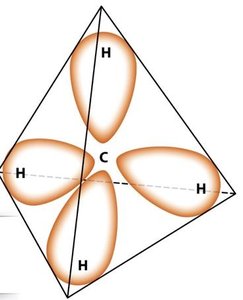
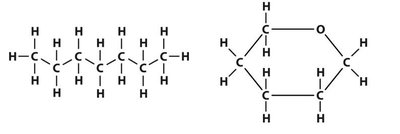
Carbon is the foundational element of organic molecules due to its ability to form four covalent bonds, allowing for a diversity of molecular structures. Each bond can rotate freely, and carbon atoms can link to form straight chains, branched chains, rings, or contain double bonds. This versatility underlies the molecular diversity essential for life.
Organic compounds are molecules containing carbon-carbon (C-C) bonds.
Carbon provides the backbone or skeleton of organic molecules, while functional groups provide chemical diversity and reactivity.
Functional Groups
Functional groups are specific groups of atoms attached to the carbon skeleton that participate in chemical reactions and confer specific properties to molecules. Only a few functional groups are responsible for the structural and functional diversity of biological molecules.
Hydroxyl (-OH): Found in alcohols; makes molecules polar and hydrophilic.
Carbonyl (C=O): Found in aldehydes and ketones; increases reactivity.
Carboxyl (-COOH): Acts as an acid; can donate H+ ions.
Amino (-NH2): Acts as a base; can accept H+ ions.
Phosphate (-PO4): Involved in energy transfer (e.g., ATP).
Acidic groups can donate H+ ions, becoming negatively charged, while basic groups can accept H+ ions, becoming positively charged.


Macromolecules: Structure and Synthesis
Classes of Biological Macromolecules
Cells synthesize four major classes of macromolecules from a limited set of small molecules:
Nucleic acids (~15%)
Proteins (~50%)
Carbohydrates (~15%)
Lipids (~15%)
Cells are composed of about 80% water, with the remaining 20% consisting of these macromolecules in the proportions above.
Polymerization: Dehydration Synthesis and Hydrolysis
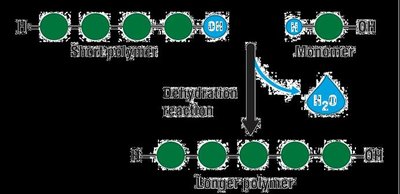
Macromolecules are formed by linking monomers through dehydration synthesis (also called condensation), which removes a water molecule to form a covalent bond. The reverse process, hydrolysis, breaks covalent bonds by adding water.
Proteins: Structure and Function
Overview of Proteins
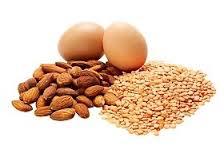
Proteins are the most abundant macromolecules in cells and are involved in nearly every cellular function. They are polymers of amino acids linked by peptide bonds.
Proteins serve as enzymes, structural components, signaling molecules, transporters, and more.
Functions of Proteins
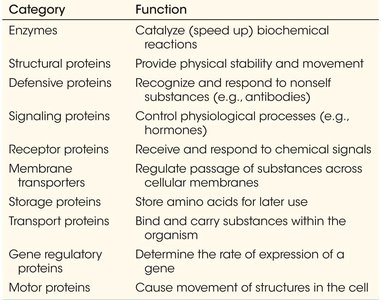
Proteins perform a wide variety of functions in cells, including catalysis, structure, defense, signaling, transport, and regulation.
Category | Function |
|---|---|
Enzymes | Catalyze (speed up) biochemical reactions |
Structural proteins | Provide physical stability and movement |
Defensive proteins | Recognize and respond to nonself substances (e.g., antibodies) |
Signaling proteins | Control physiological processes (e.g., hormones) |
Receptor proteins | Receive and respond to chemical signals |
Membrane transporters | Regulate passage of substances across cellular membranes |
Storage proteins | Store amino acids for later use |
Transport proteins | Bind and carry substances within the organism |
Gene regulatory proteins | Determine the rate of expression of a gene |
Motor proteins | Cause movement of structures in the cell |
Amino Acids: Structure and Properties
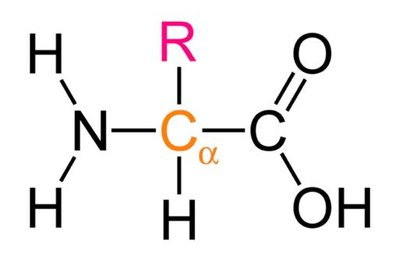
Amino acids are the monomers of proteins. Each amino acid contains a central (alpha) carbon bonded to an amino group, a carboxyl group, a hydrogen atom, and a variable side chain (R group). The properties of the side chain determine the characteristics and folding of the protein.
Peptide bonds link amino acids to form polypeptides.
The sequence of amino acids (primary structure) determines the protein's final shape and function.
Classification of Amino Acids
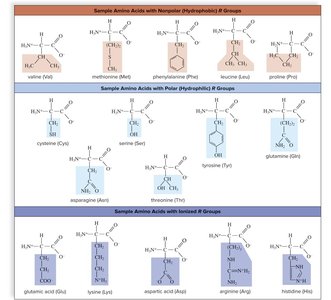
Amino acids are classified based on the properties of their side chains:
Nonpolar (hydrophobic)
Polar (hydrophilic)
Acidic (negatively charged at cellular pH)
Basic (positively charged at cellular pH)
Ionization of Amino Acids
At cellular pH, acidic side chains donate H+ ions and become negatively charged, while basic side chains accept H+ ions and become positively charged. This property is crucial for protein folding and function.
Levels of Protein Structure
Primary structure: Linear sequence of amino acids connected by peptide bonds.
Secondary structure: Local folding into alpha helices and beta sheets, stabilized by hydrogen bonds between backbone atoms.
Tertiary structure: Overall 3D shape formed by interactions between side chains (hydrophobic interactions, ionic bonds, hydrogen bonds, disulfide bridges).
Quaternary structure: Association of multiple polypeptide subunits.
Protein Denaturation
Protein structure can be disrupted (denatured) by changes in pH or temperature, which affects secondary, tertiary, and quaternary structures but not the primary structure. Mutations in the amino acid sequence can also alter protein structure and function.
Enzymes: Biological Catalysts
Role and Mechanism of Enzymes
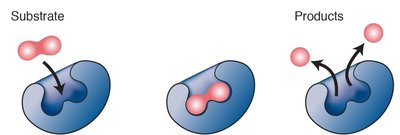
Enzymes are proteins that accelerate chemical reactions by lowering the activation energy required. They are highly specific for their substrates, which bind to the enzyme's active site (lock-and-key model).
Enzymes are not consumed or permanently changed by the reaction.
They can catalyze the same reaction repeatedly.
Enzyme-Substrate Complex and Catalysis
The substrate binds to the enzyme's active site, forming an enzyme-substrate complex. The enzyme orients the substrate, applies strain to bonds, and provides a microenvironment favorable for the reaction. After the reaction, the product is released, and the enzyme is free to catalyze another reaction.
Factors Affecting Enzyme Activity
Substrate concentration: As substrate concentration increases, reaction rate increases until the enzyme is saturated (maximum rate).
Inhibitors:
Competitive inhibitors: Compete with substrate for the active site, reducing reaction rate.
Non-competitive (allosteric) inhibitors: Bind elsewhere on the enzyme, changing its shape and reducing maximum reaction rate.
Activators: Molecules that increase enzyme activity, often by adding or removing phosphate groups (kinases and phosphatases).
Summary Table: Types of Enzyme Inhibition
Type of Inhibitor | Binding Site | Effect on Reaction Rate |
|---|---|---|
Competitive | Active site | Slows reaction; can be overcome by increasing substrate |
Non-competitive (Allosteric) | Other site (not active site) | Lowers maximum rate; cannot be overcome by substrate |
Key Terms and Concepts
Functional group: A group of atoms responsible for characteristic reactions of a molecule.
Dehydration synthesis: Reaction that joins monomers by removing water.
Hydrolysis: Reaction that breaks polymers by adding water.
Peptide bond: Covalent bond linking amino acids in a protein.
Enzyme: Protein catalyst that speeds up biochemical reactions.
Active site: Region of an enzyme where substrate binds and reaction occurs.
Inhibitor: Molecule that decreases enzyme activity.
