 Back
Functional Groups: Determinants of Chemical Behavior in Biological Molecules
Study Guide - Smart Notes
 Tailored notes based on your materials, expanded with key definitions, examples, and context.
Functional Groups and Their Role in Biology
Introduction to Functional Groups
Functional groups are specific groups of atoms within molecules that are responsible for the characteristic chemical reactions of those molecules. In biological systems, functional groups are commonly found attached to proteins, nucleic acids, carbohydrates, and lipids, and they play a crucial role in determining the chemical behavior and properties of these molecules.
Definition: Functional groups are clusters of atoms that impart specific chemical properties to organic molecules.
Importance: The presence and arrangement of functional groups influence molecular shape, reactivity, solubility, and interactions with other molecules.
Application: Understanding functional groups is essential for predicting the behavior of biomolecules in metabolic pathways and cellular processes.
Six Common Functional Groups Attached to Carbon Atoms
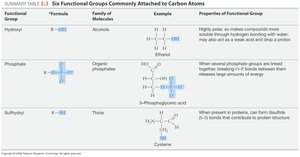
The following table summarizes six functional groups commonly found in biological molecules, their formulas, associated families, examples, and their properties.
Name of Functional Group | Formula | Family of Molecules | Example | Properties of Functional Group |
|---|---|---|---|---|
Hydroxyl | -OH | Alcohols | Ethanol | Highly polar; makes compounds more soluble through hydrogen bonding with water; may act as a weak acid and drop a proton. |
Phosphate | -PO4 | Organic phosphates | 3-Phosphoglyceric acid | When several phosphates are grouped together, breaking O-P bonds between them releases large amounts of energy. |
Sulfhydryl | -SH | Thiols | Cysteine | When present in proteins, can form disulfide (S-S) bonds that contribute to protein structure. |
Additional info: The table also includes other functional groups such as amino, carboxyl, and carbonyl, which are essential for protein structure and function, but only three are visible in the provided image. |
Properties and Effects of Functional Groups
Hydroxyl (-OH): Increases solubility and can participate in hydrogen bonding, affecting molecular interactions.
Phosphate (-PO4): Key in energy transfer (e.g., ATP), and can alter protein shape and function through phosphorylation.
Sulfhydryl (-SH): Important for protein structure via disulfide bonds, which stabilize protein folding.
Negative Charges: Functional groups with negative charges (such as phosphate) can change the shape of proteins and influence their activity.
Examples and Applications
Ethanol: Contains a hydroxyl group, making it soluble in water and able to participate in hydrogen bonding.
3-Phosphoglyceric acid: Contains a phosphate group, important in metabolic pathways like glycolysis.
Cysteine: Contains a sulfhydryl group, allowing the formation of disulfide bonds in proteins such as insulin.
Summary
Functional groups are fundamental to the structure and function of biological molecules. Their presence determines the chemical behavior, reactivity, and interactions of biomolecules, which is essential for understanding cellular processes and metabolic pathways. Memorizing the names, formulas, families, examples, and properties of functional groups is crucial for success in General Biology. Additional info: Other functional groups not shown in the image, such as amino (-NH2), carboxyl (-COOH), and carbonyl (C=O), are also vital for protein structure and function. These should be reviewed in the textbook for a comprehensive understanding.
