 Back
Functional Groups: Determinants of Chemical Behavior in Biological Molecules
Study Guide - Smart Notes
 Tailored notes based on your materials, expanded with key definitions, examples, and context.
Functional Groups in Biology
Overview of Functional Groups
Functional groups are specific groups of atoms within molecules that are responsible for the characteristic chemical reactions of those molecules. In biological systems, functional groups are commonly found attached to proteins, nucleic acids, carbohydrates, and lipids. Their presence determines the chemical behavior and properties of the molecule, influencing biological activity and molecular interactions.
Definition: Functional groups are clusters of atoms that impart specific chemical properties to organic molecules.
Importance: The type and arrangement of functional groups affect solubility, reactivity, and molecular shape.
Application: Functional groups are key to understanding metabolism, enzyme function, and molecular signaling.
Six Common Functional Groups Attached to Carbon Atoms
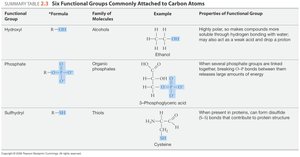
The following table summarizes six functional groups frequently encountered in biological molecules, their formulas, associated families, examples, and properties.
Name of Functional Group | Formula | Family of Molecules | Example | Properties of Functional Group |
|---|---|---|---|---|
Hydroxyl | –OH | Alcohols | Ethanol | Highly polar; makes compounds more soluble through hydrogen bonding with water; may act as a weak acid and drop a proton. |
Phosphate | –PO4 | Organic phosphates | 3-Phosphoglyceric acid | When several phosphates are grouped together, breaking O–P bonds between them releases large amounts of energy. |
Sulfhydryl | –SH | Thiols | Cysteine | When present in proteins, can form disulfide (S–S) bonds that contribute to protein structure. |
Properties and Biological Significance
Hydroxyl Group: Increases solubility and can participate in hydrogen bonding, affecting protein folding and enzyme activity.
Phosphate Group: Central to energy transfer (e.g., ATP), and can alter protein shape and function via phosphorylation.
Sulfhydryl Group: Forms disulfide bridges in proteins, stabilizing tertiary and quaternary structures.
Functional Groups and Protein Shape
Functional groups such as phosphate and sulfhydryl can introduce negative charges or form covalent bonds, which may change the shape of proteins and thus their function. This is crucial in processes like enzyme regulation and signal transduction.
Example: Addition of a phosphate group to a protein (phosphorylation) can activate or deactivate the protein's function.
Example: Disulfide bonds formed by sulfhydryl groups stabilize protein structure.
Summary Table Purpose
The table above serves as a comparison and classification of functional groups, highlighting their formulas, molecular families, examples, and properties. Understanding these groups is essential for predicting molecular behavior in biological systems.
Additional info:
Other functional groups commonly found in biology include amino (–NH2), carboxyl (–COOH), and carbonyl (–CO), each with distinct properties and roles.
Functional groups are often used to identify and classify organic molecules in biochemistry.
