 Back
Functional Groups in Biological Molecules: Structure, Examples, and Properties
Study Guide - Smart Notes
 Tailored notes based on your materials, expanded with key definitions, examples, and context.
Functional Groups in Biological Molecules
Functional groups are specific groups of atoms within molecules that have characteristic properties and chemical reactivities. They play a crucial role in the structure and function of biological molecules, influencing how these molecules interact in cells and organisms. Understanding functional groups is essential for studying the chemistry of life.
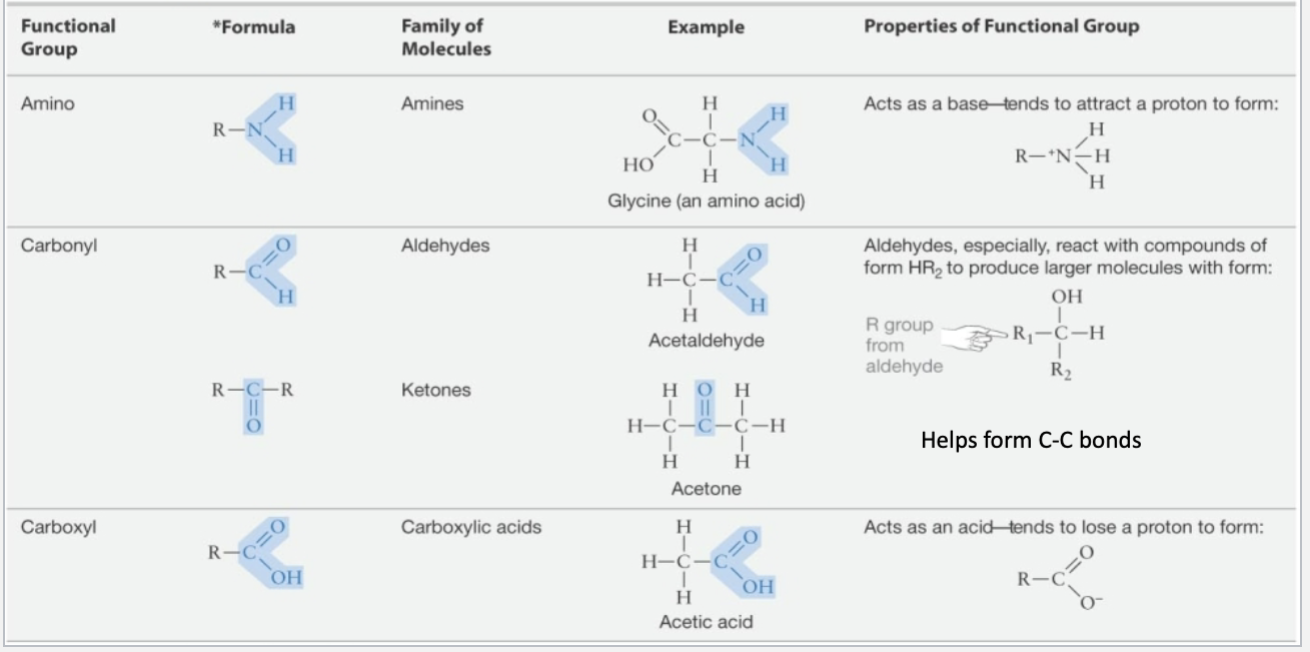
Amino Group
The amino group is a fundamental functional group found in many biological molecules, especially amino acids, which are the building blocks of proteins.
Structure: Consists of a nitrogen atom bonded to two hydrogen atoms (–NH2).
Family of Molecules: Amines
Properties: Acts as a base; tends to attract a proton (H+) to form a positively charged ion.
Example: Glycine (an amino acid)
Key Reaction: Amino groups can accept a proton to form .
Carbonyl Group
The carbonyl group is a carbon atom double-bonded to an oxygen atom (C=O). It is found in two main types of molecules: aldehydes and ketones.
Structure: C=O, with the carbon atom also bonded to other atoms (hydrogen or carbon).
Family of Molecules: Aldehydes (R–CHO) and Ketones (R–CO–R')
Properties: Aldehydes are reactive and can form larger molecules by reacting with compounds of the form HR2. Ketones help form carbon–carbon (C–C) bonds.
Examples: Acetaldehyde (an aldehyde), Acetone (a ketone)
Key Reaction: Aldehydes can react to form alcohols or larger molecules, while ketones are important in metabolic pathways.
Carboxyl Group
The carboxyl group is a combination of a carbonyl and a hydroxyl group attached to the same carbon atom. It is characteristic of carboxylic acids.
Structure: –COOH (a carbon double-bonded to an oxygen and single-bonded to a hydroxyl group)
Family of Molecules: Carboxylic acids
Properties: Acts as an acid; tends to lose a proton (H+) to form a negatively charged carboxylate ion.
Example: Acetic acid
Key Reaction: Carboxyl groups can donate a proton to become .
Summary Table: Functional Groups
Functional Group | Formula | Family of Molecules | Example | Properties |
|---|---|---|---|---|
Amino | R–NH2 | Amines | Glycine | Acts as a base; attracts a proton |
Carbonyl (Aldehyde) | R–CHO | Aldehydes | Acetaldehyde | Reacts to form larger molecules |
Carbonyl (Ketone) | R–CO–R' | Ketones | Acetone | Helps form C–C bonds |
Carboxyl | R–COOH | Carboxylic acids | Acetic acid | Acts as an acid; loses a proton |
Additional info: Functional groups are essential for the chemical diversity of biological molecules. Their presence and reactivity determine the structure, function, and interactions of biomolecules such as amino acids, nucleic acids, carbohydrates, and lipids.
