 Back
Functional Groups in Biomolecules: Structure, Properties, and Biological Roles
Study Guide - Smart Notes
 Tailored notes based on your materials, expanded with key definitions, examples, and context.
Functional Groups in Biomolecules
Overview
Functional groups are specific groups of atoms within molecules that are responsible for the characteristic chemical reactions of those molecules. Understanding functional groups is essential in General Biology, as they play a key role in the structure and function of biomolecules such as proteins, nucleic acids, carbohydrates, and lipids.
Functional groups determine the chemical properties and reactivity of organic molecules.
They are commonly found in biological macromolecules and influence solubility, acidity, and interactions.
Each functional group has a distinct structure, ionization state, and biological role.
Major Functional Groups
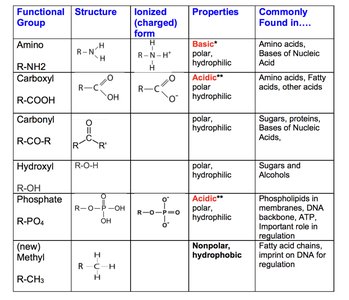
The table below summarizes the main functional groups relevant to biology, their structures, ionized forms, properties, and where they are commonly found:
Functional Group | Structure | Ionized (charged) form | Properties | Commonly Found in… |
|---|---|---|---|---|
Amino | R-NH2 | R-NH3+ | Basic, polar, hydrophilic | Amino acids, Bases of Nucleic Acid |
Carboxyl | R-COOH | R-COO- | Acidic, polar, hydrophilic | Amino acids, Fatty acids, other acids |
Carbonyl | R-CO-R | Polar, hydrophilic | Sugars, proteins, Bases of Nucleic Acids | |
Hydroxyl | R-OH | Polar, hydrophilic | Sugars and Alcohols | |
Phosphate | R-PO4 | Acidic, polar, hydrophilic | Phospholipids in membranes, DNA backbone, ATP; important role in regulation | |
Methyl (new) | R-CH3 | Nonpolar, hydrophobic | Fatty acid chains, imprint on DNA for regulation |
Key Properties and Biological Significance
Amino group: Acts as a base, accepting protons; found in amino acids and nucleic acid bases.
Carboxyl group: Acts as an acid, donating protons; present in amino acids and fatty acids.
Carbonyl group: Found in sugars (as ketones and aldehydes), proteins, and nucleic acid bases; increases polarity.
Hydroxyl group: Makes molecules more soluble in water; found in sugars and alcohols.
Phosphate group: Highly polar and acidic; key in energy transfer (ATP) and DNA structure.
Methyl group: Nonpolar, hydrophobic; important in fatty acids and epigenetic regulation of DNA.
Examples and Applications
Amino acids contain both amino and carboxyl groups, allowing them to act as buffers in biological systems.
Phospholipids contain phosphate groups, which are essential for membrane structure and function.
Methylation of DNA (addition of methyl groups) can regulate gene expression.
Formulas and Equations
Acid-base behavior of carboxyl and amino groups:
Phosphate group ionization:
Summary Table Purpose: The table above compares the structure, ionization, properties, and biological roles of major functional groups in biomolecules, aiding in the understanding of their importance in biological chemistry.
