 Back
Functional Groups in Biomolecules: Structures and Properties
Study Guide - Smart Notes
 Tailored notes based on your materials, expanded with key definitions, examples, and context.
Biomolecules: Functional Groups
Overview
Functional groups are specific groups of atoms within molecules that are responsible for the characteristic chemical reactions of those molecules. Understanding these groups is essential for studying the structure and function of biomolecules in General Biology.
Major Functional Groups
The following table summarizes the main functional groups found in biological molecules, their structures, ionized forms, and properties.
Functional Group | Structure | Ionized (charged) form | Properties |
|---|---|---|---|
Amino R-NH2 |
| R-NH3+ | Basic*, polar, hydrophilic |
Carboxyl R-COOH |
| R-COO- | Acidic**, polar, hydrophilic |
Carbonyl R-CO-R |
| polar, hydrophilic | |
Hydroxyl R-OH |
| polar, hydrophilic | |
Phosphate R-PO4 |
| R-PO4- | Acidic**, polar, hydrophilic |
Methyl R-CH3 |
| Nonpolar, hydrophobic |
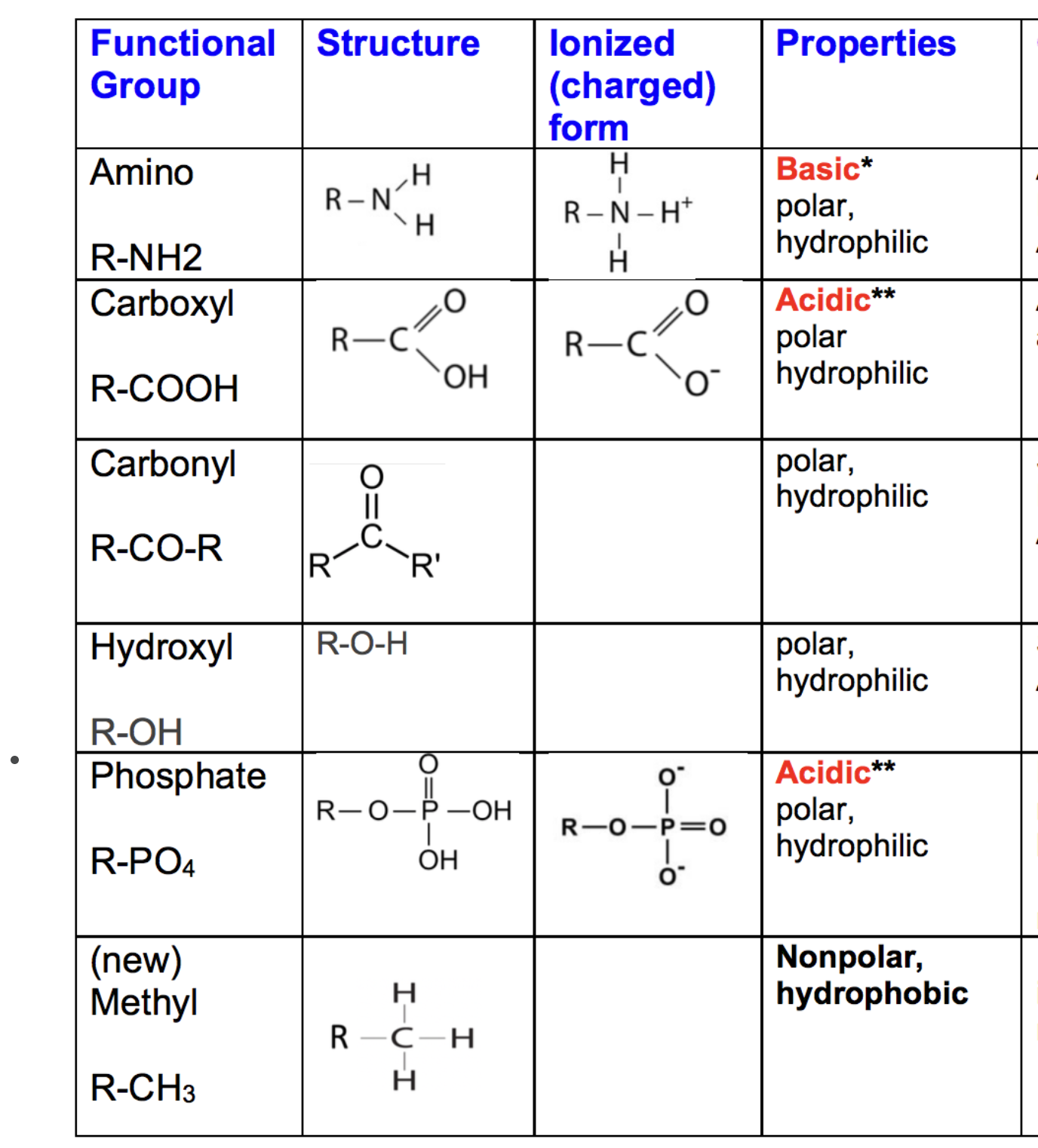
Functional Group Details
Amino Group
The amino group (R-NH2) is found in amino acids and proteins. It acts as a base, accepting protons to become ionized (R-NH3+). Amino groups are polar and hydrophilic, making them soluble in water.
Key Point: Amino groups participate in peptide bond formation.
Example: Glycine contains an amino group.
Carboxyl Group
The carboxyl group (R-COOH) is acidic and can donate a proton, becoming ionized (R-COO-). It is polar and hydrophilic, commonly found in amino acids and fatty acids.
Key Point: Carboxyl groups are involved in forming peptide bonds and ester linkages.
Example: Acetic acid contains a carboxyl group.
Carbonyl Group
The carbonyl group (R-CO-R) is found in ketones and aldehydes. It is polar and hydrophilic, contributing to the reactivity of sugars and other biomolecules.
Key Point: Carbonyl groups are important in carbohydrate chemistry.
Example: Acetone contains a carbonyl group.
Hydroxyl Group
The hydroxyl group (R-OH) is polar and hydrophilic, found in alcohols and sugars. It increases solubility in water and participates in hydrogen bonding.
Key Point: Hydroxyl groups are common in carbohydrates.
Example: Ethanol contains a hydroxyl group.
Phosphate Group
The phosphate group (R-PO4) is acidic, polar, and hydrophilic. It is found in nucleic acids (DNA, RNA) and energy molecules like ATP. The ionized form carries negative charges.
Key Point: Phosphate groups are essential for energy transfer and signaling.
Example: ATP contains three phosphate groups.
Methyl Group
The methyl group (R-CH3) is nonpolar and hydrophobic. It is found in lipids and can affect gene expression when attached to DNA.
Key Point: Methylation can regulate gene activity.
Example: Methane contains a methyl group.
Acidic and Basic Properties
Acidic groups (carboxyl, phosphate) donate protons and carry negative charges when ionized.
Basic groups (amino) accept protons and carry positive charges when ionized.
Hydrophilic vs. Hydrophobic
Hydrophilic groups (amino, carboxyl, carbonyl, hydroxyl, phosphate) interact well with water.
Hydrophobic groups (methyl) do not interact with water and are found in nonpolar regions of biomolecules.
Summary Table
The table above provides a concise comparison of the main functional groups, their chemical structure, ionized forms, and properties. Understanding these groups is fundamental for studying biomolecular structure and function in biology.
