 Back
BackFunctional Groups in Organic Molecules
Study Guide - Smart Notes
 Tailored notes based on your materials, expanded with key definitions, examples, and context.
Chemical Groups
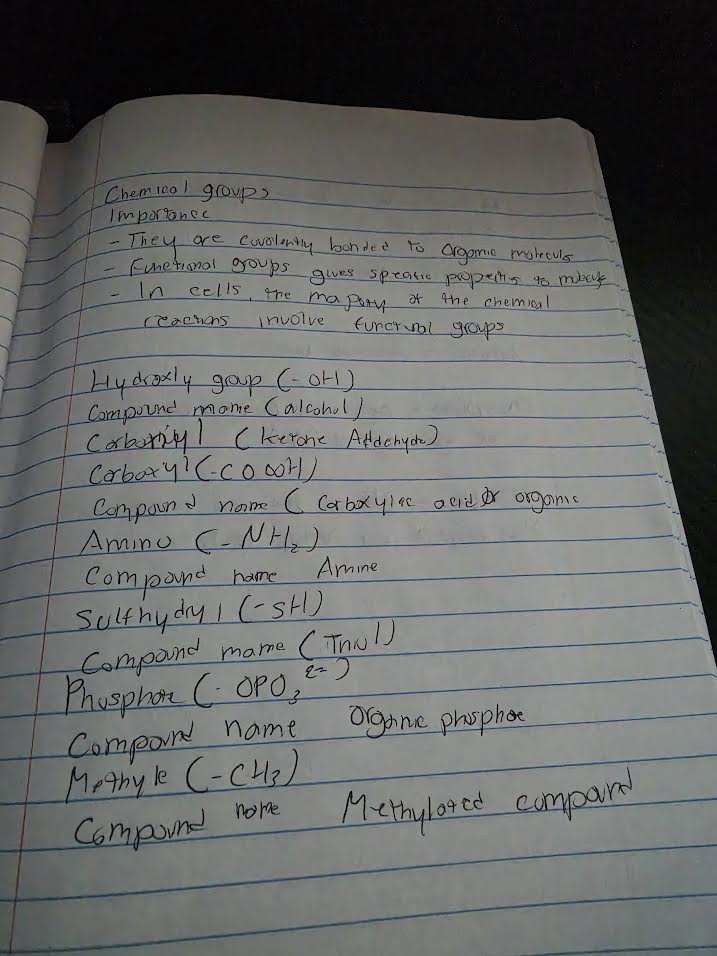
Importance of Functional Groups
Functional groups are specific groups of atoms within molecules that are responsible for the characteristic chemical reactions of those molecules. They are covalently bonded to organic molecules and impart distinct properties to the compounds they are part of.
Covalent Bonding: Functional groups are covalently bonded to the carbon skeleton of organic molecules.
Specific Properties: Each functional group gives specific chemical and physical properties to the molecule.
Biological Reactions: In cells, the majority of chemical reactions involve functional groups.
Major Functional Groups in Biological Molecules
The following table summarizes the main functional groups found in biological molecules, their chemical structure, and the typical compound names associated with them.
Functional Group | Chemical Formula | Compound Name | Example/Notes |
|---|---|---|---|
Hydroxyl | -OH | Alcohol | Ethanol |
Carbonyl | >C=O | Ketone or Aldehyde | Acetone (ketone), Formaldehyde (aldehyde) |
Carboxyl | -COOH | Carboxylic Acid | Acetic acid |
Amino | -NH2 | Amine | Glycine (an amino acid) |
Sulfhydryl | -SH | Thiol | Cysteine (an amino acid) |
Phosphate | -OPO32- | Organic Phosphate | ATP (adenosine triphosphate) |
Methyl | -CH3 | Methylated Compound | 5-methyl cytosine (in DNA) |
Key Points and Examples
Hydroxyl Group (-OH): Found in alcohols; increases solubility in water due to hydrogen bonding.
Carbonyl Group (>C=O): Found in ketones (within carbon skeleton) and aldehydes (at the end of carbon skeleton).
Carboxyl Group (-COOH): Acts as an acid; found in amino acids and fatty acids.
Amino Group (-NH2): Acts as a base; found in amino acids.
Sulfhydryl Group (-SH): Important for protein structure (disulfide bridges).
Phosphate Group (-OPO32-): Key in energy transfer (ATP, nucleic acids).
Methyl Group (-CH3): Affects gene expression when added to DNA.
Summary Table Purpose
The table above classifies the main functional groups, their chemical structure, and their biological significance. This classification helps in understanding how different organic molecules behave in biological systems.
Additional info: Functional groups are a foundational concept in organic chemistry and biology, as they determine the reactivity and interactions of biomolecules. Understanding these groups is essential for topics such as enzyme function, metabolism, and genetic regulation.
