 Back
Fundamental Chemistry and Biomolecules in Biology
Study Guide - Smart Notes
 Tailored notes based on your materials, expanded with key definitions, examples, and context.
Introduction to Biology
Defining Life and Its Components
Life is defined by a set of characteristics, including organization, metabolism, response to stimuli, growth, reproduction, and adaptation. Cells are the fundamental units of life, and all living organisms are composed of one or more cells.
Living organisms exhibit complex organization and are capable of maintaining homeostasis.
Cells are the basic structural and functional units of life.
There are two main types of cells: prokaryotic and eukaryotic.
Cell Components
Major Organelles and Their Functions
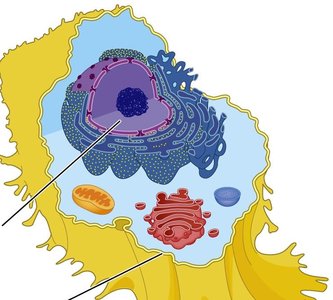
Cells contain specialized structures called organelles, each with distinct functions necessary for life.
Nucleus: Contains genetic material (DNA) and controls cellular activities.
Mitochondria: Site of cellular respiration and energy production.
Endoplasmic Reticulum (ER): Synthesizes proteins and lipids.
Golgi Apparatus: Modifies, sorts, and packages proteins and lipids.
Other organelles: Lysosomes, peroxisomes, and vesicles are involved in digestion and transport.
Biomolecules
Types and Roles in Supporting Life
Biomolecules are essential for cellular structure and function. The four major classes are:
Carbohydrates: Provide energy and structural support.
Proteins: Serve as enzymes, structural components, and signaling molecules.
Lipids: Form cell membranes, store energy, and act as signaling molecules.
Nucleic Acids: Store and transmit genetic information (DNA and RNA).
Example: Biomolecule Distribution in Cells
Lipids are abundant in cell membranes.
DNA is found in the nucleus and mitochondria.
Proteins are distributed throughout the cytoplasm and organelles.
Chemistry in Biology
Elements and Atoms
All matter is composed of elements, which are made up of atoms. Atoms consist of protons, neutrons, and electrons.
Atomic number: Number of protons in the nucleus, defines the element.
Electron shells: Electrons occupy energy levels (shells) around the nucleus.
Valence electrons: Electrons in the outermost shell determine chemical reactivity.
Periodic Table and Biological Elements
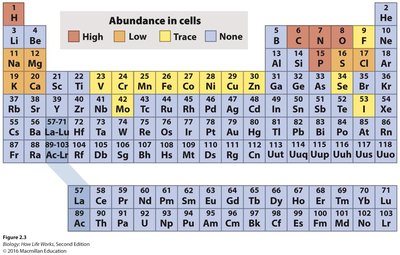
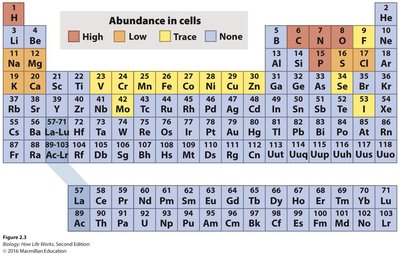
The periodic table organizes elements by atomic number and properties. Elements essential for life are found in high abundance in cells.
Major elements: Hydrogen (H), Carbon (C), Nitrogen (N), Oxygen (O), Phosphorus (P), and Sulfur (S).
Trace elements: Required in small amounts for enzyme function and other processes.
Atomic Structure and Stability
Electron Shells and Stability
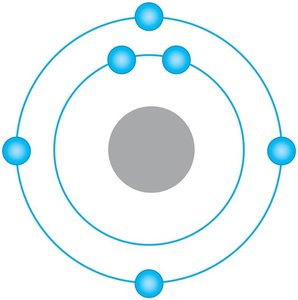
Atoms are most stable when their valence shell is full. The first shell holds 2 electrons, the second holds 8.
Atoms with incomplete valence shells tend to interact with other atoms to achieve stability.
These interactions result in the formation of chemical bonds.
Carbon Atom Example
Carbon is the most abundant element in cells and forms the backbone of organic molecules.
Carbon has 6 protons, 6 neutrons, and 6 electrons.
Its electron configuration allows it to form four covalent bonds.

Chemical Bonds
Types of Chemical Bonds
Chemical bonds are interactions between valence electrons of atoms.
Covalent bonds: Atoms share pairs of electrons to achieve stability.
Ionic bonds: Atoms transfer electrons, resulting in charged ions that attract each other.
Polar covalent bonds: Unequal sharing of electrons leads to partial charges (δ+ and δ-).
Non-polar covalent bonds: Equal sharing of electrons, no charge difference.
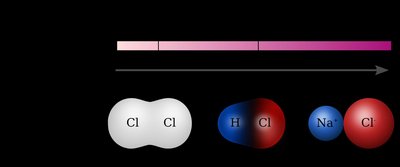
Electronegativity and Bond Types
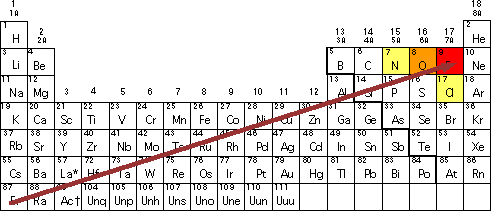
Electronegativity is the ability of an atom to attract shared electrons. The difference in electronegativity between two atoms determines the bond type.
Oxygen and nitrogen are highly electronegative.
Bond types:
Small difference: Non-polar covalent
Moderate difference: Polar covalent
Large difference: Ionic
Summary Table: Types of Chemical Bonds
Bond Type | Electron Sharing | Charge Difference | Example |
|---|---|---|---|
Non-polar Covalent | Equal | None | H2, C-H |
Polar Covalent | Unequal | Partial (δ+ and δ-) | H-O, C-N |
Ionic | Transfer | Full | NaCl |
Biological Relevance of Chemical Bonds
Structure and Function of Biomolecules
The chemical properties of biomolecules, including their polarity and bonding, determine their functional capabilities in cells.
Polarity affects solubility, membrane formation, and molecular interactions.
Covalent bonds provide stability and structure to macromolecules.
Ionic bonds and hydrogen bonds contribute to the dynamic interactions within and between biomolecules.
