Back
Fundamental Concepts in General Biology: Cell Structure, Division, and Molecular Processes
Study Guide - Smart Notes
 Tailored notes based on your materials, expanded with key definitions, examples, and context.
Cell Types and Characteristics
Prokaryotic and Eukaryotic Cells
Cells are the basic units of life, classified into two main types: prokaryotic and eukaryotic. Understanding their general features is essential for studying biological systems.
Prokaryotic cells: Lack a nucleus and membrane-bound organelles; DNA is found in the nucleoid region. Examples include Bacteria and Archaea.
Eukaryotic cells: Possess a nucleus and various membrane-bound organelles such as mitochondria, endoplasmic reticulum, and Golgi apparatus. Examples include Plants, Animals, Fungi, and Protists.
Key differences: Size, complexity, and cellular organization.
Cell Division
Mitosis and Meiosis
Cell division is crucial for growth, repair, and reproduction. The two main types are mitosis and meiosis.
Mitosis: Produces two genetically identical daughter cells; occurs in somatic cells.
Meiosis: Produces four genetically diverse gametes; occurs in reproductive cells.
Stages of mitosis: Prophase, Metaphase, Anaphase, Telophase.
Stages of meiosis: Meiosis I (reductional division) and Meiosis II (equational division).
Cell Cycle
Phases of the Cell Cycle
The cell cycle consists of a series of stages that cells undergo for division and replication.
Interphase: Includes G1 (growth), S (DNA synthesis), and G2 (preparation for division).
M phase: Mitosis or meiosis and cytokinesis.
Cell Signaling
Principal Processes of Cell Communication
Cells communicate through signaling pathways to coordinate functions and respond to environmental changes.
Signal transduction: Conversion of a signal from outside the cell to a functional response inside.
Types of signaling: Autocrine, paracrine, endocrine, and direct contact.
Cellular Components and Functions
Chemical Components of Cells
Cells contain various chemical components, both inorganic and organic, each with specific functions.
Inorganic components: Water, ions (Na+, K+, Ca2+), minerals.
Organic components: Carbohydrates, lipids, proteins, nucleic acids.
Functions: Structure, energy storage, catalysis, genetic information.
Genetic Information and Expression
Replication, Transcription, and Translation
Genetic information is stored in DNA and expressed through a series of molecular processes.
Replication: Copying DNA before cell division.
Transcription: Synthesis of RNA from DNA template.
Translation: Synthesis of proteins from mRNA template.
Key Formula:
Meiosis and Gametogenesis
Relationship Between Meiosis and Gamete Formation
Meiosis is directly responsible for the formation of gametes (sperm and egg cells) in sexually reproducing organisms.
Reduction of chromosome number: Ensures genetic diversity and stability across generations.
Cellular Organelles and Protein Synthesis
Endoplasmic Reticulum and Golgi Apparatus
The endoplasmic reticulum (ER) and Golgi apparatus are essential for protein synthesis and processing.
ER: Rough ER synthesizes proteins; smooth ER synthesizes lipids.
Golgi apparatus: Modifies, sorts, and packages proteins for secretion or use within the cell.
Membrane Transport
Types of Transport Across Cell Membranes
Cells regulate the movement of substances across their membranes through various transport mechanisms.
Passive transport: Diffusion, osmosis, facilitated diffusion (no energy required).
Active transport: Requires energy (ATP) to move substances against concentration gradients.
Membrane Composition and Function
Basic Composition of Biological Membranes
Biological membranes are composed of a lipid bilayer with embedded proteins, providing structure and regulating transport.
Lipids: Phospholipids, cholesterol.
Proteins: Integral and peripheral proteins.
Functions: Barrier, communication, transport, enzymatic activity.
Summary Table: Key Cell Biology Concepts
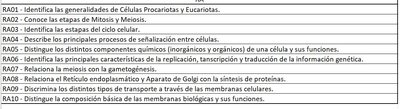
The following table summarizes the main learning objectives and their corresponding biological topics.
Objective | Biological Topic |
|---|---|
RA01 | Prokaryotic vs. Eukaryotic Cells |
RA02 | Mitosis and Meiosis Stages |
RA03 | Cell Cycle Stages |
RA04 | Cell Signaling Processes |
RA05 | Chemical Components of Cells |
RA06 | Replication, Transcription, Translation |
RA07 | Meiosis and Gametogenesis |
RA08 | ER and Golgi in Protein Synthesis |
RA09 | Membrane Transport Types |
RA10 | Membrane Composition and Function |