 Back
Fundamental Concepts in General Biology: Organization, Life Signs, Cell Structure, and Biomolecules
Study Guide - Smart Notes
 Tailored notes based on your materials, expanded with key definitions, examples, and context.
Levels of Biological Organization
Hierarchy of Life
The biological world is organized into a hierarchy of levels, each representing increasing complexity. Understanding these levels helps explain how life is structured from the smallest units to the largest systems.
Biosphere: The global sum of all ecosystems; the zone of life on Earth.
Ecosystem: All living organisms and their physical environment interacting in a specific area.
Communities: Different populations of species living and interacting in a shared environment.
Population: Individuals of the same species living in a particular area.
Individuals: Single organisms.
Organs: Structures composed of tissues that perform specific functions.
Tissues: Groups of similar cells working together to perform a function.
Cells: The basic unit of life; smallest structure capable of performing all life processes.
Signs of Life
Characteristics of Living Organisms
All living things share certain characteristics that distinguish them from non-living matter.
Order: Organized structure and function.
Evolutionary Adaptation: Ability to change over generations to survive in changing environments.
Regulation: Maintenance of internal conditions (homeostasis).
Reproduction: Ability to produce offspring.
Response to the Environment: Reacting to external stimuli.
Growth and Development: Increase in size and complexity.
Energy Processing: Obtaining and using energy for life processes.
Scientific Method: Hypothesis
Formulating Testable Explanations
A hypothesis is a tentative, testable explanation for a phenomenon or a research question. It must be able to be investigated through experiments or data collection.
Example: "If plants are given more sunlight, then they will grow faster."
Cell Structure and Function
Key Organelles and Cellular Features
Cells contain specialized structures called organelles, each with distinct functions essential for life.
Nuclear Pore: Openings in the nuclear envelope that allow molecules to pass in and out of the nucleus.
Golgi Apparatus: Sorts, modifies, and packages proteins and lipids for transport.
Lysosomes: Contain enzymes for breaking down cellular waste and macromolecules.
Ribosomes: Sites of protein synthesis; composed of RNA and proteins.
Cell Junctions
Gap Junctions: Channels between adjacent animal cells that allow for communication and transfer of molecules.
Plasmodesmata: Microscopic channels in plant cell walls that enable transport and communication between cells.
Domains of Life: Eukaryotes vs. Prokaryotes
Classification of Cellular Life
Organisms are classified based on cell structure into two main domains:
Eukaryotic: Cells with a nucleus and membrane-bound organelles; domain Eukarya.
Prokaryotic: Cells without a nucleus; domains Bacteria and Archaea.
Flagella and Motor Proteins
Eukaryotic Flagella: Composed of dynein protein complexes; enable movement.
Motor Proteins: Myosin is a motor protein involved in muscle contraction.
Biomolecules: Structure and Function
Major Classes of Biomolecules
Biological macromolecules are essential for structure and function in living organisms.
Proteins: Made of amino acids (with unique R groups).
DNA: Composed of nucleotides; stores genetic information.
RNA: Also made of nucleotides; involved in protein synthesis.
Carbohydrates: Made of sugars; monosaccharides are the simplest form.
Lipids: Made of fatty acids; can be saturated (no double bonds) or unsaturated (contain double bonds).
Chemistry in Biology
Valence Electrons and Bond Formation
Valence electrons are the outermost electrons of an atom and determine how atoms bond with each other to form molecules.
Example: Carbon has 4 valence electrons, allowing it to form four covalent bonds.
Enzyme Activity
Mechanism of Enzyme Action
Enzymes are biological catalysts that speed up chemical reactions by lowering activation energy. The process involves the binding of a substrate to the enzyme's active site, forming an enzyme-substrate complex, and then releasing products.
Substrate: The molecule upon which the enzyme acts.
Enzyme-Substrate Complex: Temporary association between enzyme and substrate.
Products: The molecules released after the reaction.
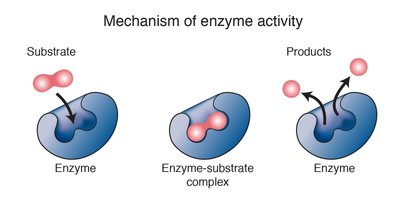
Example: Amylase breaks down starch into sugars.
Equation:
