 Back
Fundamental Concepts in General Biology: Scientific Method, Biomolecules, and Chemical Bonds
Study Guide - Smart Notes
 Tailored notes based on your materials, expanded with key definitions, examples, and context.
Scientific Inquiry and the Nature of Life
Scientific Method and Hypotheses
The scientific method is a systematic approach used to investigate natural phenomena. It involves making observations, forming hypotheses, making predictions, conducting experiments, and analyzing results to accept or reject hypotheses.
Hypothesis: A testable statement explaining an observation.
Prediction: A specific outcome expected if the hypothesis is correct.
Control Group: Subjects that do not receive the experimental treatment, used for comparison.
Independent Variable: The factor manipulated by the experimenter (e.g., type of soil).
Dependent Variable: The factor measured, which depends on the independent variable (e.g., plant growth).
Properties of Life
Living organisms exhibit several defining characteristics:
Membrane delimited
Cellular organization
Information storage and processing
Energy storage and utilization
Self-replication
Regulation and response to environment
Evolution
These properties are facilitated by biomolecules such as lipids, carbohydrates, nucleic acids, and proteins.
Biomolecules and Evolution
Main Biomolecules
Biomolecules are essential for life’s functions:
Lipids: Form membranes
Carbohydrates: Provide energy
Nucleic acids: Store information
Proteins: Perform diverse functions
Evolution is the change in heritable characteristics of biological populations over generations.
Cell Types
Prokaryotic cells: Lack a nucleus (bacteria, archaea)
Eukaryotic cells: Have a nucleus (protozoa, fungi, plants, animals)
Viruses: Not considered alive; do not self-replicate, may have DNA or RNA, lack typical membranes
The Chemical Context of Life
Atoms and Elements
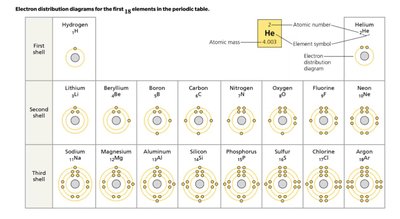
Atoms are the basic units of matter, composed of protons, neutrons, and electrons:
Proton: Charge +1, mass 1, located in nucleus
Neutron: Charge 0, mass 1, located in nucleus
Electron: Charge -1, mass 0, located in electron shell
Valence electrons in the outer shell determine chemical behavior. Atoms strive for a full valence shell for stability.
Chemical Bonds
Atoms achieve stability through interactions:
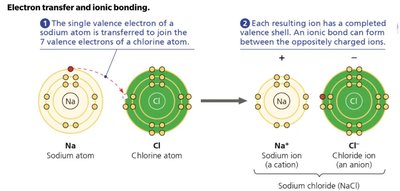
Ionic bonds: Formed between ions with full positive/negative charges
Covalent bonds: Sharing of electrons; can be polar (unequal sharing) or nonpolar (equal sharing)
Electronegativity: The ability of an atom to attract shared electrons
Types of Bonds and Electronegativity
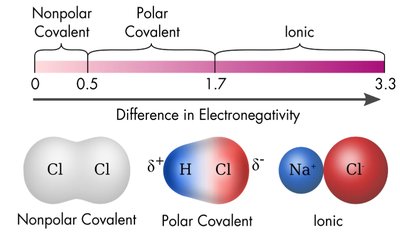
The difference in electronegativity between atoms determines bond type:
Nonpolar covalent: Equal sharing, no charge difference
Polar covalent: Unequal sharing, partial charges
Ionic: Electron transfer, full charges
Redox Reactions
Redox reactions involve electron transfers:
Oxidation: Loss of electrons
Reduction: Gain of electrons
Mnemonic: O.I.L. R.I.G. (Oxidation Is Loss, Reduction Is Gain)
Water and Its Properties
Polarity and Hydrogen Bonds
Water is a polar molecule due to the electronegativity of oxygen. Its shape and polarity allow it to form hydrogen bonds, which are weak individually but strong collectively.
Hydrogen bonds: Attraction between partially positive hydrogen and partially negative atoms (O, N)
Responsible for emergent properties: cohesion, temperature moderation, ice floating, solvent abilities
Hydrophilic vs. Hydrophobic
Hydrophilic: Polar molecules, water-loving, soluble
Hydrophobic: Nonpolar molecules, water-fearing, not soluble
pH and Water Ionization
pH measures the concentration of hydrogen ions [H+]. The scale is logarithmic; each unit represents a tenfold change in [H+].
Acids: Donate H+, decrease pH
Bases: Accept H+, increase pH
Examples:
pH = 1, [H+] = 0.1
pH = 3, [H+] = 0.001
pH = 10, [H+] = 0.0000000001
Carbon and Molecular Diversity
Carbon’s Versatility
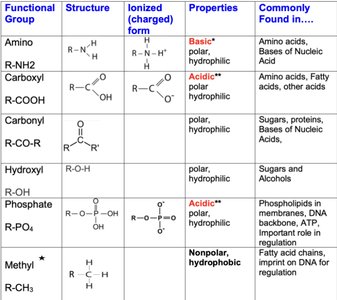
Carbon can form four bonds, allowing for diverse molecular shapes and functions. Organic molecules have a carbon core with functional groups attached.
Functional Groups
Functional groups are specific groups of atoms that participate in chemical reactions and determine the properties of molecules.
Macromolecules: Structure and Function
Polymers and Monomers
Cells build large organic molecules (macromolecules) from small units (monomers). Most macromolecules are polymers formed by dehydration synthesis and broken down by hydrolysis.
Dehydration synthesis: Joins monomers by removing water
Hydrolysis: Breaks polymers by adding water
Proteins
Proteins are polymers of amino acids. Their structure determines their function:
Primary structure: Sequence of amino acids
Secondary structure: Hydrogen bonds form alpha helices and beta sheets
Tertiary structure: 3D folding due to side chain interactions
Quaternary structure: Multiple polypeptides assemble
Protein function depends on structure; mutations can alter all structural levels.
Nucleic Acids: DNA and RNA
Nucleic acids store genetic information. They are polymers of nucleotides, each composed of a phosphate, pentose sugar, and nitrogenous base.
DNA: Double-stranded helix, stable, wraps around proteins
RNA: Single-stranded, less stable, can fold into loops and 3D structures
DNA and RNA differ at the 2' carbon of their sugars. Bases pair via hydrogen bonds (A-T, G-C in DNA).
DNA Replication
DNA’s structure allows for replication. Each strand serves as a template for a new strand, following base-pairing rules.
5' to 3' directionality
Base pairing: A with T, G with C
Nucleotides also serve other functions, such as energy transfer (e.g., ATP).
Additional info: Some explanations and examples were expanded for clarity and completeness, including definitions, context for functional groups, and details on macromolecule synthesis.
