 Back
Fundamentals of Biology I: Introduction, Scientific Method, and Study Practices
Study Guide - Smart Notes
 Tailored notes based on your materials, expanded with key definitions, examples, and context.
Introduction to Biology
What is Life?
Biology is the scientific study of life, focusing on the properties and processes that define living organisms. Life is characterized by several fundamental features:
Membrane delimited: All living cells are surrounded by a membrane that separates internal processes from the external environment.
Information storage and transmission: Organisms store genetic instructions (usually in DNA) and transmit them to offspring.
Energy management: Life stores energy, uses energy, and controls its functions.
Response to environment: Living things respond to environmental changes and stimuli.
Self-replication: Life is capable of reproducing itself.
Evolution: Populations of organisms evolve over time.
The cell is the smallest unit of life, and biomolecules facilitate life's properties.

Organisms and Evolution
All organisms are descendants from a common ancestor, and their forms are related to their functions. Organisms interact with their environment, are part of ecosystems, and are subject to evolutionary processes. The diversity of life is tied to Earth's history and changing environment, resulting in the Tree of Life.
Course Structure and Study Practices
Course Overview
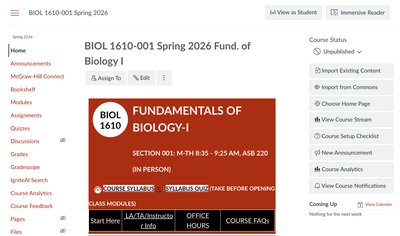
The course uses Canvas for assignments, quizzes, and exams, and McGraw-Hill for the textbook and assignments. Pre-class work is due before class, while other assignments are due at the end of the week.
Successful Study Practices
Effective study habits are essential for success in biology and future courses. Key practices include:
Developing a schedule for reading, attending class, and completing assignments.
Finding a study group and attending office hours regularly.
Using concept maps, flash cards, and drawing to learn.
Testing yourself by explaining concepts without notes.
This course forms the foundation for advanced biology courses and professional exams (MCAT, DAT, GRE).
Accommodations and Course Policies
Grade drops allow students to miss up to two weeks of coursework without penalty.
Slides and resources are available on Canvas for missed classes.
Accommodations are only for extenuating circumstances approved by the university.
Introduction to Scientific Method
Biology as a Science
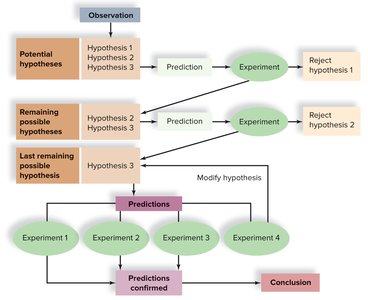
Biology uses the scientific method to understand life. The scientific method is a systematic approach to inquiry, involving observation, hypothesis formation, prediction, experimentation, and analysis.
Steps of the Scientific Method
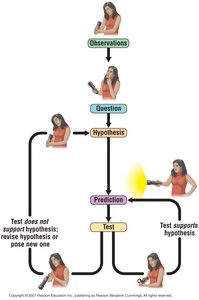
Observation: Noticing phenomena or patterns.
Question: Asking why or how something occurs.
Hypothesis: Proposing a possible explanation.
Prediction: Making a testable statement based on the hypothesis.
Experiment: Testing the prediction with controls.
Analysis: Observing results and drawing conclusions.
Repeat: Modifying, extending, or rejecting hypotheses as needed.
Controls in Experiments
A control group is used to minimize the effects of variables other than the independent variable, increasing reliability. Controls allow comparison between experimental and baseline conditions.
Variables in Experiments
Independent Variable: The factor being tested or manipulated.
Dependent Variable: The result or change measured in response to the independent variable.
Experimental Variable (Independent Variable) | Responding Variable (Dependent Variable) |
|---|---|
Factor of the experiment being tested | Result or change that occurs due to the experimental variable |
Example: Tomato Plant Experiment
Observation: Neighbor's plants are healthier than yours. Hypothesis: Soil quality may be the cause. Prediction: Improving soil with fertilizer will yield more tomatoes. Experiment: Add fertilizer to soil and measure tomato yield. Independent Variable: Fertilizer added. Dependent Variable: Number of tomatoes produced. Control Group: Plants grown without fertilizer.


Data Presentation and Graphs
Understanding Graphs
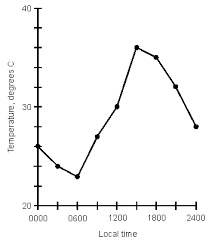
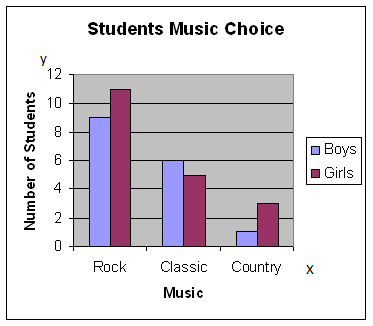
Graphs visually represent relationships between variables. The horizontal axis (x-axis) typically shows the independent variable, while the vertical axis (y-axis) shows the dependent variable.
Line graphs show changes over time or continuous data.
Bar graphs compare discrete categories.
Application: Foraging Time Experiment
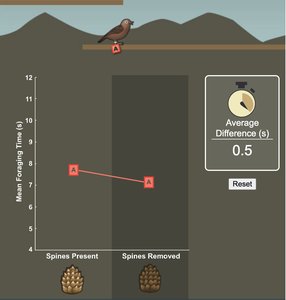
In an experiment measuring bird foraging time with spines present or removed, the independent variable is the presence of spines, and the dependent variable is mean foraging time.
Effective Study Protocols
Retention and Study Scheduling
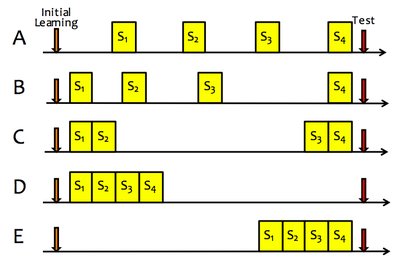
Research shows that more than 50% of learned information is forgotten within one hour. Spaced repetition and active recall are the most effective study protocols.
Spaced repetition involves reviewing material at intervals over time.
Active recall involves testing yourself and explaining concepts.
Summary Table: Scientific Method Steps
Step | Description | Example |
|---|---|---|
Observation | Notice a pattern or phenomenon | Neighbor's plants are healthier |
Hypothesis | Propose a possible explanation | Soil quality affects plant health |
Prediction | Make a testable statement | Fertilizer will increase tomato yield |
Experiment | Test the prediction | Add fertilizer to soil |
Analysis | Observe and measure results | Count tomatoes produced |
Repeat | Modify or extend hypothesis | Try different fertilizers |
Additional info: The notes provide foundational concepts for General Biology, including the scientific method, experimental design, and effective study practices. These are essential for understanding subsequent chapters in biology.
