 Back
Fungi and Early Animal Evolution: Structure, Life Cycles, and Developmental Genetics
Study Guide - Smart Notes
 Tailored notes based on your materials, expanded with key definitions, examples, and context.
Fungi: Structure and Ecological Relationships
Growth Forms and Cellular Structure
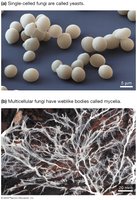
Fungi are a major multicellular eukaryote lineage with two primary growth forms: single-celled yeasts and multicellular mycelia. These forms are adapted for diverse ecological roles and modes of nutrient acquisition.
Yeasts: Single-celled fungi that reproduce by budding or fission.
Mycelia: Multicellular fungi with web-like bodies composed of hyphae, which are filamentous structures.
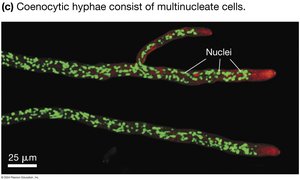
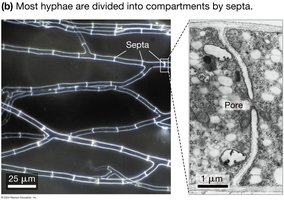
Hyphae: Individual filaments making up mycelia; may be divided by septa (compartments) or be coenocytic (multinucleate, without septa).
Ecological Relationships
Fungi are heterotrophic, digesting and absorbing molecules from other organisms. Their ecological roles include:
Detritivores: Digest dead organic tissues, uniquely capable of breaking down lignin and cellulose.
Parasitic fungi: Consume living tissue of hosts, reducing host fitness.
Commensalism: Fungi benefit without affecting host fitness.
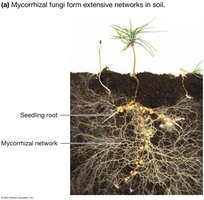
Mutualism: Both fungi and host benefit, as seen in mycorrhizal associations with plant roots.
Storage Molecules
Fungi and Metazoans store polysaccharides as glycogen.
Archaeplastida (plants) store starch.
Rhodophyta (red algae) store mannitol and laminarin.
Hyphal Structure and Function
Hyphae are connected but lack specialized nutrient transport systems found in plants and animals.
Most hyphae are divided into compartments by septa, which have pores for cytoplasmic streaming.
Coenocytic hyphae consist of multinucleate cells without septa.
Reproductive Structures
Both the reproductive structure (e.g., mushroom) and mycelium are composed of hyphae. Dense hyphal networks form reproductive bodies. 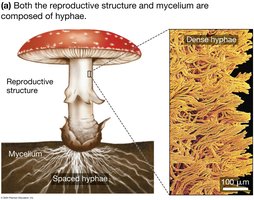
Fungal Sexual Morphology and Life Cycles
Sexual Morphology
Fungi exhibit diverse reproductive structures and modes, including swimming gametes, zygosporangia, basidia, and asci.
Swimming gametes: Motile reproductive cells (e.g., chytrids).
Zygosporangia: Spore-producing structures formed by fusion of hyphae (e.g., zygomycetes).
Basidia: Club-shaped cells where meiosis occurs, producing spores (e.g., basidiomycetes).
Asci: Sac-like cells where meiosis and mitosis produce spores (e.g., ascomycetes).
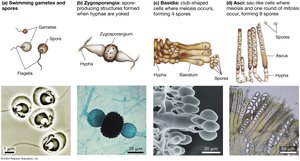
General Fungal Life Cycle
Fungi alternate between asexual and sexual reproduction. Key stages include:
Asexual reproduction: Mitosis produces spores and mycelia.
Sexual reproduction: Plasmogamy (fusion of cytoplasm), karyogamy (fusion of nuclei), meiosis, and spore formation.
Haploid, diploid, and heterokaryotic stages: Fungi may have nuclei from different parents coexisting (heterokaryotic).
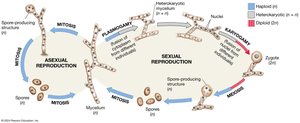
Chytrid Life Cycle
Chytrids are unique among fungi in exhibiting alternation of generations, with no heterokaryotic stage.
Includes haploid and diploid stages, with gametophyte and sporophyte generations.
Fusion of gametes produces a diploid zygote, which undergoes meiosis to form haploid spores.
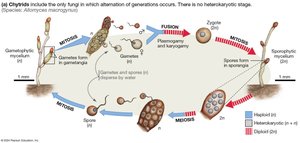
Zygomycota Life Cycle
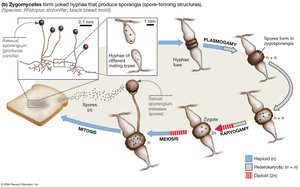
Zygomycetes form yoked hyphae that produce sporangia.
Plasmogamy produces a heterokaryotic zygosporangium.
Karyogamy and meiosis produce haploid spores.
Basidiomycota Life Cycle
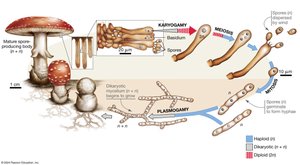
Basidiomycetes (e.g., mushrooms) have a dikaryotic stage and produce spores in basidia.
Plasmogamy produces dikaryotic mycelium.
Karyogamy and meiosis occur in basidia, producing haploid spores.
Ascomycota Life Cycle
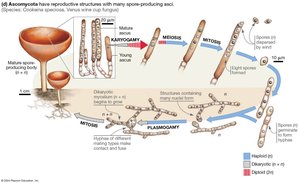
Ascomycetes produce spores in asci within reproductive structures.
Plasmogamy produces dikaryotic hyphae.
Karyogamy and meiosis occur in asci, producing haploid spores.
Fungal Phylogeny
Major Fungal Lineages
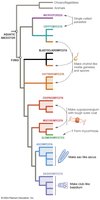
Fungi are classified into several major lineages based on molecular and morphological data.
Chytridiomycota: Motile gametes and spores.
Zygomycota: Yoked hyphae and zygosporangia.
Basidiomycota: Club-shaped basidia.
Ascomycota: Sac-like asci.
Holozoa and Metazoa: Primitive Lineages and Evolution
Holozoa and Metazoa
Holozoa: Sister taxa to fungi, includes unicellular and colonial organisms.
Metazoa (Animals): Monophyletic lineage of multicellular heterotrophs within Holozoa.
Primitive Metazoan lineages: Porifera, Ctenophora, Cnidaria, Placozoa, and Bilateria.
Developmental Genetics Tool-kit
Genetic Regulatory Cascade
Developmental tool-kit genes are conserved sets of genes coding for proteins that signal developmental rates and pathways, and transcription factors directing development.
Genetic regulatory cascade: Activation of an initial gene turns on expression of other regulatory genes, leading to complex developmental outcomes.
Homeotic mutations: Mutations resulting in body parts developing in incorrect locations.
Hox Genes
Hox genes: Transcription factors affecting expression of effector genes, leading to differentiated cells and body plans.
Each Hox gene contains a conserved Homeobox DNA sequence coding for the DNA-binding domain.
Gene duplication and mutation in Hox genes drive evolutionary changes in animal body plans.
Metazoan Cambrian Explosion and Evolutionary Innovations
Origin of Embryonic Tissue Layers
Diploblasts: Two tissue types (ectoderm and endoderm), sometimes with mesoglea.
Triploblasts: Three tissue types (ectoderm, mesoderm, endoderm).
Ctenophores and Cnidarians have genes for mesodermal components but do not produce true mesoderm (deep homology).
Origin of Contractile Tissue
Ctenophores and Cnidarians have contractile tissue (epitheliomuscular), using homologous proteins (actin, myosin).
These proteins evolved early and are developmentally modified for functional similarity (convergent evolution).
Body Symmetry
Radial symmetry: At least two planes (Ctenophores, many Cnidarians).
Bilateral symmetry: One plane (Bilateria).
Asymmetry: Porifera and Placozoa.
Hox genes regulate anterior-posterior axis and segment development in Bilateria.
Cephalization and Nervous System
Radially symmetric organisms have nerve nets.
Bilaterally symmetric organisms have nerve nets or clustered neurons, often with cephalization (concentration of nervous tissue at the leading end).
Genes for nervous system development are part of the developmental genetic tool-kit and are modified across lineages.
Bilateria: Body Cavities and Development
Body Cavities
Coelom: Fluid-filled cavity associated with mesodermal tissue.
Lineages vary in coelomic characteristics and genetic cascades for tissue differentiation.
Protostomes and Deuterostomes
Protostomes: Historically, blastopore develops into mouth first, but this is variable.
Deuterostomes: Historically, blastopore develops into anus first, but this is not a synapomorphy.
Lophotrochozoa: Sister taxa to Ecdysozoa.
Ecdysozoa: Exhibit growth within a cuticle, periodically shedding it (ecdysis).
Segmentation and Hox Genes
Segmentation evolved independently; Hox gene regulation is a pre-adaptation for segmentation.
Mutations in Hox genes produce lineage-specific features by modifying old genes for new functions.
Limb Development and Sonic Hedgehog Gene
Sonic hedgehog gene: Controls expression of signaling protein in limb buds.
Enhancer region must be active for transcription; absence leads to limb loss (e.g., snakes).
Insertion of enhancer region from other vertebrates restores limb development in mice.
Summary of Evolutionary Relationships
Holozoa is sister taxa to Fungi.
Metazoa is a monophyletic lineage of multicellular heterotrophs within Holozoa.
Porifera is the most primitive Metazoan lineage.
Bilateria includes Protostomes (Lophotrochozoa, Ecdysozoa) and Deuterostomes (Echinodermata, Hemichordata, Chordata).
Triploblastic tissue is synapomorphic for Bilateria.
Rapid adaptive radiation of Metazoa is related to developmental tool-kit genes.
