 Back
Fungi, Animal Diversity, Invertebrates, and Vertebrate Evolution: Exam 3 Study Guide
Study Guide - Smart Notes
 Tailored notes based on your materials, expanded with key definitions, examples, and context.
Fungi
General Characteristics of Fungi
Fungi are a diverse group of heterotrophic organisms that obtain nutrients by absorption. They play essential roles in nutrient cycling, ecological interactions, and human welfare. Fungi reproduce by producing spores, which can be generated through sexual or asexual life cycles.
Heterotrophs: Fungi absorb nutrients from their environment, often decomposing organic matter.
Spore Production: Spores are produced in both sexual and asexual cycles, allowing fungi to disperse and colonize new environments.
Life Cycle Stages: The fungal life cycle includes haploid, diploid, and heterokaryotic stages.
Key Processes: Plasmogamy (fusion of cytoplasm), karyogamy (fusion of nuclei), and meiosis (formation of haploid spores).
Definitions:
Plasmogamy: The fusion of cytoplasm from two parent mycelia.
Karyogamy: The fusion of nuclei from the fused cells, resulting in a diploid stage.
Meiosis: The process by which diploid cells produce haploid spores.
Example: Bread mold (Rhizopus) undergoes sexual reproduction involving plasmogamy, karyogamy, and meiosis.
Major Fungal Phyla
Fungi are classified into several major phyla, each with distinct features and reproductive strategies. The table below summarizes the main fungal phyla and their distinguishing characteristics.
Fungal Phylum | Distinguishing Features |
|---|---|
Cryptomycota (cryptomycetes) | Parasites with flagellated spores |
Microsporidia | Parasitic cells that form microsporidia |
Chytridiomycota (chytrids) | Flagellated spores |
Zygomycota (zygote fungi) | Resistant zygosporangium as sexual stage |
Mucoromycota (mucoromycetes) | Include fungi that form arbuscular mycorrhizae with plants |
Ascomycota (sac fungi) | Sexual spores (ascospores) borne internally in sacs called asci; vast numbers of asexual spores (conidia) produced |
Basidiomycota (basidiomycetes) | Elaborate fruiting body (basidiocarp) containing many basidia that produce sexual spores (basidiospores) |
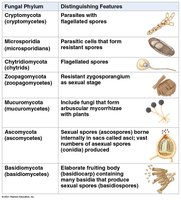
Additional info: Placement of cryptomycetes and microsporidians is recent; detailed knowledge is not required for the exam.
Ecological Roles and Human Welfare
Fungi are crucial in nutrient cycling, forming symbiotic relationships (e.g., mycorrhizae with plants), and impacting human welfare through food production, medicine, and disease.
Nutrient Cycling: Decompose organic matter, recycling nutrients in ecosystems.
Ecological Interactions: Form mutualistic relationships (e.g., lichens, mycorrhizae).
Human Welfare: Used in antibiotics (e.g., Penicillium), food (e.g., yeast), and can cause diseases (e.g., athlete's foot).
An Overview of Animal Diversity
General Characteristics of Animals
Animals are multicellular, heterotrophic eukaryotes whose cells form tissues that develop from embryonic layers. They exhibit a wide range of body plans and adaptations.
Multicellularity: Animals are composed of multiple cells organized into tissues.
Heterotrophy: Animals obtain nutrients by consuming other organisms.
Eukaryotic Cells: Animal cells contain membrane-bound organelles.
Embryonic Development: Tissues arise from distinct embryonic layers (ectoderm, mesoderm, endoderm).
Example: Sponges (Porifera) are simple multicellular animals, while mammals have complex tissues and organs.
Introduction to Invertebrates
Overview of Invertebrate Groups
Invertebrates are animals without a backbone, comprising the vast majority of animal species. They are classified into various groups based on body plan, symmetry, and developmental patterns.
Examples: Arthropods (insects, spiders), mollusks (snails, octopuses), annelids (earthworms), cnidarians (jellyfish).
Classification: Invertebrates are grouped by characteristics such as symmetry (radial vs. bilateral), segmentation, and presence of specialized tissues.
Key Point: No detailed knowledge of internal anatomy is required for the exam.
Example: Earthworms belong to the phylum Annelida, while insects belong to Arthropoda.
Origin and Evolution of Vertebrates
Vertebrate Evolution and Diversity
Vertebrates are animals with a backbone, including fish, amphibians, reptiles, birds, and mammals. The evolutionary history of vertebrates is marked by significant changes and reversals.
Evolutionary Reversals: Character losses are common in vertebrate evolution (e.g., loss of limbs in snakes).
Diversity: Living vertebrates can be very different from their early ancestors.
Examples: Birds evolved from feathered dinosaurs; whales evolved from land-dwelling mammals.
Evolutionary Causes: Natural selection, adaptation to new environments, and genetic drift contribute to evolutionary reversals and diversity.
Practice and Synthesis Questions
Essay-Type Questions for Review
Animal Phylogeny: "We are all worms" refers to the common ancestry of Bilateria, a group characterized by bilateral symmetry.
Phylogenetic Tree of Bilateria: Practice drawing and labeling a tree showing relationships among major bilaterian groups.
Evolutionary Reversals: Provide examples and explanations for character losses in vertebrate lineages.
Additional info: Use end-of-chapter questions and MasteringBiology practice exams for further preparation.
